
Brno becomes easier to like the moment you stop calculating how much Prague you are getting for less money.
Where it is — and how to get there
Brno is the main city of Moravia in the south-east of Czechia, roughly between Prague, Vienna and Bratislava. That position matters more than the 'second city' label: it is a university and business city sitting directly on one of Central Europe's easiest rail corridors.
Train is the default arrival for most visitors: Brno hlavní nádraží sits at the edge of the historic centre and has frequent links towards Prague, Vienna and Bratislava. Brno Airport has a much smaller route network, so Vienna and Prague can be more practical flight gateways depending on the fare.
Brno has a branding problem.
It is usually solved by mentioning Prague.
Smaller Prague.
Cheaper Prague.
Prague without the crowds.
Prague for people who have already done Prague.
You can see why tourism copy does this. Prague is one of Europe’s most recognisable city-break products. Brno is not.
But the comparison becomes useless almost immediately after arrival.
Brno does not have Prague’s theatre-set riverfront, castle panorama or monumental old-town density. Its centre is smaller, flatter and more ordinary. Modernist villas sit outside the tourist core. A medieval square hides several layers of cellars underneath it. The city’s best-known animal is a crocodile everybody calls a dragon. One of its most photographed monuments is a black granite clock that looks like something a nervous municipality would now struggle to approve.
And students, office workers, bar staff and people changing trams keep using all of it as an actual city.
That is the appeal.
Not that Brno is Prague with less tourism.
That Brno has not had to become Prague at all.
The useful answer first: stay two nights
One night is possible.
Two nights are better.
Brno’s historic centre is compact enough to cross on foot, which creates the dangerous impression that the whole city can be compressed into an afternoon.
It cannot.
You can see Zelný trh, the Old Town Hall, Petrov and Špilberk in a day. You can even add one underground attraction and declare the job finished.
But Villa Tugendhat needs a booked time slot. The Žlutý kopec reservoirs are outside the core. Brno’s functionalist architecture makes more sense when you stop treating it as a single famous house. And the evening is part of the city rather than something that begins after the sightseeing has ended.
Give it two nights.
Three if you want the Moravian Karst, several museums, a concert, a slower architecture day or the luxury of sitting in a café without pretending that this is also cultural research.
Arriving by train is the correct introduction
Brno hlavní nádraží is not an elegant gateway.
That helps.
You arrive beside trams, buses, shops, people cutting through to work and the southern edge of the old centre. Petrov is already above you. Zelný trh is a few minutes away. Náměstí Svobody is not far beyond that.
There is no grand ceremonial reveal.
The city starts immediately.
That is especially useful if Brno is part of a wider Central European rail trip. Prague, Vienna and Bratislava all sit close enough to make the city easy to add without turning it into a logistical project. If you are coming from Vienna through Bratislava, read our Bratislava guide before repeating the same mistake there and treating another city purely as a cheaper neighbour.
Brno belongs in that corridor.
It does not need to be the budget substitute at the end of it.
Start with Zelný trh because the city immediately goes underground
Zelný trh — the Vegetable Market — is one of those central European squares that photographs more conventionally than the city around it.
Baroque fountain.
Market stalls.
Historic façades.
People eating, shopping and cutting across the square.
Then you go underneath it.
The Labyrinth under the Vegetable Market links medieval cellars up to eight metres below the cobbles. They were used for food, wine and beer storage, trade and shelter, then connected into the visitor route that exists today.
A full ticket currently costs 180 CZK (about €7.44) and the tour takes roughly an hour.

This is where Brno begins to show its preferred trick.
The visible city is only one version.
There is an ossuary under St James’ Church. There are cellars under the New Town Hall. There is a Cold War bunker. There are enormous water reservoirs under Žlutý kopec.
TIC Brno currently offers a discounted combination if you visit several underground sites in one day; all four core underground attractions together cost 670 CZK (about €27.69). The current underground options are listed here.
Do not buy the full underground set just because it exists.
One good subterranean hour is atmospheric.
Four in a day may cause you to forget that Brno also has weather.
The Žlutý kopec reservoirs are the better kind of weird attraction
The old water reservoirs under Žlutý kopec should not be as visually effective as they are.
They are infrastructure.
Their job was to hold water.
Yet the brick vaults, columns, darkness and repetition make the spaces feel closer to an underground cathedral than a utility project.

This is the attraction I would choose if you only have room for one piece of “strange Brno”.
Not because it is more historically important than the ossuary or the labyrinth.
Because it changes the scale of the city.
The centre above ground is manageable and almost cosy. The reservoirs remind you that Brno’s nineteenth- and twentieth-century growth required infrastructure on a very different scale.
The official Brno Underground site is the place to check current access, guided-tour availability and temporary events.
Go before dinner rather than after it.
Underground brick vaults are atmospheric enough without adding three beers.
Villa Tugendhat is worth the planning inconvenience
There are famous buildings that are easier to admire in a book than in person.
Villa Tugendhat is not one of them.
Mies van der Rohe’s house is famous because of the ideas inside the building: structure freed from conventional walls, huge glass surfaces, carefully selected materials, the relationship between interior and garden, and the almost absurd technical ambition hidden behind an apparently calm modernist shell.
The catch is access.
Interior visits require advance booking. Current prices are 350 CZK (about €14.47) for the basic tour and 400 CZK (about €16.53) for the extended tour that also includes the technical floor. Garden-only access is 50 CZK (about €2.07) when available. Check the current Villa Tugendhat ticket information before fixing your itinerary.

Book this first.
Then build the rest of Brno around it.
Do not arrive in the city and assume the famous UNESCO house will politely provide a slot because you have travelled a long way.
Architecture has no sympathy for poor planning.
The more useful point is that Tugendhat should not be the end of Brno’s modernist story.
The city has an unusually strong functionalist legacy: housing, cafés, villas, commercial buildings and exhibition architecture. Tugendhat is the headline because it is extraordinary.
Brno becomes more interesting when you start noticing the quieter examples afterwards.
Špilberk gives you the city from above, then ruins the view with history
Špilberk Castle looks reassuring from below.
Hill.
Fortress.
Views.
The standard European castle package.
Then the prison history arrives.
The medieval royal castle became a major fortress and later one of the Habsburg monarchy’s notorious prisons. The casemates are part of the visitor experience, but the better reason to walk up is that Špilberk lets you read Brno physically.
Petrov on one side.
The compact old centre below.
The wider city spreading much farther than the tourist streets suggest.
The current guided Story of the Castle tour is 180 CZK (about €7.44). Špilberk publishes current tours and tickets directly.
Do not treat the castle as an obligation.
Walk the hill even if you skip the interiors.
Then come back through the park at dusk.

Brno is good at night partly because its monuments stop demanding attention and become background again.
Špilberk is especially good at this.
Petrov is the skyline, not the whole story
The Cathedral of St Peter and Paul on Petrov is the building you will keep using to orient yourself.
Its twin towers are visible from enough of the centre that they become a practical navigation tool long before they become a religious monument.
Go up.
Look around.
Then go back down through Denis Gardens instead of spending half the day collecting church interiors.
Brno has enough ecclesiastical architecture to support that kind of trip if you want one.
Most visitors do not need one.
The better use of Petrov is spatial: it shows how tightly the historic core, railway station, Zelný trh and Špilberk sit together.
That compactness is one of Brno’s real advantages over Prague.
Not because smaller is automatically better.
Because it changes how casually you can use the city.
The dragon is a crocodile and this apparently stopped being a problem centuries ago
Under the Old Town Hall hangs the Brno Dragon.
It is a crocodile.
Brno knows this.
You know this.
Everybody continues calling it a dragon.

There are legends explaining how it arrived, how it terrorised the city and how it was defeated. There is also the giant wheel hanging nearby, supported by another local legend involving a wager and a very determined wheelwright.
You do not need to take any of this seriously.
You should take it seriously enough to look.
Cities become boring when every story is reduced to the part that can be independently verified by an archival committee.
Brno is good at allowing folklore, modern design, imperial history and student nonsense to occupy the same few streets without deciding which one is the official identity.
The official Brno tourism site is unusually good at explaining these local stories without sanding off all the oddness.
After dark: Brno is small enough to improvise
Start around Jakubské náměstí and the streets between there, Kozí, Česká and the centre.
The point is not one famous nightlife district.
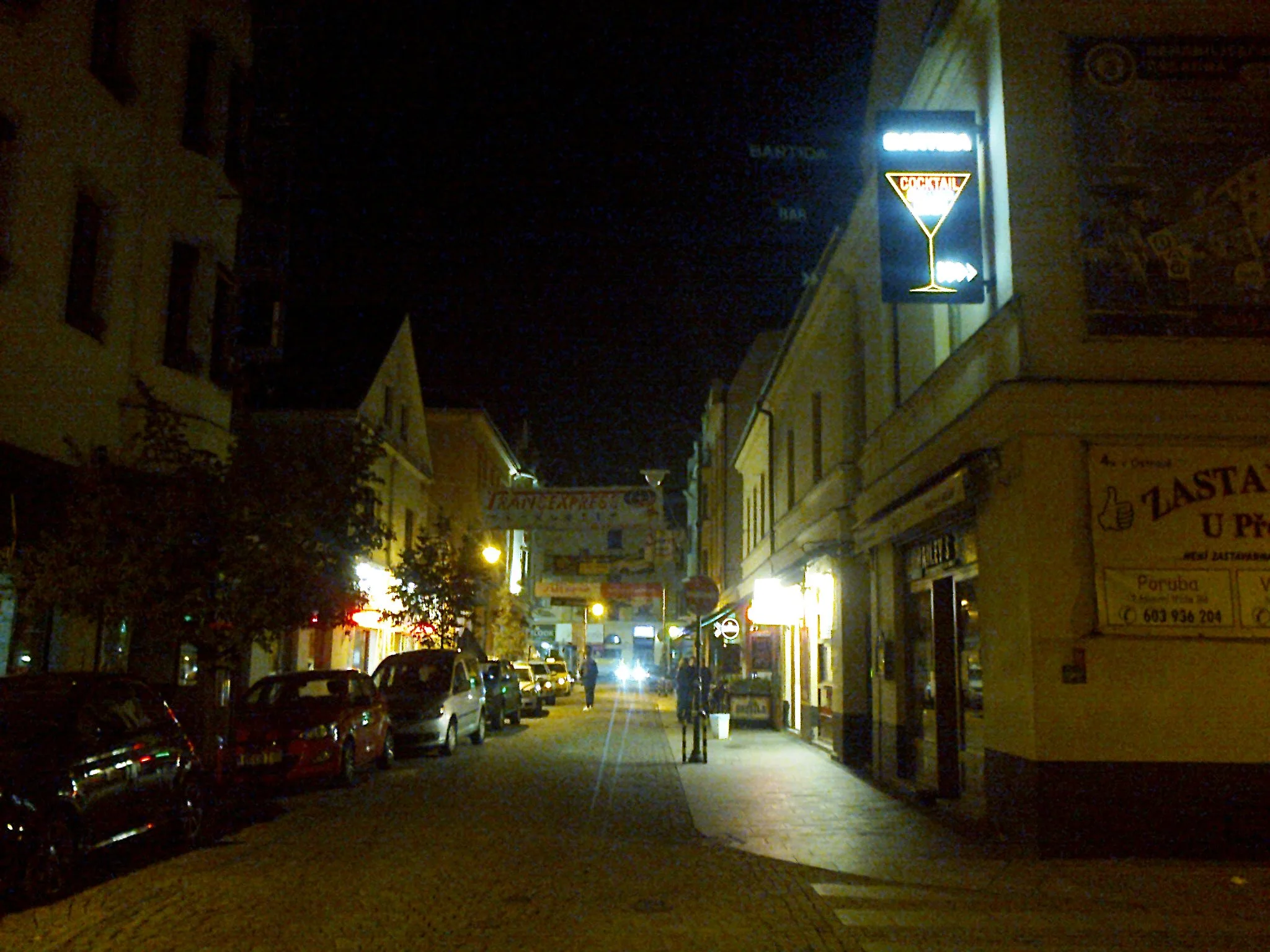
The point is density. Beer places, wine bars, cocktail bars, live rooms and event-led clubs sit close enough together that a mediocre first choice does not destroy the evening.
That deserves more than a paragraph in a daytime guide, so we have given it its own piece: Brno After Dark covers beer on the kerb at Jakubák, the city’s serious cocktail scene, Moravian wine, Kabinet MÚZ, Fléda, night buses and the difference between a strong Friday and a random Tuesday.
For the main trip, the useful advice is simpler: leave at least one evening unstructured.
Brno is compact enough to change the plan after the first drink.
About those hotel prices: no, you were not necessarily imagining it
This deserves its own section because Brno is constantly marketed as a cheaper alternative to Prague.
And yet hotel searches can sometimes look ridiculous.
Brno has been on the InstantTraveling list before. More than once, the trip was easy to imagine until the accommodation search made a secondary Czech city look strangely expensive for no obvious reason.
That may have been bad luck with dates.
But it was not necessarily imaginary.
Brno has a large exhibition centre, regular trade fairs and congresses, major motorsport weekends and extremely busy Christmas markets. These can hit a relatively limited hotel market much harder than a similar event would hit a huge capital.
MotoGP is the clearest example. The Czech Grand Prix returned to Brno in 2025 and organisers reported that accommodation in the city was almost fully booked. The 2026 race ran from 19–21 June. The city’s exhibition calendar creates smaller versions of the same problem throughout the year.
So the useful rule is:
if Brno suddenly looks much more expensive than expected, check the event calendar before changing your opinion of the city.
Look at the Brno Exhibition Centre calendar and Automotodrom Brno before booking.
Also check the Christmas-market period.
Move the trip by two or three days and the hotel market can look completely different.
That is more useful than writing “Brno is cheap” and leaving you to discover a €180 room on the one weekend when half the region has decided to arrive.
For a first visit, stay in or close to the historic centre, around the main station, Česká or the streets between the centre and Špilberk.
Brno is compact enough that paying slightly more for location can remove a lot of unnecessary transport.
But do not pay an event-weekend premium out of principle.
The city will still exist next Thursday.
Public transport is cheap enough to stop pretending every attraction is walkable
Central Brno is walkable.
Villa Tugendhat, Žlutý kopec and several functionalist sites make trams useful quickly.
Current city fares for zones 100 + 101 are 20 CZK (about €0.83) for 15 minutes, 25 CZK (about €1.03) for 60 minutes and 90 CZK (about €3.72) for a 24-hour ticket. DPMB publishes the current tariff here.
These euro equivalents use a September 2026 mid-market rate of roughly 1 CZK = €0.0413 and are rounded for practical use.
Do not walk forty minutes along a traffic road to prove that the centre is compact.
Take the tram.
Save the walking for streets worth looking at.
A two-day Brno plan that leaves room for the city
Day one: the visible centre and one layer underneath
Arrive by train and walk straight into the centre.
Start at Zelný trh. Do the labyrinth if that is your underground choice. Continue through the Old Town Hall, say hello to the crocodile-dragon, then cross Náměstí Svobody and Jakubské náměstí.
Walk up to Špilberk in the afternoon.
Come down before dinner.
Stay around the centre in the evening and let the first bar choice remain slightly accidental. If you want a deeper plan after that, use the Brno After Dark guide.
You are not conducting nightlife research for the United Nations.
Day two: modernism and infrastructure
Use your pre-booked Villa Tugendhat slot as the fixed point.
Build the morning or afternoon around it, then use public transport to reach Žlutý kopec if the reservoirs are your second major visit.
Return through Petrov and Denis Gardens if you have not already done them.
If you still have energy, find one or two functionalist buildings beyond Tugendhat instead of adding another generic museum because your itinerary has an empty box.
Finish with food, wine, beer or cocktails.
Brno does not need a dramatic finale.
It works better when the final evening simply feels easy.
Three nights? Leave the city
A third night changes the equation.
Now the Moravian Karst becomes realistic rather than aspirational.
Macocha Abyss and the cave systems north of Brno are close enough to combine with the city, but far enough that forcing them into a two-day urban break starts damaging both experiences.
You can also use the extra day for more modernist architecture, the reservoir area, museums or a slower food-and-wine day.
South Moravia does not begin and end at the city limits.
Brno is a useful base partly because the landscape around it is more interesting than the “second city” label suggests.
Who should skip Brno
Skip it if you want Prague without Prague’s visitors.
You will spend the trip noticing what is missing.
Skip it if your city break requires a monumental sight every fifteen minutes.
Brno has good architecture, important history and a strong cultural life, but it also contains stretches of ordinary streets where nobody remembered to build you an attraction.
Skip it if you are booking the MotoGP weekend by accident and are already angry about the hotel price.
Come if you like compact cities that remain useful to the people who live in them.
Come if twentieth-century architecture matters as much as medieval towers.
Come if underground reservoirs sound more exciting than another royal palace.
Come if you want a Friday night that can begin with one beer and become a completely different plan without requiring a taxi across a capital.
And come if you are moving through Central Europe and want a city that connects naturally to Vienna, Bratislava, Prague and the rest of Czechia without becoming subordinate to any of them.
If you want the Czech trip to become rougher afterwards, continue towards Ostrava after dark. If you want the road itself to become the story, the Black Triangle takes you into the Czech-German-Polish borderlands where the clean city-break logic disappears almost completely.
Brno does not need to beat Prague.
It does not even need to compete.
That was always the least interesting thing you could ask it to do.