

The interesting influence is rarely “go where they went”. It is “notice what they noticed — and then decide what you would have looked at differently”.
Where you are
Transnistria is the de facto separatist territory on Moldova's eastern side along the Dniester/Nistru, between Moldovan government-controlled territory and Ukraine. Tiraspol is its main city; for the practical 2026 entry and transport reality, use the full Tiraspol/Transnistria guide.
Nobody develops a way of travelling in complete isolation.
Books matter. Films matter. Maps matter. Other travellers matter. And, whether we like the word influencer or not, YouTube has changed what a lot of us notice when we arrive somewhere.
It has certainly influenced InstantTraveling.
That does not mean somebody on YouTube pointed at Eastern Europe and I followed.
My interest in the region was there before I knew Bald and Bankrupt existed. The mix of borders, post-socialist cities, industrial edges, awkward history, huge geographical grey zones and places that barely registered in conventional city-break coverage was already the attraction.
The later influence was more specific.
It was permission to keep looking after the obvious reason for visiting had ended.
A provincial railway station did not have to be a transfer point. A half-empty town did not have to apologise for lacking attractions. A supermarket, bus stop, apartment block or regional road could tell you something about a country without first being promoted into a sight.
Transnistria happens to make that influence unusually easy to compare.
Bald and Bankrupt, the older travel material from Simon Wilson and Simon Whistler's Places have all covered the same territory.
Same checkpoints. Same statues. Same Soviet residue. Three different stories.
And none of them is quite the story I want InstantTraveling to tell.
Bald and Bankrupt: the place through people
Bald and Bankrupt is the obvious first influence to acknowledge.
Not because he created my interest in Eastern Europe. He did not.
What his older post-Soviet material did was make the space between the destinations look worth examining. The village, the train compartment, the local shop, the person sitting beside the road and the city that had no obvious reason to appear in a mainstream itinerary could all carry the story.
His method is heavily social. Places often become legible through encounters. Russian opens conversations; conversations become scenes; a stranger can change the direction of an episode.
I travel differently.
I do not need every encounter recorded. I do not need to extract a story from every person I meet. I do not need to start a conversation with every babushka to prove that I have experienced a country rather than merely visited it.
Sometimes watching is enough.
Sometimes the useful detail is that nobody reacts to the monument you thought would dominate the square.
Sometimes it is what people buy in the supermarket, what they drive, which bus they take, where young people appear after dark or how quickly the supposedly exotic detail becomes completely ordinary once you have been standing beside it for twenty minutes.
That is the influence I keep.
Not travel like this.
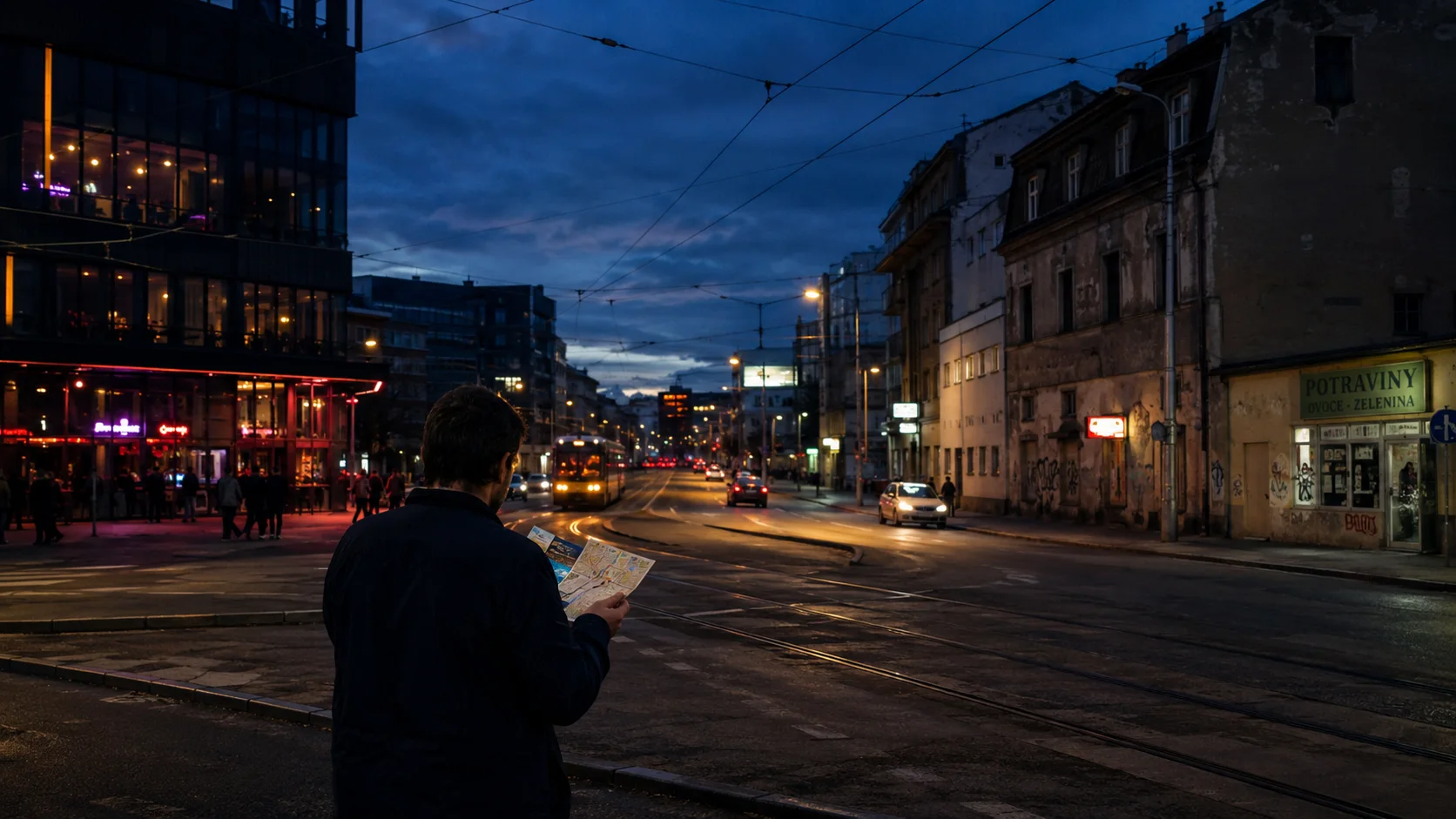
More simply: there may be something worth seeing after the tourist map stops helping.

Simon Wilson: the journey as the story
With Simon Wilson, I mean mainly the older travel material rather than the format his channel has gradually become.
The appeal was different.
The destination mattered, but so did getting there badly, cheaply, awkwardly or without much certainty about what the next step would look like. Strange accommodation, uncertain transport, border friction and the practical mess around the destination were allowed to remain part of the trip.
That matters because conventional travel publishing removes friction almost automatically.
The hotel begins at the carefully photographed room, not in the corridor outside it. The road becomes a line between attractions. The border crossing becomes a sentence under Getting there. The bus station disappears as soon as the traveller has successfully left it.
Real trips do not work like that.
The obscure entrance matters.
The station that moved matters.
The hotel that looked normal online but feels odd at 23:30 matters.
The fact that a city appears dead at 18:00 and unexpectedly busy five hours later matters.
Wilson's older material did not make me want to turn InstantTraveling into a catalogue of terrible hotels. It reinforced a smaller, more useful principle:
the inconvenient detail belongs in the story too.
That is one reason the Transnistria episode works as a useful contrast with Bald and Bankrupt. The same territory can be less about the people encountered there and more about what happens while trying to move through it.

Places: the place through context
Places, fronted by Simon Whistler, approaches the same problem from almost the opposite direction.
The presenter does not need to physically discover every street for the place to become interesting. History, geography, infrastructure, politics and odd administrative arrangements do much of the work.
That is probably the influence closest to the research side of InstantTraveling.
A concrete government building is just a concrete government building until you know why it is there.
A border can look disappointingly ordinary until you understand what it separates.
A city can look like a Soviet time capsule if you photograph Lenin tightly enough. It becomes more interesting when the frame widens and the statue has to coexist with a supermarket, smartphones, imported cars, a football economy and people whose Tuesday has very little interest in satisfying your idea of the Soviet past.
Context does not make a place less strange.
Usually it makes the strangeness more precise.
This is also why Atlas Obscura has always been useful to me, and why Robert Young Pelton's The World's Most Dangerous Places stayed in my head long before InstantTraveling existed. I wrote more directly about that in We Don't Need More Travel Guides. We Need Better Ones.
The common thread is not danger and it is not collecting oddities.
It is having a reason to look twice.

Three versions, one territory
Put the three videos beside each other and the editorial difference becomes unusually clean.
Bald finds people.
Wilson finds the journey.
Places finds the explanation.
All three can stand in Tiraspol and come home with a different Transnistria.
That is not a weakness of travel media. It is the point.
A place does not arrive with one correct story attached to it. The camera position, the questions asked, the route taken and the things a creator decides are worth leaving in all change what the audience thinks the place is.
InstantTraveling should not try to beat any of these channels at their own format.
I do not speak Russian well enough to build every journey around spontaneous conversations, and I would not want to even if I did.
I do not need the trip to become progressively more difficult for the content to become progressively better.
And I do not want to explain a destination so completely from a desk that the ordinary contradictions on the ground disappear underneath the research.
The useful version sits somewhere else.
Go there with enough context to recognise what matters.
Then leave enough room for the place to contradict the context.
Influence is not endorsement
There is a slightly dishonest version of independent travel in which everybody apparently invented their own way of seeing the world from scratch.
They did not.
An influence also does not need to become an endorsement of every method, opinion or personal principle behind somebody's work.
I can find Bald and Bankrupt influential without wanting to reproduce the social performance around every encounter.
I can enjoy older Simon Wilson videos without deciding that the worst accommodation option is automatically the most interesting one.
I can watch Places for context without wanting InstantTraveling to become a narrated geography channel with hotel links attached.
The useful fragments should eventually disappear into something else.
If the source remains too obvious, you are probably copying rather than learning.
Noel Philips belongs somewhere else
Not every influence fits inside the Transnistria comparison.
Noel Philips, for example, sits in a completely different corner of travel media: aviation, rail, obscure routes and journeys where the transport is allowed to become the destination for a while.
InstantTraveling is not becoming an aviation channel.
But the principle is useful.
The way you get somewhere is not necessarily dead space between two pieces of travel content.
A strange regional flight, an overnight train, a ferry, a long border crossing or a road that turns out to be far more interesting than the town at the end of it can all change the trip.
Philips also demonstrates that almost any recurring detail can become part of a format if you commit to it hard enough.
I am not proposing InstantTraveling introduces a universal loo-review score.
Yet.
The authenticity trap
This generation of travel media also created a new visual shorthand for real travel.
Old apartment blocks. Bad roads. Village shops. Soviet cars. Markets without English signs. Elderly people. Food you are expected to eat enthusiastically because refusing it would apparently invalidate the trip.
Some of those things are genuinely revealing.
They can also become another costume.
I do not need to find a farmhouse and eat goat's feet at somebody's kitchen table to prove that I have encountered the real country.
I may learn more about contemporary Moldova by watching twenty-year-olds arrive at a temporary courtyard club in Chișinău.
An old Lada says something.
So does a new BMW parked beside it.
A Soviet monument says something.
So does the fact that the person waiting underneath it is scrolling Instagram and barely looking up.
The mistake is deciding in advance which half of that picture is authentic.
A country does not become more authentic because the road gets worse.
That principle matters particularly in Eastern Europe, where foreign travel content can easily start treating economic roughness, Soviet residue and provincial life as a kind of scenery.
The interesting part is usually the collision between layers, not choosing the oldest or roughest one and declaring it the truth.
A fourth way of looking
That is roughly where I want InstantTraveling to sit.
Less performative than most travel vlogging.
More willing than a conventional guide to keep the awkward or ordinary details.
Interested in context, but suspicious of context that becomes so tidy it starts overriding what a place actually feels like.
The practical version of that approach is the Tiraspol & Transnistria guide: entry, money, Bender, Sheriff, Museum Quarter and the ordinary city around the symbolism.
This is why the Moldova guide spends time between the obvious stops, and why the earlier Field Note about itineraries treats failed plans and small observations as useful material rather than errors to edit away.
It is also why I do not think every field observation needs to become a sweeping claim.
Sometimes Soroca is quiet because Soroca was quiet that afternoon.
Sometimes the interesting-looking building contains nothing interesting.
Sometimes the old café is simply bad.
Sometimes young Moldovans want the same phones, music, drinks and stupid Saturday night as young Belgians.
That is information too.
A country does not owe me a story dramatic enough for a thumbnail.
Look sideways, not down
Perhaps that is the most useful thing these influences have in common.
They made looking sideways acceptable.
The suburb could matter. The strange hotel could matter. The provincial bus station could matter. A disputed strip of land most travellers only know from geopolitical explainers could support three completely different videos and still leave room for another way of seeing it.
I can still stay in a decent hotel.
I can drive rather than hitchhike.
I can visit a famous attraction without pretending I am above famous attractions.
I can walk past the babushka without interviewing her.
And when everybody else turns left towards the next thing in the guidebook, I can still wonder what happens if I turn right.
That is probably the influence that lasted.
Not travelling like somebody else.
Just learning that there was more to look at.
Hero photograph: Adam Jones / Wikimedia Commons, CC BY-SA 2.0.