
In Brno, the square starts the night. The programme decides where it ends.
Where you are
Brno is the main city of Moravia in south-eastern Czechia, on the Prague–Vienna–Bratislava rail corridor. Its nightlife is compact because the centre is compact; use the full Brno guide for arrival and the wider city.
Brno does not have a nightlife problem.
It has a nightlife-description problem.
Search for a night out and the city is often reduced to two incompatible ideas.
The first says Brno is a student town, therefore the bars must be cheap and the clubs must be full.
The second gives you a polished list of cocktail bars, as if the whole city spends Friday night discussing clarified spirits under flattering pendant lights.
Both versions exist.
Neither explains the night particularly well.
Brno works after dark because several different systems sit unusually close together. You can begin with a 61 CZK beer (about €2.52) on Jakubské náměstí, move into one of the city’s genuinely ambitious cocktail bars, catch an alternative concert at Kabinet MÚZ, discover that Fléda is hosting drum and bass rather than the student party you expected, and still get back to the centre without turning the evening into a transport operation.
That compactness matters more than any claim that Brno is a cheaper Prague.
For the daytime city, Villa Tugendhat, the underground reservoirs, Špilberk, the strange hotel-price spikes and a practical two-night plan, start with our full Brno guide.
This article begins when the architecture brochures stop being useful.
Start at Jakubák, because Brno already solved the first-drink problem
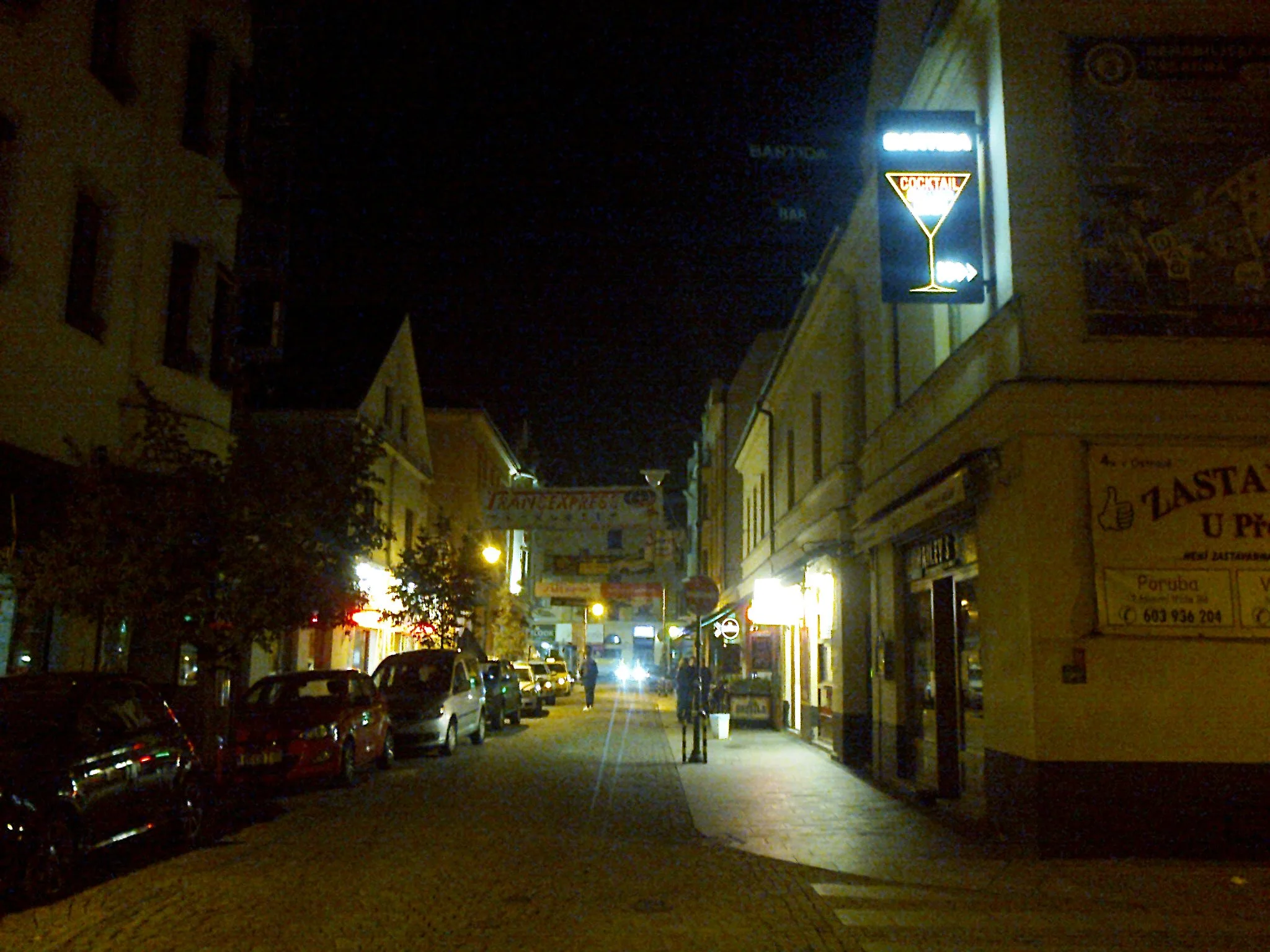
Jakubské náměstí, usually shortened to Jakubák, is the easiest place to understand how Brno goes out.
Not because the square contains every good bar.
Because it removes the pressure to choose one immediately.
The official Brno guide literally describes a local tradition of buying beer at Výčep Na stojáka, standing outside or sitting on the kerb around St James’ Square. That sounds almost too ordinary to put in a nightlife guide.
That is why it belongs here.
You arrive. People are already outside. The square itself carries part of the evening. You do not need to enter a club at 21:15 to prove that the night has started.

At the time of writing, Na stojáka lists several 0.47-litre draught beers at 61 CZK (about €2.52) and 0.3-litre pours at 46 CZK (about €1.90). Those are useful reference prices, not a promise that every central Brno bar will cost the same. Check the current menu directly.
If the weather is good, stay outside longer than your itinerary says you should.
This is one of the places where “doing nothing” is actually the local nightlife activity.
If the square feels flat, do not romanticise it either.
Rain, cold, university holidays and a Tuesday can turn the same kerb into an extremely accurate description of a kerb.
Brno is a bar city before it becomes a club city
The city’s tourism office is unusually confident about this part of Brno. Its own guide calls the bar scene famous and singles out Bar, který neexistuje and Super Panda Circus as local reference points.
That is not just promotional noise.
Brno has spent years building a cocktail reputation that is disproportionate to the size of the city.
The useful distinction is that these places are not interchangeable.
Bar, který neexistuje — literally The Bar That Does Not Exist — is the obvious first name and therefore the one most likely to appear on every English-language list. It works as a deliberate cocktail stop rather than as somewhere to wander into because the previous pub closed.
Super Panda Circus leans harder into concept, presentation and experience. It makes more sense when you actively want the cocktail bar to be part of the evening, not merely the place that supplies the next drink.
4pokoje sits in the broader modern Brno bar ecosystem and can work at different points of the day and night rather than fitting neatly into one old pub/club category.
Use Gourmet Brno and the city’s current recommendations to check what is actually operating now.
Do not turn that list into homework.
One ambitious cocktail bar is fun.
Four in sequence is a tasting exam with walking breaks.
Moravian wine is not the sophisticated alternative to beer. It is just another local layer
Brno is the capital of South Moravia.
That becomes more obvious in a wine bar than it does beside the crocodile in the Old Town Hall.
The region contains the overwhelming majority of Czech vineyard area, and the city gives local wine a much more ordinary role than visitors expecting a beer-only Czech night may assume.
In late summer, burčák — partially fermented grape must — appears seasonally. The official Brno guide cheerfully repeats the local saying that you should drink as much burčák as you have blood in your body and then, sensibly, advises against attempting that in one day.
Good advice.
Burčák can taste dangerously like something that has not yet decided to become alcohol.
It has.
Wine bars are useful when a group wants the evening to continue without making it louder. They also make Brno feel more South Moravian and less like a generic Czech student city.
Do not frame wine as the mature choice and beer as the student choice.
Real cities are less neatly organised than lifestyle magazines.
The right live-music venue depends on tonight, not its reputation
Brno’s music infrastructure is larger than the centre suggests.
The city’s own guide points travellers towards Kabinet MÚZ, Metro, Sono and Fléda, and describes a scene that moves from guitar music to electronic events, jazz and experimental work.
The important word is programme.
Kabinet MÚZ is a good example. Its September 2026 calendar alone moves through local bands, international alternative acts, post-punk, experimental music, jam sessions, hip-hop-adjacent work and DJ sets. October continues with another dense run of concerts and niche events.
That does not mean Kabinet is automatically the answer every night.
It means the calendar is worth opening.
A venue with a strong identity can still have the wrong event for you.
A band you have never heard of can still become the best decision of the trip.
This is where Brno starts behaving less like a compact bar crawl and more like an actual music city.
Fléda is not one club. It is whatever the poster says tonight
Fléda is the easiest place to misuse in a static nightlife guide.
It has history. Brno’s official guide traces the venue back to the Brünner Fledermaus cabaret and dance hall more than a century ago.
It also has a current programme that refuses to stay in one box.
In September 2026 alone, Fléda’s official calendar lists student semester-opening parties, rap, hip-hop, electronic events, drum and bass and international artists.
The prices show the same range.
A student or Erasmus opening party can be 149 CZK (about €6.16) in advance. A rap show on the same calendar is 449 CZK (about €18.56). Andromedik’s drum-and-bass night is 490 CZK (about €20.25). An international electronic booking such as Ely Oaks reaches 699 CZK (about €28.89).
Same building.
Completely different night.
So do not write “go to Fléda” into your itinerary.
Write:
check Fléda.
Genre, crowd, ticket, doors and finishing time matter more than the venue name.
That is increasingly true across Central and Eastern Europe. We make the same point in Ostrava After Dark, where an old nightlife reputation is even less useful without checking what is actually happening.
Students make Brno younger. They do not make every night Saturday
Brno has a large university population.
You can feel it.
Especially around the start of a semester, when Fléda’s calendar suddenly fills with welcome parties and the centre acquires the particular energy of thousands of people who have all just rediscovered that tomorrow’s lecture is optional in spirit if not in fact.
That does not create guaranteed nightlife seven nights a week.
Friday and Saturday remain the easiest nights if you want density without research.
Thursday can work extremely well in a university city.
Monday can work when a specific student event or concert gives it a reason.
And Tuesday in February can still be Tuesday in February.
The city is not failing you when this happens.
You chose Tuesday in February.
This is why Brno rewards checking the cultural calendar before booking the trip. A small city changes more dramatically around a strong event than a capital with a huge permanent nightlife market.
That same effect is one reason accommodation can suddenly become expensive. The main Brno guide explains why trade fairs, MotoGP and major weekends can distort hotel prices badly enough to make the “cheap Prague alternative” label look ridiculous.
The centre is compact enough that a bad first choice is cheap to abandon
This sounds like a minor advantage.
It is not.
In a large city, choosing the wrong bar can cost forty minutes, a metro connection and enough group negotiation to kill the evening completely.
Central Brno gives you much less distance to regret.
Jakubák, Česká, Kozí, Náměstí Svobody, Zelný trh and the surrounding streets remain close enough that you can walk out of a room that is too quiet, too loud, too polished, too student-heavy or simply wrong and try again.

That freedom makes Brno particularly good for mixed groups.
One person wants beer.
One wants cocktails.
One wants live music.
One person said they were fine with anything and is now rejecting everything.
You can survive that group in Brno.
Do not confuse a famous bar scene with a guaranteed social scene
A good bar can be full and still be terrible for somebody travelling alone who wants to meet people.
A sophisticated cocktail room can be excellent for a pair and useless for a group that wants to move around.
A student party can be packed and still feel closed if everybody arrived with their own university circle.
These are different measurements.
Brno’s compactness lets you test them quickly.
Look through the room before committing to three cocktails.
If you are solo, Jakubák gives you a lower-pressure starting point than a seated cocktail reservation. Live events can also work better than random clubs because everybody has at least one reason to be in the same room.
If you are a group, book the specialist cocktail place you actually care about, then leave the rest flexible.
A nightlife guide should reduce bad friction.
It should not remove spontaneity.
Late transport is better than a city this size strictly needs
Brno’s night-bus network is one of the reasons you do not have to sleep directly above the bars.
The current DPMB timetables list night lines N89 through N99, with routes crossing the city and several services running through Hlavní nádraží, the main station.

Check the current route on the night itself because diversions happen. Brno has enough tram works, street reconstruction and temporary changes to turn memorising a 2024 blog post into a hobby with no practical reward.
Central accommodation is still convenient.
Walking home from Jakubák is even more convenient.
But staying a little farther out is not automatically a nightlife mistake if a useful night line connects you.
The bigger accommodation warning is the date, not the postcode.
A practical Brno night without turning it into a military operation
If you want one simple first-night structure, use this:
18:30–20:30 — eat properly
Brno has too much good food to begin the night with emergency fried cheese at 23:45.
Eat in or around the centre.
Do not over-plan the bar route while the food is arriving.
20:30–22:00 — Jakubák
Walk to Jakubské náměstí.
Have a beer outside if the weather allows. A 0.47-litre beer at Na stojáka is currently around 61 CZK (about €2.52).
Watch what the square is doing.
This is reconnaissance disguised as sitting down.
22:00–00:00 — choose your actual night
Now make the first real decision.
Cocktails? Pick one strong bar and enjoy it properly.
Live music? Check Kabinet MÚZ, Metro, Sono or the current city listings.
A club or bigger party? Open Fléda’s programme and see whether tonight’s event is actually for you.
Wine? Stay central and slow the night down rather than pretending every successful evening needs a dance floor.
After midnight — follow evidence
If the room is alive, stay.
If it is dying, leave.
If somebody says “there must be another place” with no actual place in mind, return to the centre before spending an hour proving them wrong.
Brno gives you enough options to improvise.
It does not guarantee that all of them work simultaneously.

Zelný trh is useful when the city starts becoming quiet again
There is a pleasant point late in the night when Brno’s compact historic centre becomes legible again.
The groups thin out.
Trams become less frequent.
The squares stop acting as meeting rooms.
Zelný trh, Petrov and the old streets regain the version of themselves you saw during the day, only without the market rhythm and sightseeing traffic.
That is a better ending than forcing one more club because the article promised nightlife “until sunrise”.
Some nights will reach sunrise.
Some should not.
Who should choose Brno for nightlife
Choose Brno if you want variety without huge distances.
Choose it if the idea of beer outside, one serious cocktail bar and a concert sounds more useful than a giant strip of clubs.
Choose it if you like the fact that Moravian wine belongs in the same evening as Czech beer.
Choose it if you are willing to let a programme determine the final venue.
Brno also works particularly well when nightlife is part of a broader city break rather than the only reason for the flight. The daytime city is strong enough that a mediocre Thursday night does not make the whole trip feel wasted.
Who should not choose Brno for nightlife
Do not choose it because somebody promised “Prague nightlife but cheaper”.
That is the same lazy comparison the main Brno article is trying to kill during daylight hours.
Do not choose it if you need a guaranteed mega-club district with multiple enormous rooms operating every night of the week.
Budapest is easier for that kind of low-friction party weekend. Kraków is easier if concentration and tourist-facing nightlife are the priority. Sofia gives you several larger nightlife systems to choose between.
Our broader piece on whether Eastern Europe is still a good party destination in 2026 explains why comparing cities only on beer prices stopped being useful years ago.
Brno’s advantage is not scale.
It is switchability.
The night can change direction without changing city.
The useful version of Brno after dark
Start with the square.
Check the programme.
Do not confuse an old venue reputation with tonight’s crowd.
Drink Moravian wine because you are in Moravia, not because wine makes the evening more sophisticated.
Pay attention to the calendar because students, concerts, summer events and major weekends can completely alter how the centre feels.
And if Jakubák is full of people sitting on the pavement with beer, resist the urge to search for something more authentic.
You may already be looking at it.
Brno does not need one legendary club to justify an After Dark guide.
It has something more useful.
A night that can begin casually, become specific when you want it to, and still leave enough room for the city to surprise you.