Bratislava becomes interesting the moment you stop asking why it isn't Vienna.
Where this sits
Bratislava is Slovakia's capital on the Danube; Vienna is Austria's capital about 60 km to the west. They are close enough for direct train/bus travel and a combined trip, but they operate at completely different urban scales.
Bratislava is only a short journey from Vienna, but treating it as the Austrian capital's budget annex makes for a disappointing introduction. The two cities reward different kinds of visits. Vienna offers major museums and monumental neighbourhoods over a much larger area; Bratislava lets you move between the Old Town, the Danube and post-war residential districts without dedicating half a day to transport.
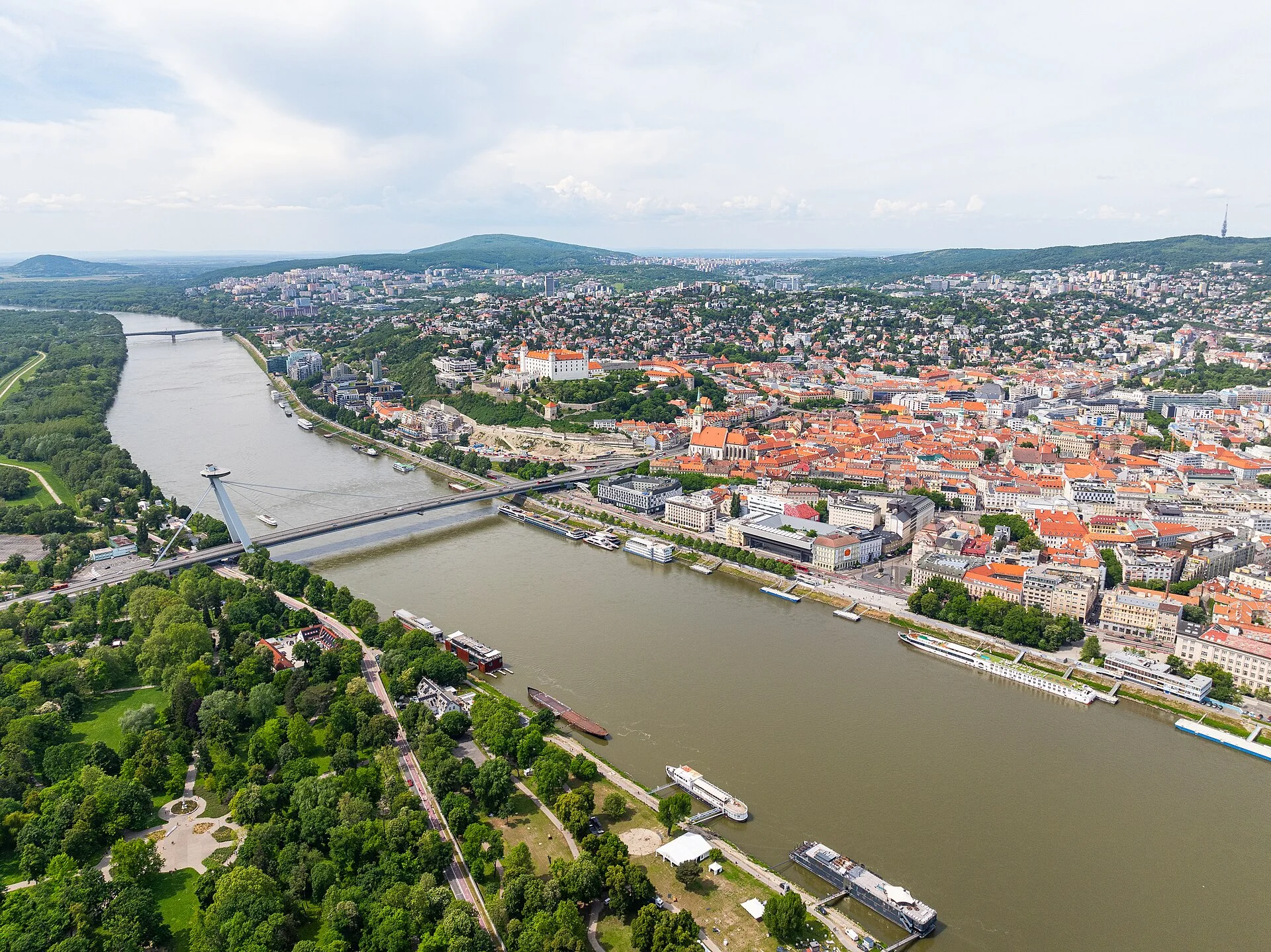
The proximity is useful, especially by rail or as part of a road trip, but the Slovak capital deserves a night of its own. Its historic streets are compact, the castle sits dramatically above the river, and the city's less-photographed districts explain much more about how people live than a rushed loop through the central squares.
Begin with the Old Town and the river
Bratislava's centre is genuinely small, which is a practical advantage on a short stay. Walk through Michael's Gate, continue towards the Main Square and Old Town Hall, and allow time for the surrounding lanes, cafés and smaller courtyards. You can see much of the central route in a day without treating every building as a compulsory museum.
Bratislava Castle is worth the climb for the views across the Danube and into Austria, even when you do not plan to visit the museum. The Blue Church offers an extraordinary piece of Secessionist architecture slightly beyond the obvious loop. Its religious use makes interior access less predictable than exterior photography. The Slovak National Gallery is a worthwhile stop for the way its renovated Danube-side complex joins historic and modern architecture.
Other central choices include the Primate's Palace, St Martin's Cathedral and the Old Town Hall. Rather than collect all of them in a few hours, choose the interiors that interest you and spend the remaining time along the riverfront or in a café. Bratislava is more enjoyable when the itinerary leaves some space.
Beyond the castle postcard
The castle dominates Bratislava's skyline, but below it lie ordinary streets, flats, offices, small restaurants and transport connections. Walk down through the area around Hviezdoslav Square and the riverfront instead of returning directly to the next landmark. The transition from monumental centre to everyday streets is part of the city's character.

A useful change of perspective is to cross the SNP Bridge into Petržalka. The UFO observation deck offers a high viewpoint across the Danube, castle and the broader city, but the neighbourhood across the bridge is interesting at street level too.

Petržalka is a vast residential district associated with socialist-era panel housing. Between its apartment blocks are footpaths, schools, trees, sports facilities and local services. Walking a little beyond the bridge gives a much better idea of the district than looking at its skyline from the Old Town. It also makes the historic centre appear surprisingly small across the river.
Devín deserves its own half-day
Devín Castle stands above the confluence of the Danube and Morava rivers. The ruined fortress and border landscape bring a very different geographical and historical dimension to a Bratislava stay: you are looking at a junction of rivers and former frontiers, not simply another view over the centre.

Devín is accessible by public transport and car, with seasonal boat options also worth investigating. Check opening hours for the actual month and weather before travelling. It is an excellent extra half-day when you have two nights or more, but a poor use of time if squeezing it in would leave you rushing through the centre.
What evenings are like
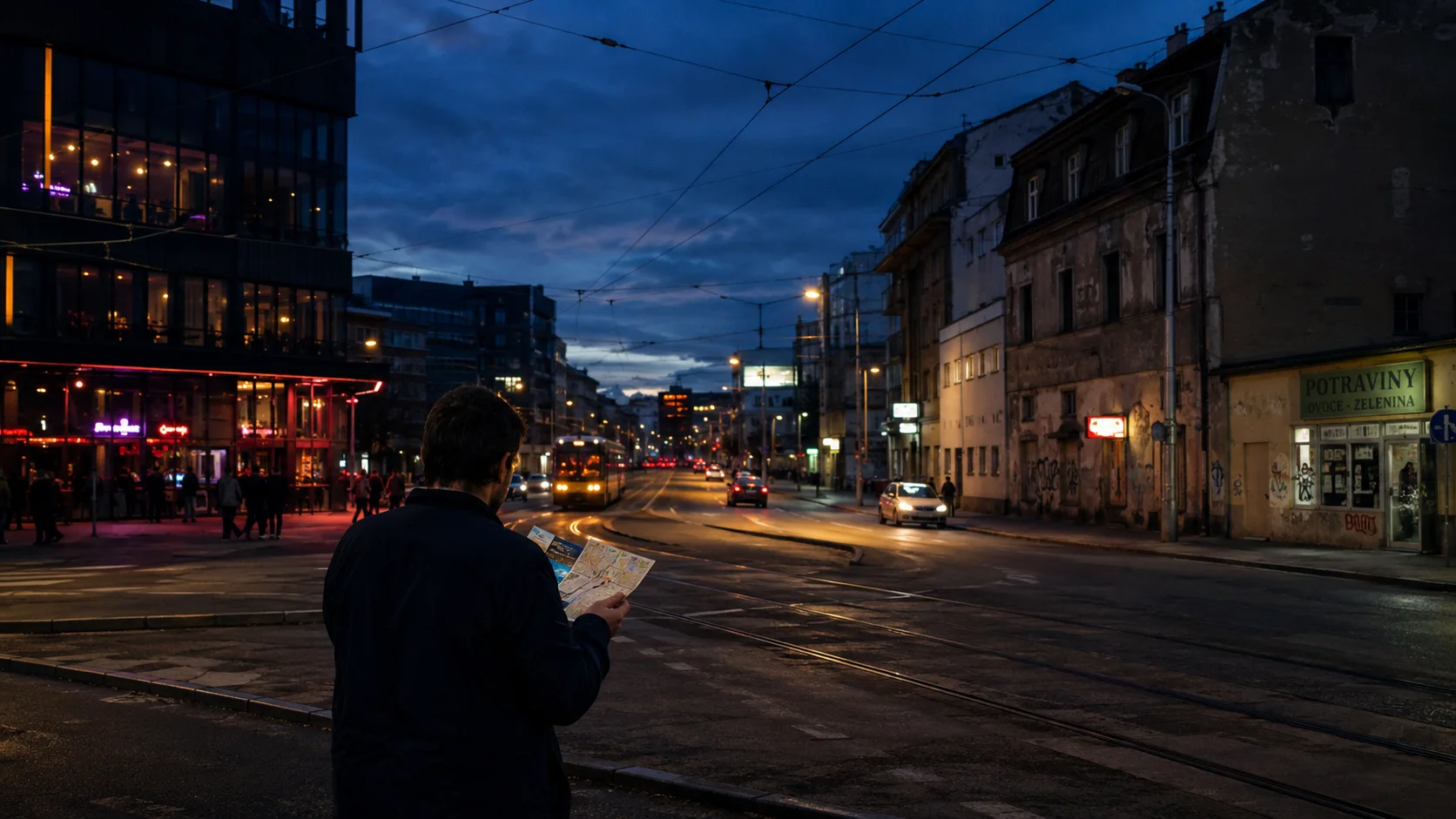
Bratislava has a compact nightlife circuit, with ordinary pubs, restaurants, music venues and more commercial clubs close to its historic streets. Because the centre is small, you can enjoy dinner, try a bar and decide whether a concert or late venue deserves the rest of the night without complicated transfers.
Good Life Club advertises mainstream music nights including hip-hop, Afrobeat, Latin and pop. Channels Club is another central late option near Michael's Gate, with several floors and a commercial party format. Check the current programme and door conditions rather than assuming a directory's hours will apply on your date. Fridays and Saturdays give more scope for spontaneous nightlife; midweek it pays to choose a specific venue or event.

A quieter evening is equally satisfying: sit in a pub, walk the waterfront and enjoy a compact city after its day visitors have left. Bratislava's social atmosphere can be less immediately outgoing than a heavily visitor-focused party district. Service and conversation may be direct rather than performative; the best response is to enjoy the place as an ordinary city rather than demand a constant tourist welcome.
The road trip that makes Bratislava especially useful
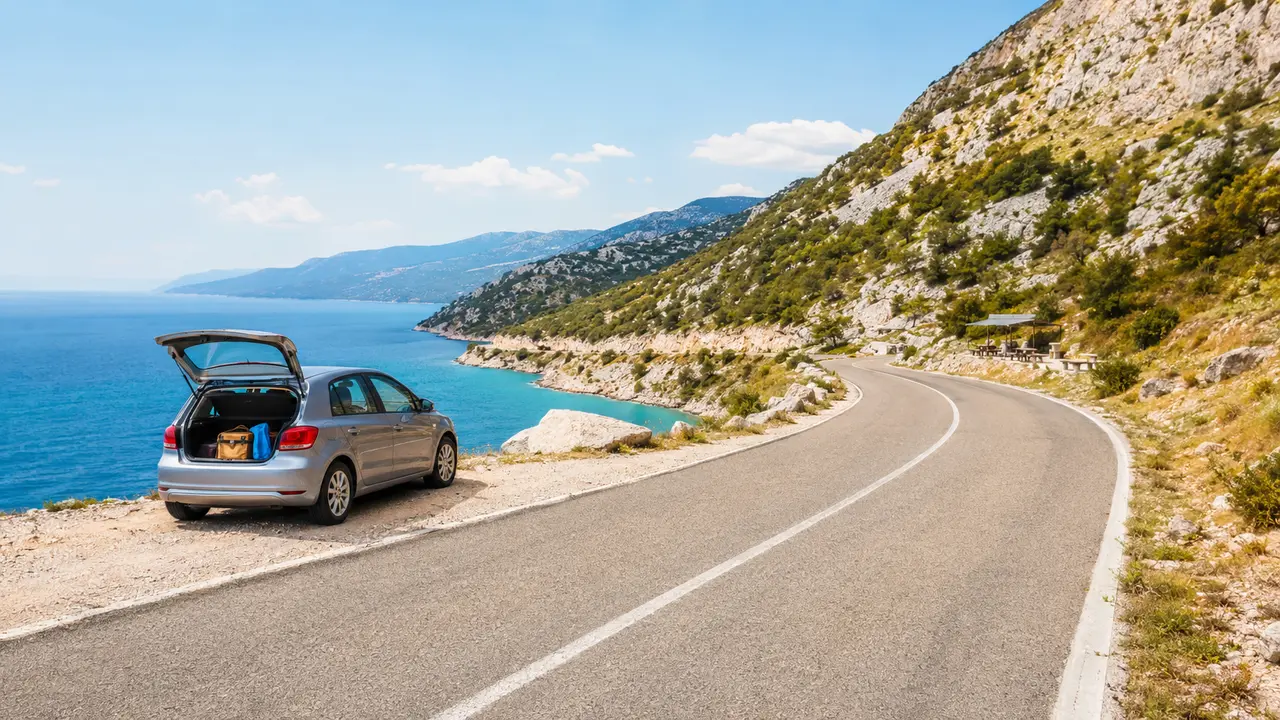
Bratislava sits at a meeting point of Slovakia, Austria and Hungary. On a regional driving trip, it provides a comfortable overnight stop between capital cities and smaller border landscapes. The Austrian town of Hainburg an der Donau is a worthwhile possible stop on the approach from Vienna, while nearby Carnuntum adds Roman archaeology and reconstructed spaces to the corridor.
Farther south-west, Lake Neusiedl and northern Burgenland offer flatter scenery, reeds, small towns and wine culture without requiring a formal wine-tour itinerary. Travelling east from Bratislava opens routes farther into Slovakia, towards Trenčín, the central mountains or eventually the Tatras.
A car is useful for such connections, but not for navigating the Old Town. Park it near your hotel and explore the centre on foot. The local tram, bus and trolleybus network reaches outer districts, and night transport information is worth checking if your return is late. Use the car to enlarge the trip, not to find parking between the Blue Church and lunch.
One day, two nights or a longer stay?
One full day allows a satisfying introduction to the Old Town, castle, riverside and a few chosen stops. Two nights give you the city after its day visitors leave and space for either Petržalka or Devín without racing. Three or four nights become attractive when Bratislava is a base for regional outings, a quieter stop between larger cities or simply a place where you want to slow down.
Staying in Bratislava solely to avoid Vienna's hotel prices is worth calculating carefully. Transport between the cities, the last useful connection and the time lost travelling can erase an apparent saving. If Vienna is your main destination, stay where you actually intend to spend the evenings; if Bratislava interests you, enjoy it as a separate city.
A short trip with more character than the day-trip label
Bratislava works because its historic streets, Danube setting and smaller scale are easy to enjoy without a dense schedule. Castle views, the Blue Church, an evening in the centre and an excursion to Devín are all good reasons to spend time here. Petržalka adds an honest view of the modern city and is accessible without dedicating a whole day to it.
The connection to Vienna remains one of Bratislava's most useful advantages. It should make the journey easier, not become the standard by which every street, museum and evening is judged.