

Nikšić is not the Montenegro people fly in to photograph. That is exactly why it earns a night on an inland Balkan road trip.
Where it is — and how to get there
Nikšić lies in west-central Montenegro, inland from the Adriatic and roughly 50 km north-west of Podgorica. It sits on the road logic between Bosnia and Herzegovina, central Montenegro and the coast, which is why so many travellers pass near it without treating it as the destination.
Road and bus are the normal arrivals from Podgorica, the coast and Bosnia, but Nikšić also has a working rail link with Podgorica; Montenegro's railway operator still lists Nikšić as an active station. Podgorica Airport is the nearest major flight gateway. If the trip is already coming through Tjentište, the road south is the more interesting arrival anyway.
Montenegro has trained visitors to look west.
Kotor Bay.
Budva.
The Adriatic.
Cruise ships.
Stone towns.
Beach roads.
Nikšić sits inland and does almost none of that work.
It is a large Montenegrin city built around a very different combination: industry, students, beer, wide streets, lakes, sport, music and the fact that people actually live here all year.
The country's tourism organisation summarises it with unusual honesty as a city of “beer, steel and strong friendship bonds”. That description is still on the official Montenegro city guide.
It is slightly cheesy.
It is also much closer to the truth than pretending Nikšić is a secret Kotor.
One night is enough to understand the argument
Nikšić is not a city you need to “do” for three days before being allowed to continue.
On an inland Balkan road trip, one night works extremely well.
Arrive from Bosnia and Herzegovina through the mountains.
Walk Bedem and the centre.
Go up Trebjesa if daylight allows.
Eat.
Drink somewhere people from Nikšić are actually drinking.
Sleep.
Continue towards Albania or the coast the following morning.
A second night makes sense if the lakes, surrounding countryside or a festival are part of the trip.
A week makes sense only if you have a reason.
That is not an insult.
It is useful planning.
The centre is bigger than it needs to be — which is part of the point
Nikšić's Trg Slobode does not feel designed for a tiny tourist core.
It feels civic.
Wide.
Open.
A place where the city can gather rather than somewhere every square metre needs a restaurant terrace and souvenir rack.
The municipality lists it alongside Bedem, Trebjesa, Krupac, the Tsar's Bridge and other main city landmarks. Its current city overview is here.

Use the square as orientation.
Do not stand in the middle asking where the attraction is.
The useful part is the streets radiating away from it: cafés, bars, shops, students, people meeting after work and a city centre that is not constantly negotiating with visitors.
If you have spent the previous days in Sarajevo, Kotor or Mostar, the difference is immediate.
Nikšić is not trying very hard to explain itself.
Good.
Bedem is the ruin that still belongs to the city
The remains of Bedem sit close to the centre on a rocky rise.
The site carries layers of the older settlement known through forms including Onogošt, with Roman, medieval and Ottoman history tied into the location. The municipality still presents Bedem as one of Nikšić's defining historical landmarks.
But the useful reason to go is not a detailed chronology.
It is proximity.

You can move from a current city street to old fortress walls without turning the afternoon into an archaeological expedition.
The ruins are rough enough to feel like ruins.
They are also embedded enough in present-day Nikšić that cultural events and music have repeatedly used the space.
That overlap matters.
Bedem is not preserved behind the city.
It is part of the city.
Trebjesa explains the geography better than another museum
Trebjesa is the low hill rising directly beside Nikšić.
Go up for the view rather than for an obligation.
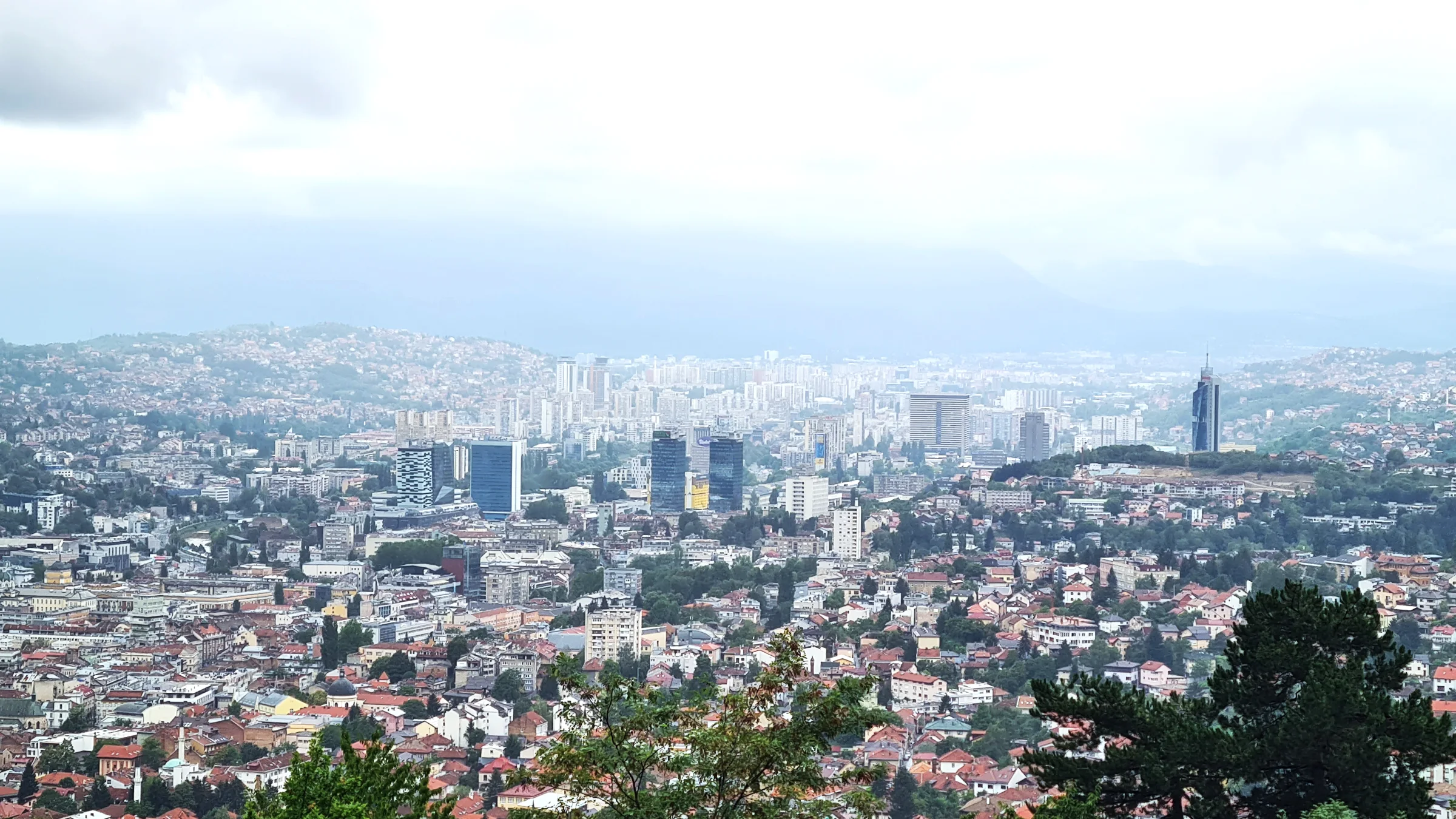
From there, the city becomes readable.
Apartment blocks and streets occupy the karst field.
Mountains close the horizon.
The scale is large enough to feel urban and small enough that the edge of town is never abstract.

This is also where the coastal bias in Montenegro travel starts looking ridiculous.
The country does not stop at the first ridge behind Kotor.
Nikšić's municipality covers an enormous inland area, and the city has long functioned as a road, industrial and administrative centre linking the coast with the Balkan interior.
If your Montenegro trip never leaves the Adriatic, you have seen a very photogenic slice of the country.
Not the whole thing.
Krupac is not a beach replacement
Lake Krupac sits just outside the city and is one of Nikšić's easiest escapes.
In summer, locals use the water and shore recreationally.
That does not mean the article needs to call it “Montenegro's hidden beach”.
Please do not.
It is a reservoir landscape beside an inland city.
That is already useful.
The official tourism organisation includes Krupac among the natural places around Nikšić, along with Slano and other lakes. It becomes nationally visible for another reason every summer: Lake Fest.
In 2026 the festival ran from 7–9 August, combining rock, alternative music and DJs beside Krupačko Lake. The current 2026 event page is archived by Montenegro's national tourism organisation.

So Krupac has two lives.
Most days: local lake.
Festival weekend: temporary music city.
Both are more interesting than describing it as an attraction with a rating.
The Tsar's Bridge is too large for the traffic it now carries
The Carev Most — Tsar's Bridge — outside central Nikšić is one of those pieces of infrastructure whose scale looks slightly detached from its current use.
That is the attraction.
Built in the late nineteenth century with Russian support during the period of Prince Nikola, the long stone bridge belongs to a moment when roads and state-building were part of the same political project.
It is not a reason to cross Montenegro by itself.
It is a good short detour if you have the car and the light.

More importantly, it fits the city.
Nikšić repeatedly gives you things that were built for a larger idea: fortress, square, bridge, industrial plants, reservoirs, cultural infrastructure.
The place makes more sense when you stop asking whether each object is “beautiful”.
Dom Revolucije is the building that explains why “industrial city” is too small a label
Nikšić also has one of the stranger pieces of Yugoslav civic ambition sitting close to the centre: Dom Revolucije.
It was conceived as a vast cultural and social complex, expanded far beyond its original programme and then left unfinished for decades. The municipality still lists Dom Revolucije among the city's protected and significant built heritage, while parts of the site and plateau continue to be reused for events. Nikšić's current municipal planning documents include Dom Revolucije in the historic urban core.
The useful part is not “abandoned communist building” photography.
It is what the structure says about Nikšić.
This was a city expected to be large, industrial, organised and culturally ambitious enough to need a monumental public building on that scale. The fact that the project then spent decades unfinished says something about the rupture after Yugoslavia too.
And it is not completely dead space. In August 2026, Revolucija Fest used the plateau outside Dom Revolucije for live music; local coverage also recorded the very Nikšić detail that some younger residents skipped the €10 ticket and simply gathered nearby because the music carried beyond the paid area. Local 2026 coverage is here.
That is more useful than pretending the building belongs only to architectural history.
Beer matters here without becoming a brewery theme park
Nikšić and Nikšićko beer are linked so strongly that even the national tourism organisation tells visitors to try it here.
That does not require turning the city into a craft-beer pilgrimage.
Nikšić's industrial identity includes the Trebjesa brewery, but the beer is more useful as part of the city's social texture than as merchandise.
Order one because you are in Nikšić.
Then pay attention to where you are drinking it.
That is the better guide to the city.
After dark: this is where Nikšić becomes more convincing
Nikšić's nightlife is not Budva nightlife inland.
That distinction matters.
There is no tourist strip of giant seasonal clubs selling the idea that everybody arrived from abroad to stand around a reserved table.
The city is a university and regional centre.
A normal night is therefore built around cafés, pubs, bars, live music, local company and venues that become later or busier depending on the day.
Start around Trg Slobode.
Propaganda Bar, directly on the square, remains an established central option and current listings still show it operating daily into the evening. The current listing is here.
Do not treat that as the end of the research.
A local November 2025 discussion asking specifically where to go in Nikšić on a Saturday until 03:00–05:00 produced Propaganda Bar and House Pub as straightforward suggestions — alongside the much more revealing local answer that Bedem, Trebjesa, the park or “a random bench” works if the company is good. The thread is here.
That is more useful than a copied “Top 10 Nightclubs” page.
The night is social before it is venue-driven.
If you actually want to stay out late
Current July 2026 club listings show a small later-night layer including Montenegro Pub, with Rock Club, Diamond Club, AB Place and Jerry Pub also appearing in the local category. This is a directory snapshot, not a guarantee that every venue is open tonight.
That caveat matters.
Provincial nightlife changes quickly.
Opening hours on map listings can be wrong.
A venue can be technically open and empty.
A place can be excellent on Saturday and irrelevant on Tuesday.
So use the centre as a live system: start where people are, ask where the night continues and move with the crowd.
That is much more reliable in Nikšić than pre-booking a “club experience”.
Two weekends when the city is absolutely not normal
Bedem Fest ran on 31 July and 1 August 2026 inside the fortress, with regional rock and alternative acts. Official event information is here.
One week later, Lake Fest took over Krupac from 7–9 August.
Those weekends change the city.
Accommodation tightens.
The nightlife becomes event-led.
People who normally spread across bars converge on the festival.
If you want a quiet, representative Nikšić night, choose another weekend.
If you want the city at maximum volume, those dates are the point.
This is a better food stop than the coast gives it credit for
Nikšić does not need a “foodie scene” paragraph.
It needs dinner.
The local food logic is straightforward enough to be useful: lamb or veal under the sač, kačamak, cicvara, local cheese, prosciutto and grilled meat. A current 2026 Nikšić hotel guide aimed at its own guests makes almost exactly that list, which is more convincing than a tourism article inventing a tasting menu around the city. The July 2026 local food overview is here.
Montenegrin inland food tends to be heavier and less marine than the coastal menus: grilled meat, slow-cooked dishes, cheese, smoked products and the familiar Balkan architecture of salads, bread and too much food arriving at once.
Do not search only around the prettiest table on the square.
Look for restaurants serving locals at normal dinner times.
If the menu contains enough pages to cover sushi, pizza, burgers, steaks, pasta and “traditional Montenegro” simultaneously, scepticism is healthy.
For something concrete rather than a ranked “best restaurant” list, current 2026 review data repeatedly surfaces Merak for simple local grill food and Konoba Portun for a more conventional sit-down meal, while Propaganda remains more useful as a drink/café stop than as a reason to design dinner around it. These are current reference points, not permanent endorsements; restaurant quality changes faster than Bedem does. Current Nikšić restaurant listings are here.
A good Nikšić dinner does not need to prove range.
It needs to feed you properly before the second beer.
Trebjesa is not just a viewpoint
The municipality's current biodiversity plan classifies Trebjesa as a protected landscape and notes more than 250 herbaceous plant species and 40 woody species, alongside caves, monuments, sports infrastructure and Hotel Trebjesa at the summit area. The current municipal biodiversity plan is here.
That makes the hill more than the place you drive up for a city panorama.
If the weather is good, walk part of it.
If you only want the view, drive.
The point is not to turn Nikšić into a hiking destination. It is to notice that protected landscape, Yugoslav urbanism and a working city sit almost on top of each other here.
Staying centrally is more important than parking five metres from the motorway
Nikšić is easy to drive through.
That can create bad accommodation logic.
A hotel on the edge looks efficient because you are leaving in the morning.
Then dinner, drinks and the centre all require the car again.
Stay close enough to Trg Slobode to walk the evening.
Park once.
Use the next morning to retrieve the road-trip version of yourself.