Bratislava's compact old town makes a wonderful start; the riverbanks, modern districts, markets and Devín put the capital into a much broader setting.
Where it is — and how to get there
Bratislava is Slovakia's capital on the Danube in the far south-west of the country, pressed close to both Austria and Hungary. Vienna is only about 60 km away, which explains both how easy Bratislava is to reach and why it is so often reduced to a side trip.
Direct trains connect Bratislava with Vienna and other Central European cities, and buses run straight from Vienna Airport as well as central Vienna. Bratislava Airport handles a smaller flight network of its own; from there city buses are the practical public connection. Arriving by rail is usually the cleanest introduction because the city starts almost immediately.
Bratislava's historic centre is genuinely lovely: narrow streets, grand churches, cafés and the hilltop castle are all close enough for a relaxed first day. Yet the capital stretches far beyond that compact core. The Danube, the striking SNP Bridge, Petržalka's residential districts, the Old Market Hall and the modern bus station tell different parts of its story. A visit becomes more rewarding when you stay for an evening or take a trip towards Devín instead of treating the whole city as a quick break between trains from Vienna.
Bratislava in 60 seconds
Give Bratislava two nights if the city itself is the trip. One full day covers the obvious centre; the second lets you cross the river, use public transport and see a resident capital rather than a heritage island.
Stay in or beside Staré Mesto for a first visit, around Nivy / Ružinov if transport and price matter more, or in Petržalka only when you deliberately want the south-bank city and understand the connection.
Public transport is cheap. With the current Tapni sa bank-card system, a 30-minute ticket is €1.09, 60 minutes €1.60, and the daily cap / 24-hour level is €4.85 under the 2026 tariff. DPB explains the current contactless system here.
For nightlife, use Bratislava After Dark. Obchodná, WAX2, river venues, queer events and student nightlife make much more sense once the day-tripper crowds are gone.
The Old Town's compact pleasures
Michael's Gate, Hlavné námestie, the Old Town Hall, Primate's Palace and the surrounding lanes form a heritage core you can cross quickly.

Travel writing often reacts to this by padding Bratislava with unnecessary attractions or pretending every courtyard deserves an hour. Do not. Small is operationally useful. You can look at façades instead of route-planning. You can sit for coffee without sacrificing a monument. You can return to the same square after dinner and notice that the social city has changed around it. The problem begins only when the boundary of the pedestrian centre becomes the boundary of curiosity.
Our broader field note on why Old Town is usually the worst way to understand a European city applies here almost embarrassingly well.
Bratislava Castle and the city below
The rebuilt Bratislava Castle sits above the Danube so effectively that it can make the city look more historically coherent than it is.
Go up.

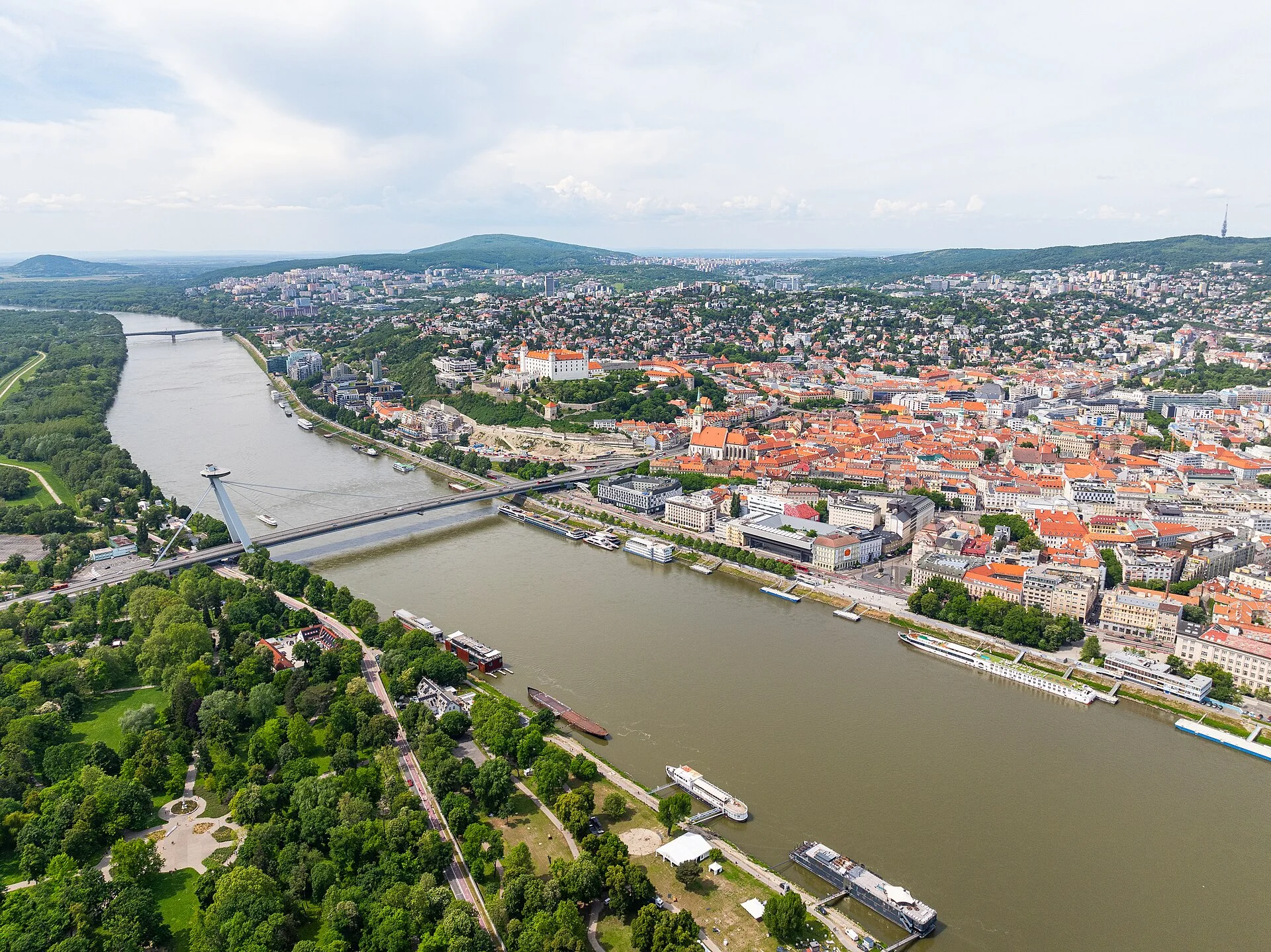
Use the terrace and viewpoints to understand the geography: Old Town below, Austria close to the west, the river, SNP Bridge, Petržalka spreading south and large transport corridors making visible how quickly Bratislava escaped its old walls.
Whether you spend serious time inside the museum depends on your interest in Slovak history and the current exhibitions. The panorama does the essential urban work even if you never buy a ticket.
SNP Bridge and Bratislava's modern skyline
The Most SNP / SNP Bridge and its UFO tower are among the clearest reminders that Bratislava was radically remodelled during the socialist period.

Construction required demolition in the old Jewish quarter below the castle. The result is both engineering landmark and evidence of how modern planning cut through historical urban fabric.
This is exactly the kind of contradiction that polished city-break coverage often avoids because neither 'beautiful bridge' nor 'communist monstrosity' is adequate.
Walk across it. The transition matters more than the tower restaurant. On the south side, Bratislava stops looking like a miniature Central European old town almost immediately.
Bratislava's two banks are both part of the trip
The old centre, cathedral and castle make an excellent first morning. Yet the SNP Bridge, the Danube embankments and the large residential district of Petržalka explain how much of the modern capital developed after the historic centre. Looking across the river from the castle makes its geography clearer; actually crossing gives you a different street-level experience.
Petržalka is a working residential area, not an exhibition of socialism for visitors. Its parks, everyday shopping streets and public transport links make sense as part of an ordinary city rather than a contrived 'edgy' excursion. Choose a clear destination or walking route if you want to explore, and use the tram or bus network for the longer distances.
For a genuine outing beyond central Bratislava, Devín Castle stands above the confluence of the Morava and Danube. It connects the city's frontier history with a beautiful landscape. The Slovak tourism description explains the medieval ruins and historic importance; opening areas and prices should be checked before travel. Devín is a worthwhile alternative to treating Vienna as the only possible extra destination.
The guide continues below the travel-planning tools.
Read further ↓Petržalka: homes, parks and a very different city
Petržalka is enormous relative to historic Bratislava. Mass housing, wide roads, green strips, later renovations and new development define a district where a large share of the city's residents actually live. That makes it useful. It does not make it an attraction designed for people who want to photograph 'communist blocks'. The city tourism office itself now includes post-socialist Bratislava in its visitor material, explicitly connecting Petržalka and other socialist-era sites to the city's twentieth-century story. Its post-socialist overview is a decent framework.
Take a tram or bus south, walk a section and look back toward the old city. The contrast is the point. Residents are not exhibits.

The Danube is bigger than the promenade below the castle
Bratislava's riverfront can look like one clean strip of restaurants, offices and new development if you never leave the centre.
Walk further. Eurovea and the modern waterfront show the capital's contemporary investment city. Older port and industrial geography sits beyond the polished centre. On the opposite bank, floodplain and park spaces pull the river back toward recreation. The Danube is infrastructure, border history, leisure space and development pressure simultaneously. That is a much more useful reading than 'nice place for sunset'. Sunset is still allowed.
Stará tržnica is better when it is functioning
The Old Market Hall / Stará tržnica is one of the city's most useful examples of a historical building remaining part of current urban life.
On Saturdays the current market runs roughly 09:00–15:00, with food and local producers depending on the programme. Check the hall's current listing before the trip.
Go when something is happening. An empty market hall is architecture. A working hall tells you more about the city. This sounds obvious, but travel itineraries are remarkably good at arriving at markets when the market is gone.
A market morning and the city that commutes
Stará tržnica, the Old Market Hall, is worth planning around when the market and events are actually operating. Its present use connects local food businesses, pop-ups and community activities inside a central historic structure. Rather than treating the building as an attraction with a permanent exhibition, check the event calendar and choose a visit that fits what is on.
A short walk outside the most photographed lanes brings you to transport links and ordinary commercial streets. The Nivy area and bus terminal make sense in this wider context: this is a working capital with regional journeys, commuting and services, not only a compact baroque city. It is particularly useful to compare this modern city infrastructure with a walk along the Danube and a later evening in the old streets.
For a trip beyond the centre, Devín combines river scenery and historical ruins and is worth reserving several hours rather than treating it as a quick taxi photo stop. Check the Slovak tourism site for details.
Nivy explains contemporary Bratislava better than another baroque room
The Nivy area around the bus station and new development is not beautiful in the inherited-city sense. That is useful. Office towers, shopping, transport, apartments and construction show where growth pressure is being absorbed beyond the old core. Nearby parts of Ružinov feel more residential and less visitor-oriented while remaining well connected. If you are staying more than one night, this part of town helps explain the economic capital Bratislava has become since Slovakia joined the EU and attracted major investment.
You do not need to love a mall-bus-station complex. You need to recognise that contemporary capitals are partly made of things heritage itineraries delete.

Food, culture and the city's Slovak identity
Bratislava has a national-capital problem shared with many small countries. Visitors want it to summarise the country. It cannot. Western Slovakia, the Tatras, eastern Slovakia, Roma communities, Hungarian-majority areas and industrial regions all sit badly inside one compact capital narrative. That is why Košice becomes more interesting once Bratislava is behind you. Bratislava is useful as Bratislava: border capital, political centre, university city, EU-connected economy and historically multilingual place at the edge of the country.
It does not owe you the whole national executive summary.
Food beyond a short list of Slovak classics
Bryndzové halušky will appear in every first-trip food list. Eat it if you want it. Then let Bratislava be a current city. Contemporary Slovak cooking, Central European staples, Vietnamese and Asian restaurants, Balkan influences, bakeries, wine bars and modern café culture all belong to the same capital. The old centre has visitor-facing pricing and menus because visitors are there. Moving toward residential districts usually changes value before it produces some magical authenticity upgrade.
Do not spend an hour hunting 'where locals eat' if the restaurant beside you is good.
Where to stay
Old Town / Staré Mesto: easiest first trip. Walk everywhere famous, accept weekend noise and higher rates on the most obvious streets.
Nivy / eastern centre: practical for buses, modern hotels and easy public transport; less romantic and often better operationally. Ružinov: resident feel, trams/buses and potentially better value; choose exact connections rather than the district label. Petržalka: strong if you deliberately want the south-bank city or have a reason near the station/event area. Less intuitive for a 24-hour first visit. Around the main railway station: functional rather than atmospheric. Useful for early Vienna/Prague/Košice trains, but the immediate streets are not Bratislava's prettiest introduction.
Getting around with trams and buses
Bratislava's integrated network of trams, buses and trolleybuses is more useful than the tiny old centre makes it appear. The 2026 Tapni sa contactless system simplifies a short stay: tap a bank card in the vehicle and choose the appropriate product under the current rules. Prices include roughly €1.09 for 30 minutes, €1.60 for 60 minutes and a €4.85 daily cap/24-hour level. Use DPB's current instructions because tariff details can change.
Do not walk fifty minutes beside arterial roads because somebody called Bratislava walkable. The old centre is walkable. The city is larger.
Airport: the public bus is the obvious default
Bratislava Airport connects with the main railway station via line 61, with N61 serving the night period. Current September 2026 timetables put the airport-to-station journey at roughly the high-20-minute mark in normal conditions. Current airport connection information is maintained here.
A 30-minute fare can work for the direct run when timing is clean; use a longer-validity ticket when transferring or when you want margin.
Vienna Airport can also be relevant for Bratislava because of the cross-border airport network and far larger route map. That does not mean every Bratislava trip should begin in Austria. Compare the full door-to-door journey rather than airport branding.
Vienna, Devín and the wider Danube region
Yes, combine the cities. Rail and bus links make it easy. But do it symmetrically. Read the full Vienna guide for Vienna and this one for Bratislava. If you only want the comparison itself, the existing piece Bratislava Is Not Vienna's Cheap Side Trip makes that argument directly. The useful split for a short combined trip is often three nights Vienna + two Bratislava, not Vienna plus six daylight hours before dinner.
Proximity is not a reason to deny one city a night.
A Saturday worth organising around
The Stará tržnica market at Námestie SNP 25 is a reason to plan an actual Saturday in Bratislava. The Trh-Piac-Markt operates 09:00–15:00, with local food, small producers and a first-floor book and record market. The covered building dates to 1910 and stands on the site of older city fortifications. It is a functioning weekly event, not a museum that will have the same experience on a random Tuesday. The city's official market listing gives the programme. Start there, then walk towards the everyday commercial streets of Nivy, whose modern bus terminal and surrounding offices show the regionally connected city outside the old lanes.
For a larger change of scene, give Devín Castle a half-day. The ruins stand above the Morava–Danube confluence, close to Austria, making the border geography of this capital impossible to miss. Reserve time to reach the village, explore the ruin and return; do not slot it between two city-centre museum tickets. The Slovak tourism listing describes the site, while local public transport planning should determine the actual journey and last suitable return. The view makes the trip worthwhile, but the experience is as much about landscape and history as the ruined walls.
Bratislava's scale makes a comfortable weekend possible: a market and old-centre day, a river walk, Petržalka across the SNP Bridge and perhaps Devín. Choose the sequence by market and museum opening days rather than following a guide's arbitrary 'day one' order.
Cross the river for one of Bratislava's best parks
The SNP Bridge changes how Bratislava looks and feels. On its southern side, Sad Janka Kráľa is a substantial public park in Petržalka, not an incidental patch of grass after the bridge. Visit Bratislava describes its eighteenth-century origin and 42 hectares of paths, mature trees and open space between the Old Bridge and SNP Bridge. It is publicly accessible day and night, with no timed admission. This is an easy, low-cost way to spend a relaxing hour outside the historic centre. Continue into Petržalka by public transport if you want to see the modern residential district rather than returning immediately for another castle photograph.
A realistic two-day plan
Day 1: Stará tržnica if Saturday → Old Town → castle → SNP Bridge → walk into Petržalka → return along the Danube → use Bratislava After Dark instead of catching the 19:00 train elsewhere.
Day 2: choose a contemporary-city line: Nivy/Ružinov, post-socialist architecture, Danube development or a museum that actually interests you → long lunch → river / café time → departure.
If you only have one day, do Day 1 and accept that you saw the historic capital, not everything the capital is.
That is still a legitimate trip.
Bratislava's scale and its limits
Bratislava works for travellers who enjoy compact cities, border geography, twentieth-century urban contradictions, cafés, short-distance logistics and a capital that does not require five days to become legible.
It works poorly for people who equate value with monument count. It can feel quiet on the wrong evening. It can feel finished quickly if you refuse public transport. It can feel expensive if the only comparison allowed is 'cheaper than Vienna'. None of those makes the city a failed destination. They make it specific.
The city fits a proper weekend
Bratislava is a relaxed two-night trip when you let it include the river, market, Petržalka and a late evening alongside the castle and old streets. The capital is easily walkable at its centre, but the nearby border landscape and residential districts give it more range than a quick train stop suggests. For a real music or bar plan, continue with Bratislava After Dark.