


Buzludzha is the photograph. Dimitrovgrad and Madzharovo are the reason the route becomes more than one monument.
Where this sits
This Bulgaria loop leaves Sofia for the central Balkan range, Buzludzha and Shipka, then turns south-east through socialist-era and Rhodope landscapes before returning through the country's interior. It is a car-led route through places that sit outside the Sofia–Plovdiv–Black Sea visitor spine.
Bulgaria is usually divided into several easy products.
Sofia is the city break.
Plovdiv is the photogenic old town.
The monasteries supply heritage.
The mountains supply hiking.
Sunny Beach supplies the version many visitors later pretend they did not book.
All of those Bulgarias exist.
None is the route here.
This loop is built around the country’s more difficult physical evidence: a communist monument shaped like a flying saucer, a national memorial on the next peak, a city constructed as a socialist project, a brutalist wall of stone soldiers, volcanic formations beside secondary roads and a former mining town sitting inside an ancient caldera.
It is not an urban-exploration fantasy.
You do not break into Buzludzha.
You do not treat empty buildings as permission.
You use a car to connect places that make Bulgaria less easy to summarise.
For the capital before or after the loop, use the full Sofia guide.
The route in 60 seconds
The useful version takes seven days and six or seven nights.
- Day 1: Sofia without a car.
- Day 2: Sofia to Buzludzha and Shipka; sleep around Kazanlak or Stara Zagora.
- Day 3: Stara Zagora and its Defenders memorial; continue to Dimitrovgrad.
- Day 4: Dimitrovgrad to Kardzhali through the Stone Mushrooms and the Eastern Rhodopes.
- Day 5: Kardzhali to Madzharovo; use the landscape rather than collecting archaeological stops.
- Day 6: Madzharovo to Plovdiv; finish at Alyosha rather than pretending the Old Town is the only Plovdiv.
- Day 7: Plovdiv to Sofia and return the car.
The full loop is roughly 800–900 kilometres, depending on detours.
That is not difficult motorway mileage.
Much of the value sits on mountain and secondary roads where 100 kilometres can consume more attention than the map suggests.
Do not schedule every day around a theoretical arrival minute.

Day one: Sofia is the beginning, not a rental-car problem
Sofia deserves at least one full day.
It does not deserve a rental car parked expensively while you walk around Serdika, the Largo and Vitosha Boulevard.
The M4 metro connects Terminal 2 with central Sofia. The airport station sits directly beside the terminal, and the metro runs into the centre without requiring a road-trip decision at arrivals. Check the airport station and current service information.
Use public transport or a legitimate taxi for the first night.
Collect the car when leaving the city.
This avoids:
- central paid-parking zones;
- hotel-garage charges;
- the first confrontation with Sofia traffic while tired;
- paying a rental day to store a vehicle;
- crossing the centre twice only because the airport desk made it look convenient.
Sofia is not merely a runway for Buzludzha.
But the road improves when the capital and the rental are separated.
Day two: Buzludzha is real enough without entering it
The Buzludzha Monument was opened in 1981 as the Monument House of the Bulgarian Communist Party.
Its concrete disc and 70-metre tower sit at 1,441 metres in the Central Balkan Mountains.
It looks less plausible when visible from kilometres away.
Then it looks even less plausible when the road reaches the summit.
The structure commemorated the socialist movement associated with an 1891 gathering in the area. After the political system collapsed, the building lost its function, weather entered through the roof and windows, mosaics deteriorated and the site became an international symbol of abandoned communist architecture.
That familiar story is now incomplete.
Buzludzha is no longer simply an unguarded ruin waiting for an urban explorer.
The Buzludzha Project Foundation has stabilised mosaics, developed a conservation plan and is working toward controlled cultural use. Its annual Open Buzludzha festival now surrounds the monument with exhibitions, music and projection mapping; the 2026 edition ran from 14–16 August. Follow the official Buzludzha Project for access and conservation updates.
The normal visitor experience remains the exterior.
That is enough.
Walk around the disc.
Look down the mountain.
Notice the red stars still set into the tower.
Do not crawl through a hole because an old blog post described how.
A dangerous, secured interior is not made legitimate by a camera.

Use the southern approach and keep the weather in the plan
The most practical access comes from the Kazanlak side through the town of Shipka and up the mountain.
There is no useful public transport to the summit.
A rental car or organised tour is the real choice.
The final road is paved, but elevation changes the conditions. Fog can erase the building. Wind can turn a summer stop cold. Snow and ice can make the mountain a different trip entirely.
Check current road and weather information before climbing.
Do not trust a route screenshot saved several weeks earlier.
The monument may be visible from the valley while the summit is sitting inside cloud.
That is not necessarily a failed visit.
Buzludzha in poor weather becomes less photogenic and more honest.
Shipka is not the smaller monument beside the famous one
The Shipka Freedom Monument stands on a neighbouring peak.
It commemorates the defence of Shipka Pass during the Russo-Turkish War of 1877–78 and the Bulgarian volunteers who fought there.
Buzludzha is the international image.
Shipka carries far more weight inside Bulgaria.
Treating it as a quick extra because both monuments fit in one afternoon misses why the pairing works.
One structure tells a national liberation story through a stone tower and battlefield.
The other tells a later state’s ideological story through a concrete spacecraft.
They occupy the same mountain landscape and argue through architecture.
As of August 2026, substantial conservation work on Shipka is scheduled to begin in early September and continue across three construction seasons. Access and exhibitions may therefore change. Check the latest restoration status before travelling.
The roadtrip should survive a closed interior.
The peak, pass and relationship with Buzludzha remain the point.
.jpg)
Sleep below the mountain
Do not build the day around returning to Sofia.
That turns Buzludzha into an eleven-hour excursion and removes the country around it.
Use Kazanlak when you want the most convenient mountain base.
Use Stara Zagora when you want a larger city, more hotel choice and an easier start for the following day.
The famous Valley of Roses exists.
You do not have to turn the route into a rose-and-tomb itinerary.
Choose one Thracian site if that history matters.
Choose none if the day already contains enough.
A roadtrip becomes weaker when every nearby attraction is promoted to an obligation.
Day three: Stara Zagora puts seven stone figures against a concrete flag
The Defenders of Stara Zagora Memorial Complex was opened in 1977, one hundred years after the 1877 battle.
The sculptural group shows six Bulgarian volunteers and a Russian officer.
Beside them, a huge concrete form represents the Samara flag.
The geometry is severe.
So is the history it carries.
The memorial includes an ossuary and an eternal flame. It is freely accessible, while guided interpretation can be arranged through the regional museum. See current visitor information for the memorial.
This is not a substitute Buzludzha.
It is a different example of how socialist-era Bulgaria materialised national history at monumental scale.
Give it enough time to walk the whole composition.
Then leave the city.
Stara Zagora itself is functional rather than essential to this route. It is a good place for breakfast, supplies and an ordinary urban reset after the mountain.
The memorial is why the stop belongs.

Dimitrovgrad is the city Buzludzha cannot explain
Buzludzha compresses ideology into one spectacular object.
Dimitrovgrad spreads it through streets, housing, parks, civic buildings and the logic of an entire city.
The town was founded in 1947 and built through a state-led brigade movement around industry and a new socialist urban identity.
Its centre combines Stalinist neoclassicism, later modernist interventions, broad axes and public art.
It does not look abandoned.
It looks used, changed, under-maintained in places and completely ordinary to many people who live there.
That is more valuable than another ruin.
The Historical Museum contains Bulgaria’s only hall dedicated to the brigade movement and an exhibition on Dimitrovgrad’s construction as a socialist symbol. Check the museum’s current information before arrival.
The wider centre is effectively an open-air collection:
- Bulgaria Boulevard;
- the town hall and its ceramic historical composition;
- Maritsa Park;
- Penyo Penev Park;
- post-war residential ensembles;
- the relationship between monumental planning and present-day commercial life.
The ATRIUM cultural route documents the town centre as twentieth-century totalitarian-regime heritage rather than pretending architecture loses its politics when it becomes picturesque. Use the ATRIUM overview for the architectural layer.
Stay one night if the museum timing works.
Do not expect a large visitor economy.
That is part of the decision.

Day four: the road changes before the map does
South of Dimitrovgrad, the route stops behaving like a sequence of monuments.
The land rises.
The road narrows.
Reservoirs, volcanic rock and the Eastern Rhodopes begin to replace the planned geometry.
This section is where the car becomes more than access.
It becomes the reason to be here.
The Stone Mushrooms near Beli Plast sit almost directly beside the Haskovo–Kardzhali road. The formations are rhyolite volcanic tuff, shaped into pink stems and greenish caps by erosion. The protected area is small enough to inspect without sacrificing half a day. Read the current Bulgarian tourism overview.
There is no need to pretend they are enormous.
Their usefulness is stranger.
A road that had been explaining the twentieth century suddenly exposes an ancient volcanic seabed.
Stop.
Walk around.
Continue before the place becomes a photoshoot queue.

Kardzhali is a base, not the final revelation
Kardzhali has the hotel stock, fuel, shops and restaurants the smaller Eastern Rhodope stops cannot guarantee.
That makes it operationally important.
It does not require a full day of attraction collecting.
Perperikon, the Stone Wedding, reservoirs and archaeological sites sit around the city. Select by interest and weather.
Do not add all of them because a regional tourism map printed many icons.
A strong afternoon could be:
- the Stone Mushrooms;
- one reservoir viewpoint;
- fuel and supplies in Kardzhali;
- an early evening;
- enough time to leave the next day without turning Madzharovo into a late-arrival photograph.
The Eastern Rhodopes punish checklist logic.
Distances are short.
Road attention is not.
Day five: Madzharovo is a shrinking mining town inside a volcano
Madzharovo is where the route stops feeling like an architecture itinerary.
The town sits inside the eroded caldera of an extinct volcano beside the Arda River.
Mining shaped its modern economy.
The closure and contraction of that economy left a settlement with more built capacity than its current population needs.
Above it, cliffs hold griffon vultures and other birds of prey.
This is not a polished eco-resort.
It is a small, partly emptied town inside one of Bulgaria’s strongest landscapes.
The Eastern Rhodopes Nature Conservation Centre can arrange observation of the griffon-vulture colony, with transport from the centre or town and equipment for viewing. The activity operates year-round, though sightings and conditions vary. Contact the local centre rather than improvising around nesting cliffs.
The combination matters:
- mining history;
- depopulation;
- volcanic geology;
- river landscape;
- wildlife conservation;
- limited tourism infrastructure.
Madzharovo is not interesting despite being small.
Its scale is part of what the larger Bulgarian story has done to it.

Book Madzharovo before the rest of the route
Sofia and Plovdiv can absorb a late booking.
Madzharovo may not.
Accommodation is limited and can be dispersed across guesthouses and nearby settlements. Restaurants and opening hours require more planning than in a regional capital.
Reserve the night first.
Then shape the surrounding days.
Carry water.
Refuel before the most remote section.
Download offline maps.
Do not count on every village shop being open when the route calculation expects it.
This is not expedition planning.
It is ordinary rural competence.
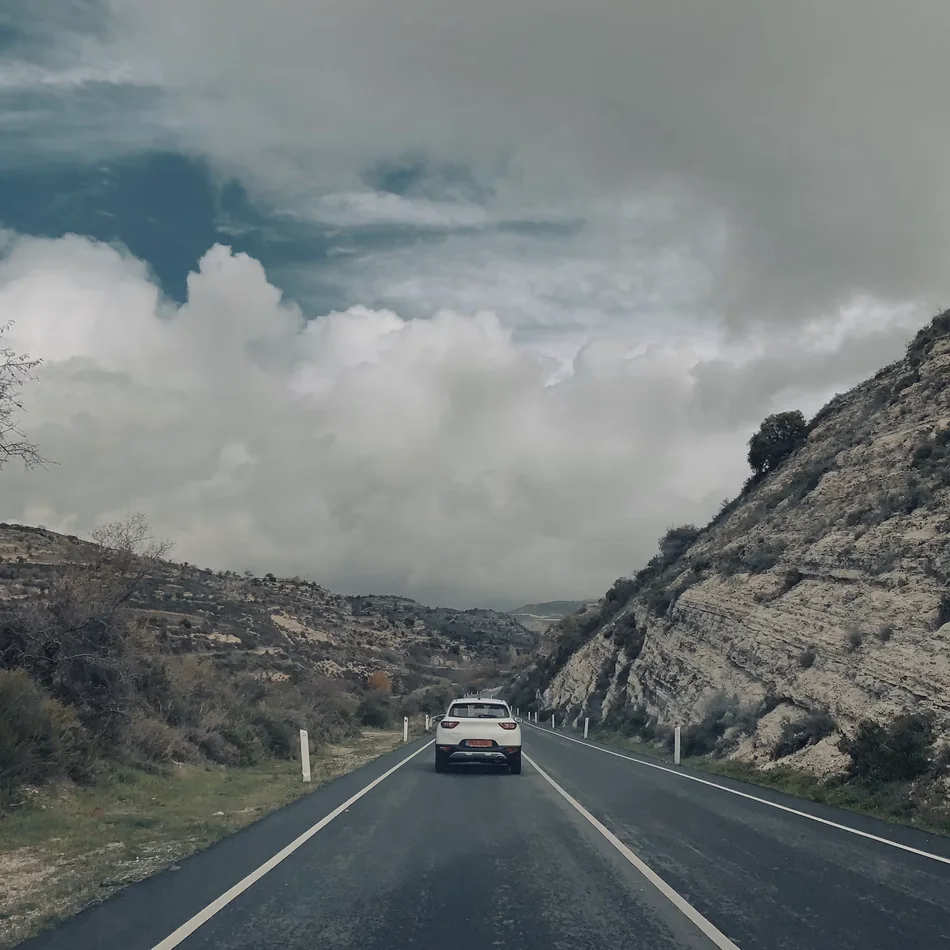
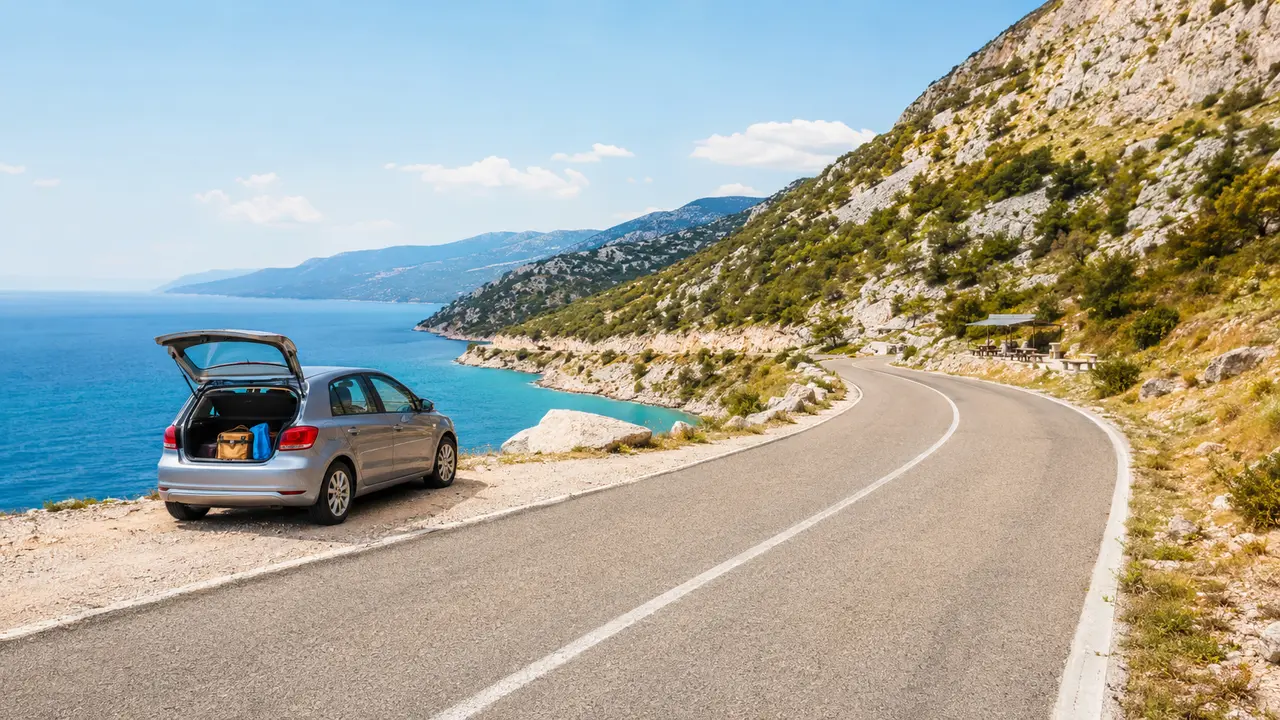
The car does not need to look adventurous
If the road itself matters more than collecting attractions, DriveBeyond’s route-first approach follows the same instinct at a larger European scale: the interesting line, the detour and the freedom to keep moving are the product.
A normal compact or mid-size rental is sufficient in sensible weather if you remain on public paved roads.
Ground clearance helps only when it is attached to a mechanically sound vehicle and a rental agreement that permits the road you want.
The useful priorities are:
- current tyres;
- working lights;
- air conditioning in summer;
- clear insurance;
- roadside assistance;
- a spare-wheel or repair-kit check;
- enough luggage space without leaving everything visible;
- an electronic vignette already included or correctly registered.
Secondary roads can contain potholes, weak markings, slow vehicles and unlit sections. Mountain roads also add rockfall, weather and animals. Current foreign travel advice explicitly warns about poor repair, aggressive driving and rural hazards. Read the current road-safety overview before departure.
Use dipped headlights.
Do not drink and drive.
Do not build remote arrivals after dark merely to prove the car gives freedom.
Freedom is the ability to stop.
Bulgaria uses the euro now
Bulgaria adopted the euro on 1 January 2026.
The fixed conversion rate was €1 to 1.95583 Bulgarian lev, and dual price display remained mandatory through 8 August 2026. By late August, euro is the working currency; old travel guides quoting lev as though nothing changed are already stale. See the European Commission’s current changeover information.
Cards are practical in cities and at larger fuel stations.
Cash remains useful for small rural businesses, minor admissions and the place whose payment terminal has chosen that afternoon to become theoretical.
Do not carry a week’s budget in cash.
Do not assume the smallest stop wants a card.
Both errors are avoidable.
Day six: finish in Plovdiv without letting the Old Town swallow the ending
Plovdiv is the polished release valve.
That is useful after Madzharovo.
The Old Town, Roman theatre and Kapana district justify their popularity.
They do not need to erase the city’s twentieth-century layer.
The Alyosha monument stands on Bunardzhik Hill above Plovdiv. The Soviet soldier was unveiled in 1957 and remains a contested, visible presence over the city.
Walk up for the panorama.
Read the object as part of Bulgaria’s unresolved public memory.
Then decide how much restored old town you actually want.
This is a better ending than adding another remote overnight and returning the rental car through exhaustion.
Plovdiv gives you:
- a reliable hotel;
- a full restaurant choice;
- an evening that can be walked;
- a final monumental viewpoint;
- a straightforward motorway return to Sofia.
Comfort is not a betrayal of an unpolished route.
It is what makes the difficult middle sustainable.

Do not reverse the route automatically
The loop works in either direction.
The default clockwise version — Sofia, Buzludzha, Dimitrovgrad, Eastern Rhodopes, Plovdiv — has one major advantage.
It becomes progressively less organised before returning to comfort.
Reversing it creates a different rhythm:
- polished Plovdiv first;
- remote Madzharovo early;
- socialist city and monuments later;
- Buzludzha as the climax.
That can work if Buzludzha weather is better near the end or accommodation forces the change.
The route is not sacred.
The sequence of reservations is.
Secure the limited night in Madzharovo.
Check museum closing days.
Check mountain weather.
Then decide direction.
Summer and winter are different roadtrips
In late spring and early autumn, the route has its best balance: usable mountain roads, longer daylight and less punishing heat in the south.
In summer, Buzludzha can still be cold and windy while Dimitrovgrad and the Eastern Rhodopes are extremely hot. Start remote days early. Do not leave wildlife viewing for midday.
In winter, this becomes a more serious mountain-drive decision. Buzludzha access, Shipka conditions and remote-road ice must be checked day by day. A route that is technically open can still be a bad leisure drive.
Open Buzludzha festival weekend is another product entirely.
The monument gains music, mapping, crowds and temporary infrastructure.
That may be exactly why you go.
It is not the lonely concrete encounter shown by the rest of the year.
What to remove when you have only five days
Do not compress every stop.
Cut cleanly.
For five days:
- Sofia;
- Buzludzha and Shipka;
- Stara Zagora and Dimitrovgrad;
- Kardzhali and the Stone Mushrooms;
- Plovdiv and return.
Madzharovo is the wrong place for a rushed out-and-back.
Either give the Eastern Rhodopes two nights or accept that the shorter route remains monument-led.
The full seven-day version is stronger because Madzharovo changes the genre.
Who should actually drive this?
This route works for travellers who enjoy:
- contested architecture;
- roads where the transfer still exposes the country;
- post-socialist cities without a heritage makeover;
- strange geology;
- small towns that are not pretending to be destinations;
- landscapes with limited visitor infrastructure;
- a good hotel at the end rather than a backpacker endurance test.
It is weaker for travellers who need:
- a famous attraction every two hours;
- uniform roads;
- nightlife at every overnight;
- luxury accommodation in every stop;
- permission to enter abandoned structures;
- a week built around beach weather.
The road is not cheapness theatre.
Use the better hotel when it exists.
Rent the reliable car.
Pay for the room that prevents a 90-minute detour.
Spend less attention on proving authenticity and more on understanding the place.
The honest verdict
Buzludzha is enough reason to begin.
It is not enough reason to call the result a Bulgaria roadtrip.
The route becomes valuable when the famous flying saucer loses its monopoly.
Shipka puts another national story on the next peak.
Stara Zagora turns memory into a wall of bodies and concrete.
Dimitrovgrad shows ideology functioning as a city rather than decaying as one building.
The Stone Mushrooms replace politics with geology.
Madzharovo combines the remains of mining with the return of vultures.
Plovdiv returns you to comfort without resolving any of it.
This is not Bulgaria’s definitive route.
It is the route for people who suspect the country becomes more interesting after the obvious version runs out.
.jpg?width=1800)
