

The mistake is treating Minsk as either forbidden territory or a Soviet museum. One erases the trip. The other erases the city.
Where it is — and how to get there
Minsk is the capital of Belarus near the centre of the country, far from any EU border city and built at a scale that makes the ceremonial centre only one part of the urban area. The geography is simple; the political and border context around reaching it is not.
Minsk National Airport lies east of the city with road-based bus/taxi transfers. Air routes, land-border availability and visa-free entry rules can change with sanctions and government policy, so this is not a destination where an old transport paragraph should decide the trip. Check current official border rules and your government's travel advice immediately before booking.
Last checked: 5 September 2026. Entry rules, border crossings, transport links and venue status around Belarus can change quickly. Check the rules for your own passport immediately before travel.
Minsk has spent years being described by people who apparently never got farther than an avenue, a statue and the National Library.
Wide streets.
Clean city.
Soviet architecture.
Cheap.
Done.
That description is not completely wrong. It is just insultingly incomplete.
Minsk is a city where the ceremonial centre is enormous enough to intimidate the map, but some of the most useful places are a market hall, a workers’ neighbourhood beside a functioning tractor factory, an overdecorated supermarket cafeteria, a railway-station district that becomes much more interesting after the last metro, and residential streets that were never designed to be photographed by foreign visitors.
The politics around entering Belarus in 2026 are complicated.
The city itself is less mysterious.
It is just poorly explained.
Minsk in 60 seconds
- Yes, some foreign visitors can still enter visa-free in 2026. The exact rule depends on passport and route.
- No, visa-free does not make Belarus a normal European city break. Several governments advise against travel and border/device checks are a real consideration.
- Best first stay: two full days if you want to understand the city rather than photograph it.
- Metro: three lines, cheap, fast and more useful than trying to walk the entire monumental axis.
- Do not build the trip around: “Soviet nostalgia”. Minsk is not a theme park and the Tractor Plant is not an abandoned prop.
- Do not miss: Independence Avenue as an urban system, Komarovka, the Tractor Plant district, Asmaloŭka, the Great Patriotic War Museum if the subject matters, and the National Library if you enjoy arguing with buildings.
- At night: use the dedicated Minsk After Dark guide. The nightlife is large enough and volatile enough to deserve more than five bar names buried here.
- Useful warning: the main National Art Museum building closed for reconstruction in August 2026. A lot of “updated” guides still send you there as if nothing happened.
Can you enter Belarus in 2026?
There is no useful answer called “international travellers can enter Belarus”.
Your passport and your route matter.
Belarus currently maintains a temporary visa-free regime through 31 December 2026 for citizens covered by its 38-country European programme. For many covered passports the limit is 30 days per visit and 90 days per calendar year; Poland, Lithuania and Latvia have specific conditions. Start with the Belarusian State Border Committee rather than an old travel blog.
Current UK guidance, for example, confirms visa-free entry for ordinary British passport holders under the temporary scheme, but also makes an important exception: it does not apply when travelling directly to or from Russia. Current UK entry requirements.
Other passports have different arrangements. Australian travellers, for example, have rules tied to designated airports. US, Canadian, Asian, African and Latin American passports should not borrow a European rule from somebody else’s itinerary.
The useful sequence is boring because immigration mistakes are boring until they happen:
- check the Belarusian rule for your passport;
- check whether that rule applies to the border or airport you intend to use;
- check the travel advice issued by your own government;
- check the crossing again shortly before departure.
Visa-free is an immigration rule.
It is not a guarantee that the journey behaves like Schengen with worse coffee.
Put the risk context in one section. Read it. Then move on.
Several governments currently advise against travel to Belarus, including the UK, Canada and Australia. Check the advice for your own nationality rather than treating one government as universal.
The recurring practical issues are what matter:
- border officials can inspect phones, laptops and luggage;
- political and social-media history connected to Belarus can create problems;
- demonstrations are not spectator events;
- photographing military, security and some official sites can lead to serious consequences;
- Belarus applies drug laws very severely, including to small quantities;
- the Belarus–Ukraine border is not a route to improvise with;
- insurance may be invalid if you travel against official advice;
- dual nationals can have much less consular protection than they expect.
The current FCDO safety page is explicit enough that there is no benefit in rewriting it into softer travel-blog language.
Read it before deciding.
Then, if you are going, do not spend the whole trip behaving as if Minsk is one enormous security checkpoint.
That is another way of not seeing the city.
Getting to Minsk is the awkward part
The easy pre-2020 Baltic itinerary is gone.
Old articles still tell people to take the train from Vilnius as though Europe’s transport map froze in 2019. It did not.
Direct EU–Belarus air links disappeared after 2021. Air access now generally means a connection through a third country, with routes commonly linking Minsk to places such as Istanbul, Dubai, Tbilisi, Baku and Yerevan. The exact best route depends on where you start.
Land crossings have changed repeatedly. Poland, Lithuania and Latvia have each altered access at different moments. Lithuania reopened the Medininkai–Kamenny Log and Šalčininkai–Benjakony road crossings in late 2025, but nobody should interpret a currently open crossing as permanent infrastructure.
If you cross by land, check both countries’ border authorities.
One side being open is not enough.
Minsk National Airport is roughly 40 kilometres from the centre. Buses and minibuses serve the central bus/railway area; ride-hailing and taxis are also available.
The more important question is not how you arrive.
It is how you leave if your original route stops being available.
Have a realistic exit plan before entering the country.
Money: cards are inconsistent, not mythical
Belarus uses the Belarusian rouble — BYN.
Foreign-card advice online is usually useless because it turns personal anecdotes into universal rules.
One traveller says Visa is impossible.
Another says Mastercard worked everywhere.
Both can be true with different issuing banks, terminals and sanctions filters.
Current foreign-government guidance warns that some Belarusian banks and merchants may not accept foreign cards, cash withdrawals can fail and your own bank can block Belarus-related transactions. Current UK money guidance recommends checking with your bank and carrying a lawful cash backup.
Treat card acceptance as unreliable rather than nonexistent.
Carry a second method. Do not assume Apple Pay will rescue every failure. If taking EUR cash, remember EU sanctions contain restrictions on exporting euro banknotes to Belarus with an exception for personal use by travellers and their immediate family; substantial amounts deserve more research than a Reddit comment.
The irony is that ordinary Minsk can still be cheap once you are actually inside it.
Getting the money to behave is the sophisticated part.
Data is easy enough. Roaming is where people get lazy.
Belarus is outside EU roaming rules.
The domestic networks include A1, MTS and life:). Visitors can buy local prepaid SIMs with passport registration at operator shops. Roaming and some international eSIM options may also work, depending on provider.
Do not assume a plan called “Europe” includes Belarus.
Download offline maps and an offline Russian language pack before arrival anyway.
That is not because Minsk is cut off from the internet.
It is because offline maps are most useful exactly when your roaming login, bank card and verification SMS decide to fail together.
Russian is the practical everyday language for most visitor interactions. Belarusian is visible and culturally important, but if you only download one offline translation pack, Russian will solve more immediate problems.
The metro is the part of Minsk that requires almost no imagination
Price reference used in this guide: euro conversions use the official National Bank of the Republic of Belarus rate for 5 September 2026: €1 = 3.5738 BYN. Rounded figures are planning equivalents; card and cash rates differ.
Minsk has three metro lines.
Use them.
The city is far too spread out to turn walking every kilometre of Independence Avenue into a moral achievement.
Since 27 March 2026, a single metro ride costs 1.15 BYN (€0.32). A bus, trolleybus or tram ride bought in advance costs 1.10 BYN (€0.31), and a one-day integrated pass is 5.56 BYN (€1.56). Current 2026 fare summary.
The official Minsk Metro channel states that stations accept passengers from roughly 05:30 to 00:40. Current operating-hours notice.
That last number matters after dark.
By 01:00, the same city becomes a taxi city.
For nightlife logistics, use Minsk After Dark.
For daytime, the metro is simply the thing that lets you stop pretending every useful neighbourhood must be within twenty minutes of Upper Town.
Start at the railway station if you want Minsk to explain itself quickly
The Gates of Minsk opposite the railway station are almost too perfect as an arrival image: symmetrical towers, monumental scale, transport infrastructure, people moving underneath all of it because they have somewhere to be.
Do not photograph the gates, declare Stalinist Minsk understood and leave.
Walk the station district.
Bobruiskaya, Kirova, the underground passages, the commercial spaces around the station and the pedestrian flows towards Independence Square show how monumental architecture survives because ordinary people keep using the spaces underneath it.
This is the part glossy guides skip because there is no clean object to caption.
A railway underpass full of small retail is not “a hidden gem”.
It is infrastructure.
That is why it belongs here.
Minsk gets more convincing when you stop demanding that every useful stop be a sight.
Independence Avenue is an urban endurance test — in a good way
Minsk was devastated during the Second World War and rebuilt at a scale that turns the central axis into something more than a collection of façades.
The usual advice says “walk Independence Avenue”.
That is technically correct and physically annoying.
The avenue runs for kilometres. Use the metro between pieces of it. Walk where the architecture changes. Cross the huge intersections. Look at the shops underneath ceremonial façades. Notice how the same buildings that look like state theatre from across six traffic lanes become supermarkets, cafés, apartments and pharmacies when you get close.
For long stretches, Minsk is the ensemble.
Victory Square is the cleanest place to see the logic.

The obelisk, the traffic circle, the apartment blocks and the metro below all occupy the same space. The memorial is not isolated inside a heritage zone.
People commute through it.
That double use — ceremony and ordinary life occupying the same structure — is more interesting than the usual “impressive Soviet square” sentence.
The Great Patriotic War Museum deserves time, not irony
The Belarusian State Museum of the History of the Great Patriotic War is one of the most important museums in Minsk.
It is also where travel writing becomes lazy in two opposite directions.
One version calls it propaganda and moves on.
The other repeats the museum narrative as politically neutral fact.
Neither does much work.
Belarus suffered catastrophic wartime occupation, mass killing, destruction and civilian loss. That history is real. The current state also places enormous political weight on how victory and memory are presented.
Both things can be true at the same time.
.jpg?width=1400)
The museum is therefore worth reading on two levels:
what happened?
and
how is the story organised now?
The museum’s own website currently lists regular Tuesday–Sunday opening, with Monday closed; check before visiting.
If the subject matters to you, two hours is more realistic than a 45-minute photo stop.
One famous recommendation is currently wrong
The main building of the National Art Museum of Belarus closed for reconstruction after 10 August 2026, with works planned into 2027. Current closure report.
That matters because “updated 2026” articles are already reproducing the old museum list without noticing the door has closed.
This is the useful Minsk rule:
a recent date on a web page is not the same thing as recent research.
The Museum of the History of Minsk operates multiple sites around the city, including City Hall, gallery and archaeological locations, so a closed flagship museum does not mean there is nothing to see indoors.
But do not replace one list item with another just to keep the itinerary full.
Minsk is better outside than many guides allow it to be.
Upper Town is the city behaving nicely for you
Around Svabody Square, Niamiha, the Svislach and Trinity Suburb, Minsk becomes much easier to understand in conventional city-break terms.
Churches.
Lower buildings.
Terraces.
River.
A reconstructed historic frame.

It is pleasant.
It is central.
It is also the section of Minsk most likely to trick you into thinking the city has finally become normal.
Do not call it the “real Minsk” hidden behind Soviet architecture.
That is nonsense.
It is simply the part that requires the least explanation to a visitor.
Use it as a break from the avenues, then leave it again.
Asmaloŭka is what happens when the monumental city suddenly becomes domestic
Behind the Opera Theatre, Asmaloŭka drops the scale fast.
Low-rise 1940s housing, green courtyards, trees, parked cars, domestic windows, people living inside what another city might already have turned into a protected lifestyle district.
There is no single monument to collect.
Good.
A local guide by 34travel still singles the area out because it breaks the false choice between historic Minsk and monumental Minsk.
Asmaloŭka is post-war too.
It just does not shout.
Walk it after the Opera. Twenty or thirty minutes is enough to reset the scale in your head.
Komarovka is more useful than another souvenir shop
Komarovsky Market — Komarovka — is a working food market north of the centre near Plošča Jakuba Kolasa.
Go because cities become easier to read when people are buying normal things.
The indoor market is organised and modern enough to disappoint anyone hoping for staged post-Soviet decay. That is not a problem.
Around Kulman Street, the wider commercial geography gets messier: quick food, kebab, shops, people moving between market, metro, housing and taxis.
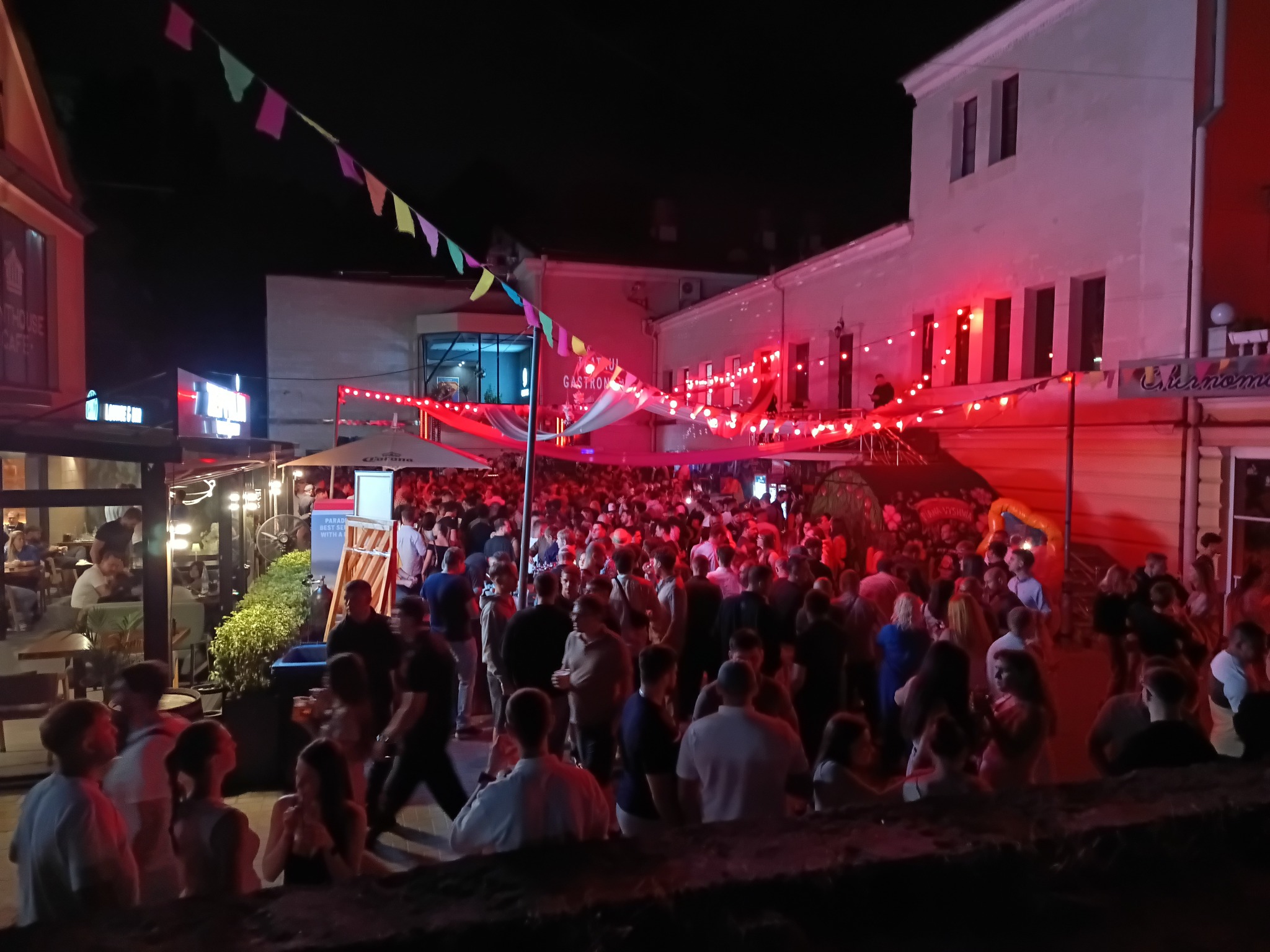
At night, the same wider Komarovka area becomes one of Minsk’s useful late-food zones. The dedicated Minsk After Dark guide gets into the 03:00 shawarma geography instead of pretending dinner ends when the restaurant kitchen does.
The market itself is everyday Minsk.
That is enough.
Centralny is Minsk at its most absurdly ordinary
At Independence Avenue 23, Centralny looks like a supermarket that accidentally inherited a state ballroom.
That is more or less the reason to go.
The first-floor cafeteria occupies a grand Stalinist interior with chandeliers, decorative plaster and high ceilings, while the transaction can still be coffee, pastry and a cheap quick meal.
Current listings still show Centralny operating at the same address. Current Yandex listing.
This contrast is more interesting than a restaurant deliberately decorated to look Soviet.
One is ordinary life using monumental architecture.
The other is a theme.
InstantTraveling will take the supermarket.
The Tractor Plant district is where the city stops caring whether you are impressed
Take the metro east to Traktarny Zavod.
The Minsk Tractor Works is still a functioning industrial manufacturer. Around it, the post-war workers’ settlement built its own residential city: housing, courtyards, services, arches, balconies and formal façades translated down from ministries to ordinary apartments.

This is not an abandoned-factory excursion.
Do not treat it like one.
People live here. People work here. The factory still makes tractors.
That is exactly why the district matters.
Walk around Čabatarova, Kašavoha, Kłumava and Stachanaŭskaja. Do not look for one Instagram coordinate. The useful thing is the consistency of the environment and the fact that almost nobody is selling you an interpretation of it.
The ceremonial centre explains what Minsk wanted to project.
The Tractor Plant district explains how that planning vocabulary was supposed to be lived in.
That is a much better reason to take the metro than another monument at the end of the line.
Kastrychnickaja is more interesting before the night begins
Kastrychnickaja Street became internationally famous for industrial walls, murals, bars and nightlife.
Then English travel writing froze the district somewhere around 2017 and kept recommending the same vanished venues forever.

Walk it in daylight first.
The street makes more sense when you see the industrial geography under the branding: large buildings, yards, working businesses, murals and reused spaces all occupying the same strip.
At night the relevant question is no longer “is Kastrychnickaja cool?”
The question is what event is happening there tonight?
That is why nightlife has been removed from this city guide and expanded into Minsk After Dark, where Modul, ЦЕХ, Proletarijat, Zybitskaya, 375, Re:Public, face control and 04:00 food can be checked properly.
A destination guide should not pretend three cocktail bars equal nightlife research.
The National Library is ridiculous. Go anyway.
The National Library of Belarus is a rhombicuboctahedron.
There is no need to make the sentence funnier.

Opened in 2006, the building sits on the eastern Independence Avenue axis and looks as though somebody tried to turn geometry into a state institution.
It is awkward.
It is shiny.
It is absolutely a Minsk building.
The important part is the scale around it. In a tighter city, the object would overwhelm everything. Minsk gives it enough road, lawn, sky and distance that the building becomes another piece of the city’s long argument for bigger than human.
Check the National Library for current observation-deck access before going.
You do not need to like the building.
You just need to stop pretending dislike makes it irrelevant.
The sleeping districts are not “hidden Minsk”. They are where most cities actually happen.
There is a temptation in alternative travel writing to overcorrect.
The normal guide says “stay in the centre”.
The edgy guide responds by sending everybody to a random housing estate and calling it authentic.
No.
A residential microdistrict on the edge of Minsk does not become a tourist attraction because it has concrete and trolleybuses.
But riding the metro through residential Minsk is still useful because it fixes the scale problem.
The centre is not the city.
The places where people sleep, shop, commute and wait for buses are not obliged to entertain you.
That is precisely why one trip beyond the visitor core can make the visitor core easier to understand.
Go east for the Tractor Plant because there is a reason.
Go to the National Library because there is a reason.
Do not roam housing courtyards looking for poverty, decay or “Soviet vibes”.
That is not curiosity.
It is lazy anthropology with a camera.
Two days: the route that gives Minsk some friction
Day one — the city Minsk wants you to see, plus the bits underneath it
Start at the railway station and the Gates of Minsk.
Walk towards Independence Square, then use the avenue selectively rather than marching the whole thing. Go through the underground passages. Use Centralny as an ordinary stop. Continue towards Victory Square.
Give the Great Patriotic War Museum real time if the subject matters.
Drop through the Svislach and Upper Town when you want the scale to breathe.
Walk Asmaloŭka before dinner.
After dark, stop using this article and switch to Minsk After Dark.
Day two — stop asking the centre to explain everything
Take the metro to Traktarny Zavod in daylight.
Walk the workers’ district without turning it into ruin tourism.
Return towards Komarovka and eat around the market area.
Take the metro east again to the National Library if the building interests you.
If Kastrychnickaja has a real event at night, go because of the event. If it does not, pick a different part of the nightlife map.
The route is deliberately inefficient.
Minsk is large enough that efficiency can make it boring.
What old Minsk guides get wrong in 2026
“Take the train from Vilnius.” The geographic distance is short. The transport system is not the pre-2020 one. If you are combining Minsk with Vilnius, research the border from scratch.
“Visit the National Art Museum.” The main building closed for reconstruction in August 2026.
“Go to Dozari / Madison / Rich Cat because everybody does.” Some famous nightlife names are closed or no longer reliable. The Minsk After Dark guide checks the current circuit instead of recycling old rankings.
“Minsk is a Soviet time capsule.” The post-war layer is enormous. So are contemporary retail, event culture, new construction, ordinary residential life and the fact that a working tractor factory is not a museum exhibit.
“Everything is cheap.” A metro ride is cheap. An indirect journey, insurance problem or failed card can make the trip expensive in ways a menu price does not show.
“Nobody goes there.” Foreign visitors still enter under the current visa-free programme. That does not cancel the risk context. It does mean “empty forbidden city” is another lazy fantasy.
Minsk works better beside Vilnius, Riga and Chișinău than inside a Soviet-capitals list
Vilnius is geographically close and practically in another travel universe in 2026: euro, Schengen, easy cards, short distances, no geopolitical border calculation.
Riga shares some grand urban scale but not Minsk’s post-war coherence.
Chișinău has enough post-Soviet visual vocabulary to tempt bad comparisons while behaving completely differently at street level. The Chișinău After Dark guide makes that difference even clearer.
The point of internal links is not to say these places are versions of one another.
It is to show how quickly that idea collapses.
So: should you visit Minsk in 2026?
The city is worth understanding.
That is not the same thing as saying every traveller should go there now.
Minsk has a genuinely distinctive urban structure, excellent cheap public transport, a centre that operates at an absurd scale, a workers’ district that makes the planning logic tangible, market and station zones that feel much more useful than another souvenir street, and a current nightlife that turned out to be far more alive than old English search results suggest.
The hard part is wrapped around the city: passport, border route, government advice, insurance, payment reliability and personal risk.
Those are not reasons to write a fake normal city-break article.
They are also not reasons to write 3,000 words in which Minsk itself barely appears.
If you go, go informed.
Then stop looking only where the monuments tell you to look.
The polished centre is the front room.
Minsk gets better once you start opening the other doors.
Why there are no Belarus booking links on this page
This guide does not push hotels, flights, tours or attraction bookings in Belarus.
EU sanctions adopted in 2026 prohibit the provision of services directly related to tourism activities in Belarus. Council Regulation (EU) 2026/513 is the relevant legal text.
This page is editorial destination information, not a Belarus tourism sales funnel.