The hourly night bus serves central Tirana; Durrës, Shkodër and other regional routes follow their own timetables.
Where it is — and how to get there
Tirana International Airport (TIA), also called Rinas, lies north-west of Albania's capital, between the Tirana urban area and the routes towards Durrës and the north. It is not a city-centre airport; the onward direction matters.
The official LU-NA bus links the airport with central Tirana behind the Opera and Ballet theatre 24 hours a day, once every full hour; the airport publishes a 30–40-minute journey and 400 ALL (about €4.50) fare. A separate daytime LU-NA service serves Tirana's South and North Bus Terminal. Direct regional shuttles have different, more limited schedules. Check the airport's current bus listing before booking a late connection.
A late flight into Tirana can be a remarkably practical way to start a short trip to Albania. The airport operates around the clock; the capital has a public bus through the night; coastal Durrës is relatively close; and northern Albania is reachable by road without first crossing the city. All of that is genuinely useful.
The airport's transport services connect different destinations on different schedules. The hourly city bus serves central Tirana, a separate shuttle serves the regional bus terminal, and direct routes to Durrës and Shkodër have their own last departures. Allow time after landing for passport control, baggage collection, payment and reaching the correct stop.
This guide is based on the airport's published schedules checked on 21 November 2026, not on a fictional personal arrival. It separates what an operator advertises from what a traveller can prudently promise themselves.
Tirana Airport: location and onward connections
The airport sits at Rinas, north-west of Tirana. Central Tirana lies to the south-east; Durrës and the Adriatic are broadly to the west; Shkodër and the road towards the Albanian Alps are to the north. An hour wasted driving into central Tirana before heading north again is not a particularly rewarding way to begin a mountain trip.
Still, a central Tirana night can be the sensible option after a late arrival. The city has restaurants, cafés, accommodation and a proper social evening. A first night there can be a genuine part of the journey, particularly if the following morning is reserved for Berat, Gjirokastër or another longer transfer. Our Tirana city guide explains what makes the capital worthwhile after the logistics are solved.
The crucial distinction is between the route that exists and the route that connects to your flight. Published bus times are point-to-point departures; they do not guarantee that immigration, baggage collection, payment, waiting and the final hotel journey will fit neatly between the lines on a timetable.
The 24-hour LU-NA bus to central Tirana
The airport's official bus page describes a LU-NA service between Rinas and central Tirana operating 24 hours a day, seven days a week, with departures every full hour in each direction. It gives 30–40 minutes as the journey time and lists the fare as 400 ALL (about €4.50).
That is a useful 2026 operating fact, and it changes the economics of flying late. An arrival after midnight does not automatically imply paying for a private car. But do not translate “24/7” into “a bus is waiting whenever the terminal doors open.” If you reach the stop shortly after a departure, the scheduled wait could approach one hour. Traffic, operations and holiday changes add uncertainty. The official timetable is the authority for the day you travel.
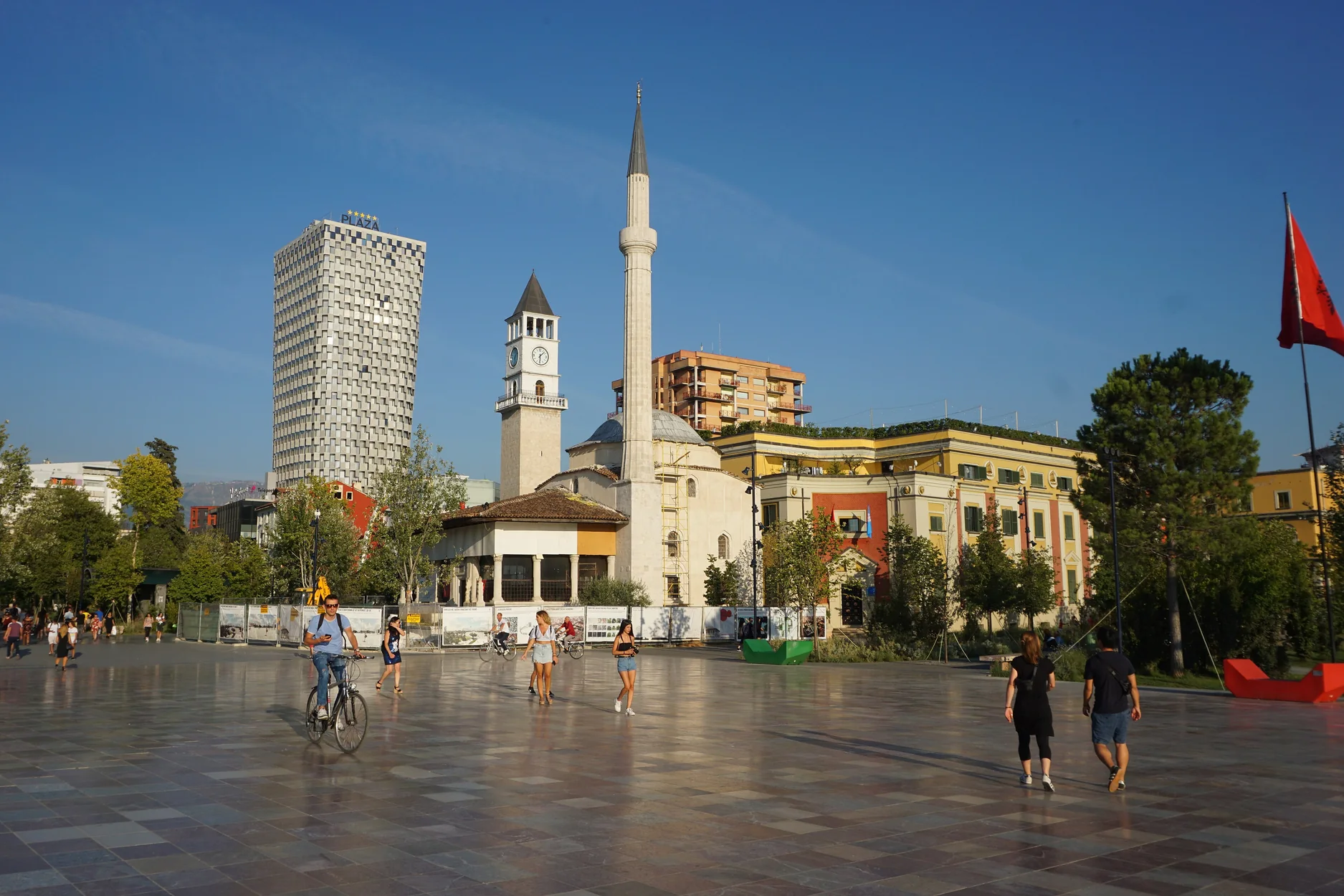
In Tirana the bus is described as parking behind the Palace of Opera and Ballet, close to Skanderbeg Square. That is a central landmark, not a blanket promise that every central hotel is a comfortable walk. Look at your accommodation's exact street, the slope, the street lighting, luggage and the hour before choosing to walk the final leg.
The operator's own LU-NA booking site is an additional place to check the current stop and ticket process. Do not rely on an old travel-blog photograph of a bus stop; arrivals infrastructure and pick-up points can change.

Two LU-NA routes, two different clocks
The airport also lists a second LU-NA route between Rinas and the South and North Bus Terminal, the regional hub used for services elsewhere in Albania. This is important for people continuing to Shkodër, Berat, Sarandë and other places rather than staying in Tirana.
The airport's published schedule is different from the city service: airport to terminal 08:00–18:00, and terminal to airport 07:00–18:00, with hourly departures and an approximately 20–30-minute ride. The listed fare is 300 ALL (about €3.50). Those are daytime hours.
A traveller arriving at 01:30 who sees “airport bus 24/7” and imagines a direct connection to a 07:00 intercity departure is combining two services that do not share the same schedule. The overnight city bus is not the daytime bus to the out-of-town regional terminal.
This matters because the South and North terminal and the central airport-bus stop are not interchangeable. They sit in different parts of the urban transport geography. Reaching one does not put you on the platform of the other. Before building an onward itinerary, use the official eTransport timetable platform to identify the actual origin of the next leg, not merely “Tirana” as a city label.
Durrës: direct bus fares and the final 23:00 departure
Durrës is one of the easiest coastal extensions from the airport, a working port city and seaside destination west of Tirana. The airport's direct Durrës listing publishes daily airport-to-Durrës departures at 08:30, 10:00, 12:00, 14:00, 15:30, 17:00, 19:00, 21:00 and 23:00, with a fare of 600 ALL (about €6). Those were the published times on 21 November 2026, not a guarantee for a particular flight.
The distinction between a 21:30 landing and a 22:50 landing is therefore enormous. With only cabin baggage and a smooth arrival, a traveller on the former flight may have a realistic path to the 23:00 bus. Someone whose aircraft touches down at 22:50 should not book a non-refundable late bus on the assumption they can leave the aircraft, cross the terminal and board in ten minutes.
If the last direct bus has gone, a pre-booked road transfer may be the rational solution, especially for two or more passengers sharing its cost. Another valid option is to spend a night in Tirana and continue the next day. The wrong comparison is “€6 bus versus €40 taxi” without accounting for whether the €6 bus actually exists at the moment you are ready to leave.

Durrës itself also needs a more precise accommodation choice than “near the sea.” The waterfront, city centre and long Plazh hotel zone are not one small, perfectly walkable strip. A drop-off described merely as “Durrës” may leave another transfer to your hotel. Check the final stop, the hotel's actual map location and the late check-in procedure rather than assuming a coastal address is automatically convenient.
Shkodër: the mountain trip begins with an earlier last bus
Shkodër is the gateway to many northern Albania trips, including routes towards Theth and the Albanian Alps. It is also a substantial city worth a night, with cafés, photography, a historic centre, lake access and evenings that make sense independently of mountain transport. Our Shkodër guide develops that city rather than treating it as a bus interchange.
The official airport listing names Hermes Airport for direct Rinas–Shkodër buses and publishes 11:15, 12:45, 17:30 and 20:10 departures from the airport. The listed one-way fare is 1,000 ALL (about €10–11).
That 20:10 service can be valuable for an early-evening flight. It is not a late-night connection. After it, a traveller who must be in Shkodër that night needs a road transfer, accommodation close to the airport, or a more deliberate first night elsewhere.
The operator's own website should be checked against the airport listing before paying. Seasonal revisions, departure-point changes and the exact booked vehicle need verifying. Do not solve a missed scheduled bus by asking an unofficial driver at the terminal to improvise a long-distance fare without agreeing the total beforehand.
The next morning matters too. Theth and other mountain destinations have their own transfers, sometimes subject to season and road conditions. Arriving exhausted at Shkodër after midnight does not make a dawn mountain departure pleasant or reliable. A Shkodër overnight with a proper dinner and a rested start often turns that logistical compromise into a better trip.
Fier and Vlorë: direct routes and their departure schedules
The airport also advertises regional shuttles to Fier and Vlorë. Its November 2026 page publishes 1,000 ALL (about €10–11) for Fier and 1,200 ALL (about €12–13) for Vlorë. It shows a limited set of departures, some unusually late or early, and is not evidence of an all-night bus network across southern Albania.
In particular, the airport lists a 00:45 Rinas–Vlorë departure and a 01:00 Rinas–Fier departure. Those times look attractive for late flights, but they demand care. A departure listed at “24:45” on an operator's page should be confirmed as a service on the calendar day you intend, not interpreted carelessly as an additional departure before midnight.
If an onward connection matters, ask the operator how it treats a delayed arriving flight and how long before the departure passengers must be at the meeting point. The airport's printed schedule is a starting point; it is not an integrated air-to-bus guarantee.
A long drive to Vlorë immediately after a late flight may be reasonable if the first morning is important. It may also consume money and sleep with little benefit if your actual destination is farther south and you have not yet organised the next leg. Choose where the first night's accommodation should be, then choose the transfer. A map arrow alone cannot answer that.
What about taxis after midnight?
A taxi is neither automatically a rip-off nor automatically the best choice. Its strength is that it takes you to the actual hotel, rather than to a bus stop whose final walk and check-in still need sorting. For a late arrival, several people with luggage, a hotel far from the bus stop, or a time-critical onward departure, that door-to-door element has a real value.
If you are considering collecting a car at the airport instead of taking a transfer, the Albania rental-car guide explains late-counter charges, credit-card deposits and insurance exclusions before you commit to driving through the night.
The airport links to its official taxi service. Before agreeing to a car, obtain a total fare in writing for the exact address, date and hour, including baggage, late-night charges and any toll. “Tirana” and “Durrës” are not sufficiently precise destinations for a quote. Do not accept a price based on an unspecified hotel zone and argue about the last kilometre at 02:00.
A taxi price advertised by a blog six months earlier is not a source of truth. Demand a current quote from the provider you will actually use. If a vehicle is ordered online, check whether the booking is a guaranteed pickup, a request subject to confirmation, or a metered city ride. Those are three different products.
There is a commercial alternative, too: arrange a transfer through the hotel you have already selected. Hotels do not universally offer the cheapest prices, but they can provide a clear driver identity and a destination-specific arrival process. A traveller alone late at night may value that clarity more than shaving a few euros off an uncertain offer.
A 00:30 landing: three plans that work differently
Consider a hypothetical flight scheduled to touch down at 00:30. It is only a planning example, not a claim about a real route.
Plan A — central Tirana: clear the airport, find the LU-NA city-bus point, catch the next hourly service and walk or take a short final ride to a hotel with confirmed late check-in. The published bus fare is 400 ALL (about €4.50). The actual time you reach bed depends mostly on getting out of the airport and the hourly departure cycle.
Plan B — Durrës: the airport's published direct bus finishes at 23:00, so a 00:30 landing cannot use that timetable. Compare a fixed-price road transfer directly to the precise Durrës hotel with an overnight in central Tirana. Include hotel and time costs, not just the transport fare.
Plan C — Shkodër: the listed last direct airport shuttle is 20:10. The robust choices are a prearranged transfer or a first night at Rinas/Tirana followed by daytime movement. If you are going to Theth, the value of sleeping rather than immediately covering every possible kilometre is greater still.

These three answers differ despite the same aircraft and the same airport. That is why an airport transfer guide should never stop at a city-centre bus price and call Albania solved.
Luggage, payments, late check-in and travelling alone
The airline fare and the airport transfer are different problems. A traveller with checked luggage should leave more margin than someone holding a small cabin bag. It is possible for a perfectly punctual aircraft to produce an awkward onward transfer if luggage delivery is slow. A transport ticket bought for an exact departure may not be forgiving.
Carry a payment method that works without depending on a single mobile wallet, plus a modest amount of local cash where practical. The official bus price is published in lek and euro equivalents are approximate. Ask the operator whether card payment, euro cash or lek is accepted for the actual service; do not infer payment policy from a fare table.
For an accommodation booking, confirm late check-in in writing, especially if an apartment uses self-check-in codes or a small guesthouse closes its front desk. A cheap hotel is not cheap if it does not admit the guest at 02:30. Verify the check-in cut-off before deciding to travel across the country at night.
For women travelling alone, the most useful distinction is not a sweeping judgement that Albania is safe or unsafe. It is whether the final segment is known: a confirmed public-bus stop, a walk you can assess on a map, a licensed transfer whose driver and pickup point are identifiable, and accommodation that will open its door. The same practical clarity helps anyone arriving tired.
A useful first-night budget
The public-transport component can be modest. A central-Tirana arrival using the official city bus is 400 ALL (about €4.50) before the final walk or taxi. The daytime terminal shuttle is 300 ALL (about €3.50), but it is not the same product and is unavailable overnight. The direct airport–Durrës bus is 600 ALL (about €6) when its scheduled departure exists; the direct airport–Shkodër shuttle is 1,000 ALL (about €10–11) on its limited timetable.
These are published operator fares, checked 21 November 2026, not generic trip estimates. Accommodation prices and private-transfer quotations vary materially by date, luggage, location and party size; making up a “typical hotel” figure would add a false sense of precision. Price the actual first-night options side by side before booking.
A rational comparison has three columns: flight-arrival-to-hotel time, total cost for the people actually travelling, and how much of the following morning remains usable. The lowest advertised vehicle price often loses once those three are considered together.
The booking decision before you click pay
Save the airport's current bus page, the eTransport schedule site and the exact hotel address. For a regional shuttle, also check the named operator; for the city service, confirm LU-NA's stop and ticket conditions. If any of them disagree, ask the operator rather than choosing the version with the most convenient departure.
Then choose one of two honest plans: get to the city you are actually spending the night in, or sleep near the gateway and continue with a fresh morning. Tirana's overnight bus makes both kinds of trip more flexible. The separate clocks of Albania's regional routes are what determine the rest.

The attraction of Albania is that a cheap flight can open a varied country: Tirana's cafés, Shkodër's streets, Durrës by the sea, Vlorë and the mountains beyond. The correct first transfer lets you enjoy those places instead of treating arrival as a race against a timetable that was never designed around your flight.