Between Pristina's cafés and Skopje's bazaar lies a short road with an international border.
Where it is — and how to get there
Pristina is Kosovo's inland capital, roughly 90 km north of Skopje, the capital of North Macedonia. The main road corridor runs south through Kaçanik and Hani i Elezit, crosses the border at Blace, then approaches Skopje along the northern edge of its urban basin.
Scheduled buses connect Pristina's bus station with Skopje's intercity terminal in around two hours on published timetables, but the frontier can add an unpredictable delay. The standard road crossing is Hani i Elezit–Blace. There is no practical direct passenger train to treat as a substitute; a rental car needs advance approval and valid cross-border insurance.
The road from Pristina to Skopje runs roughly 90 kilometres through southern Kosovo, across the international frontier at Hani i Elezit–Blace and into North Macedonia's capital.
At the northern end, Pristina's contemporary institutions, busy cafés, residential districts and cultural spaces offer a varied city visit. At the southern end, Skopje's Vardar riverfront, older bazaar, Debar Maalo restaurants and monumental squares create a different set of streets to explore.
The scheduled bus connection is short, but the stations, border procedures and onward hotel transfer deserve attention. Time in both capitals allows their neighbourhoods, food and evenings to come into focus.
This guide draws on documented transport and city sources without claiming a personal journey.
The road through southern Kosovo
Pristina and Skopje are close together in distance, but both are working capitals rather than compact theme parks. Political history is unusually visible in their streets. Kosovo declared independence in 2008 and has a young national institutional landscape; North Macedonia's political and ethnic relationships have a different history, and Skopje's built environment carries both earthquake reconstruction and the huge Skopje 2014 makeover.
A traveller who simply posts NEWBORN, a photo of Skopje's statues and a border-passport stamp has seen three symbols without learning much about where people actually spend their day.
There are other differences that a short map cannot show. Pristina's cafés and independent cultural spaces sit among ongoing residential development, university life and institutions of a young state. Skopje offers a radically different set of contrasts: a revived neoclassical-looking centre, socialist modernism and an older Ottoman commercial district with strong Albanian cultural presence.
The bus makes the pairing accessible; it should not encourage you to flatten two complex cities into one afternoon.
The practical answer: take the bus, but leave room for the border
For most independent travellers without a car, the direct bus is the rational choice.
The Gjirafa Travel route listing checked on 13 November 2026 displayed around nine daily departures, with fares €8.50–€10 one-way and scheduled journeys of roughly 1 hour 55 minutes to 2 hours over about 92 km. It listed departures from Prishtina Station to Skopje Station, not door-to-door hotel transfers.
That is a useful planning snapshot, not a service guarantee. The day, operator, public holiday and border queue may change the result. Leave a buffer before an onward flight or long-distance connection.
Buying a ticket online can be helpful, but check where to board, whether you need to show a QR code or printed ticket and whether the operator has changed its loading bay.
The terminal matters more than the kilometres
Pristina's long-distance bus station is away from the prettiest part of the central pedestrian area. Reach it deliberately. A short local cab ride or sensible public transport connection may be easier with baggage than an optimistic walk based on straight-line distance.
Skopje's principal bus terminal is beside the railway complex east of the central visitor core. Arrival is not the same as standing in Macedonia Square. Decide whether your accommodation is within a comfortable walk before leaving the station.
The simple mistake is to interpret “two-hour bus” as “leave one hotel and enter the next in exactly two hours”. Add packing, checkout, getting to the terminal, boarding, the border, getting from the arrival terminal and check-in. A half-day travel block is the honest unit.
What you actually pass on the road south
The main route does not simply teleport from one capital to another. Leaving Pristina, the road runs through southern Kosovo past Ferizaj/Uroševac, the area around Kaçanik, and the narrowing valley towards Hani i Elezit. Mountains and transport corridors become more apparent as you move south.
The border crossing at Hani i Elezit–Blace is an international frontier, with separate document control for the states. If you're using a regular coach, the driver and border officials decide whether passengers stay seated or need to present documents at a window.
You do not need to turn every bus stop into a historical lecture, but the corridor matters. A city-to-city journey here connects regions with Albanian- and Macedonian-speaking communities, goods traffic and a very real economic relationship. It is not a blank line between tourist attractions.
If you want to visit Tetovo or spend time in the Šar Mountains, that is a different itinerary requiring actual transport research. Tetovo is not a spontaneous ten-minute diversion from the main capital-to-capital coach route.
Hani i Elezit–Blace: what the crossing actually involves
The principal route goes south from Pristina past Kaçanik and Hani i Elezit, then crosses into North Macedonia at Hani i Elezit–Blace.
Passengers need the entry documents accepted by both authorities. On a bus, keep your passport or other permitted document accessible, not buried in checked luggage, and follow the driver's instructions at each control. Do not assume every passenger follows the same formalities: nationality and travel document can change the requirements.
The scheduled two-hour journey includes a route that crosses a border; it does not guarantee a two-hour journey during holiday traffic or extra checks.
A little patience here is not part of the city's 'authentic charm'. It is ordinary international travel, and it should be built into the schedule.
For document rules, consult official advice for Kosovo and North Macedonia for your passport nationality.
Why the Kosovo–Serbia problem is not the same trip
There is a genuinely important border complication elsewhere in many Balkans itineraries. Serbia does not recognise crossings from Kosovo as international entry points.
According to current UK Kosovo entry guidance, travellers arriving in Kosovo from somewhere other than Serbia may be refused direct entry from Kosovo into Serbia without an earlier valid Serbian entry stamp. Kosovo → North Macedonia is an ordinary international border route, not that same direct-Serbia scenario.
This matters if you are planning Pristina → Skopje → Belgrade, or if you want to enter Serbia later by another frontier. The routing logic, entry stamps and your nationality can change what is possible. Plan the entire trip before assuming a short bus hop makes all political complications irrelevant.
The issue is not an excuse to frighten readers away from Pristina. It is a specific practical trap that most glossy city-break lists do not explain.
Should you rent a car for ninety kilometres?
Usually not for this particular city-to-city transfer.
A rental car gives freedom for detours, but only when the rental company explicitly allows Kosovo and North Macedonia, the contract covers border travel, and insurance is valid on both sides. Generic European 'green card' assumptions are not enough: Kosovo often requires special insurance arrangements, and terms vary by provider.
A detailed 2026 cross-border rental guide from a regional operator illustrates these paperwork questions, but its price examples are commercial claims, not official border rules. Verify terms in writing with the company you actually rent from.
If you are mainly staying in the two capitals, the car becomes something to park and pay for. If you want extra stops in the Šar Mountains, Tetovo or rural Kosovo, a car may be more useful. Decide based on the wider route, not the 90-km connection alone.
Pristina's neighbourhoods: Ulpiana is not the pedestrian boulevard
Mother Teresa Boulevard is a useful public meeting axis, but a first visit should not stop there. South of the centre, Ulpiana and Dardania are residential-commercial districts whose cafés, apartments and public spaces describe everyday Pristina rather than a curated old town.
A World Bank analysis of Pristina's neighbourhoods distinguishes the more open spaces in Ulpiana and Dardania from the denser central historic fabric. That difference is visible in how the city feels on foot.
Pejton/Lakrishte and surrounding central areas show another layer: contemporary hospitality, office and residential buildings mixed with a café-and-bar culture. Sunny Hill, known internationally through the association with Dua Lipa's festival, is not necessarily the best hotel location for a visitor who wants to walk between dinner and late bars.
The EU in Kosovo neighbourhood guide gives a practical starting point for comparing locations. It is much more useful to know whether a hotel lies in the social corridor you will use than to label every non-tourist district 'authentic'.
Books, coffee, nightlife and the institutions of a young capital
Pristina's social life is not a one-dimensional backpacker pub crawl. Soma Book Station, associated with the Pejton area, combines the cultural book-and-café world with an evening social space. Dit' e Nat' is another reference for people who want to sit over coffee and encounter a different creative crowd. Neither should be presented as a guaranteed live concert or a space where strangers automatically become friends.
For louder nights, venues and event spaces change. An August 2026 directory based on current official profiles lists places such as Gate Club, Posht', Zone Club and Zanzi Jazz Bar. The existence of those listings does not guarantee an event on your chosen night. Check the actual artist, door policy and latest social channels.
Pristina also has an active cultural and LGBTQ+ scene whose events take place across different spaces, not necessarily in a fixed district. An example of actual cultural infrastructure: in February 2026, UNDP documented the transformation of an old civil-defence shelter in Ulpiana into an art centre. This is a far more revealing piece of contemporary city life than the claim that Pristina has 'nothing to see'.
The best practical advice is to choose an actual event and a central base, then leave enough time for the city before sunset.
Pristina: neighbourhoods and contemporary public spaces
Pristina's most telling public spaces include Mother Teresa Boulevard, the NEWBORN installation and the extraordinary-looking National Library. Much of the city's centre has been rebuilt, modified, crowded and argued over. Visitors searching for a coherent medieval old town may conclude there is none.
That is an unhelpful test. The capital is about contemporary Kosovo, commerce, university life, cafés, politics and a strong sense of the present. Its restaurants and pedestrian routes can be lively without looking like an easily packaged postcard.

The NEWBORN installation is a good starting point because its appearance and meaning have changed. It is not a permanent static monument that tells you everything in one glance.

The ordinary boulevard is just as valuable for understanding the city. Spend enough time to see people use it, but look beyond the central pedestrian zone. For neighbourhoods, lodging decisions and transport, use our full Pristina city guide.
Skopje 2014 is not just 'fake statues': it was a political urban project
One reaction to Skopje's monumental centre is amusement. The buildings look extravagant, and some facades look far older than the materials beneath them. But the more interesting issue is why an entire capital's historical image was deliberately re-engineered.
The Skopje 2014 initiative was controversial not merely because of taste but because of cost, national symbolism, transparency and its effect on public space. BIRN's detailed investigation traced the project to more than €560 million in public expenditure in its reporting. Different subsequent studies have produced different cumulative estimates; it would be careless to present any single number as a final universal total.
The city was also devastated by the 1963 earthquake. Reconstruction, modernist planning and later nationalist monumental projects sit in tension with each other. An academic overview of Skopje's rebuilding documents the earthquake's role in the city's physical identity.
The Stone Bridge links more than two tourist photo settings. It connects the new-looking monumental square to an older working commercial district with its own communities and historical depth. Walking both sides without immediately ranking one 'fake' and the other 'real' is the beginning of understanding Skopje.
Skopje: a centre that was intentionally made to look older
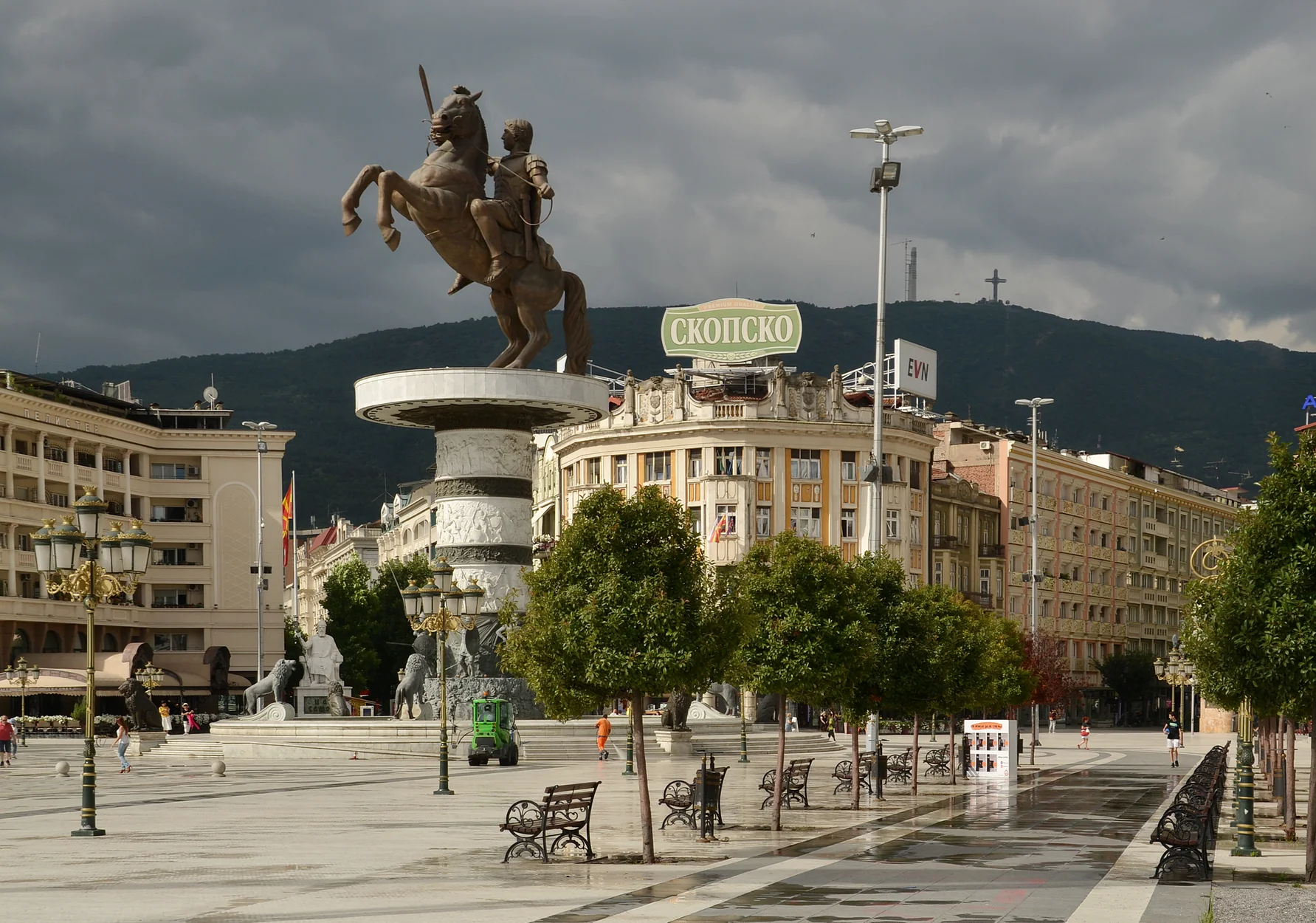
Skopje's central monumental architecture often produces the opposite first impression: visitors see large statues, dramatic facades and a theatrical riverfront and conclude the city must always have looked this way.
It did not. Much of the central monumental makeover reflects the controversial Skopje 2014 project. The city also carries the physical and cultural consequences of the 1963 earthquake, socialist-era rebuilding, and its Albanian and Macedonian urban communities.
The Stone Bridge crosses the Vardar between Macedonia Square and the older bazaar side. Walking over it is a short distance and a much larger shift in the city's atmosphere.

Do not reduce the Old Bazaar to a scenic 'authentic' counterweight to the 'fake' main square. It is a lived commercial area with cafés, shops, food and religious buildings, and the city's identities are not captured by one simple river division.
Our full Skopje guide explains the architecture without stopping at ridicule.
Debar Maalo, kafanas and an evening in Skopje
Many Skopje travellers leave their evening to chance after photographing Macedonia Square. A more useful plan is to walk west to Debar Maalo, a neighbourhood of cafés, restaurants and kafanas — traditional taverns built around substantial meals, company and sometimes live music.
The streets around Orce Nikolov have a different atmosphere from the giant central statues. This is where you can spend hours over dinner without pretending that all nightlife has to become a dancefloor. A 2026 city nightlife guide describes the difference between Debar Maalo, central cocktail terraces and the Old Bazaar after dark.
Try tavče gravče (beans baked in a clay dish), ajvar (roasted pepper spread), shopska salad and grilled kebapi. The North Macedonian tourism authority's Skopje guide describes the bazaar's grilled-food tradition and tavče gravče. These are concrete food choices, unlike the generic advice to 'sample Balkan cuisine'.
The Old Bazaar contains cafés, bakeries, shops, religious buildings and some late bars; it is not a uniform nightclub strip and certain traditional places do not serve alcohol. Skopje's social experience changes by block, time and season. That is an important distinction for a solo traveller seeking dinner and conversation rather than a prescribed alternative-music scene.
Two capitals, two evenings
Pristina's evening culture often centres on restaurants, cafés and specific current music venues. The social atmosphere around central streets can be energetic, but late-night activity does not spread evenly through every block. The Pristina After Dark guide explains why the visible centre can mislead visitors about where the actual night continues.
Skopje has its own set of mainstream bars, restaurants, music programming and dancing options, spread across different areas and affected by the day and season. The Old Bazaar is one part of the story, not necessarily where every late-night plan should end. Use a current event programme instead of an old list of clubs.
Neither city requires that you be a backpacker, a clubber or an alternative-music enthusiast to enjoy an evening. If you want dinner and a drink, both can work. If you want a specific sort of dancing, verify the night's event before you book around it.
The second question is always how to get home. Choose a central base or arrange a trustworthy ride rather than treating a long unfamiliar late-night walk as a compulsory part of 'unpolished travel'.

Choosing a hotel is about the second half of the day
If your stay in Pristina is mainly a bus connection, proximity to the bus station is practical. But if you want cafés, restaurants and evening walks, the central area, Pejton or suitable parts of Ulpiana may suit better. A cheap apartment far uphill can be a poor bargain after dark.
In Skopje, staying around the centre or Debar Maalo can allow a dinner and bar evening on foot. A hotel on the other side of the city may have a lower price but create repeated taxi dependence. Don't assume all Old Bazaar addresses are equally quiet or suitable for a late check-in.
The important comparison is not simply 'best hotel in each capital'. It is what you actually want to do on the night you arrive and how you will return. Both cities have residential areas where people continue their lives, not an open-ended entertainment grid.
For exact accommodation prices, compare current refundable and nonrefundable rates for the same dates, room type and services. One offer priced in euros and another in denars can look deceptively different before conversion, taxes and payment fees.
Two currencies, one short road
Kosovo uses the euro, so bus fares and local prices in Pristina are easy to read for euro-area travellers.
North Macedonia uses the denar (MKD). At the 13 November 2026 central-bank reference rate, €1 was approximately 61.5 MKD. A hypothetical local price of 300 MKD (about €4.90) or 600 MKD (about €9.75) illustrates the conversion; these are not claims about the current cost of a particular beer, meal or attraction.
Bank exchange rates, card margins and cash withdrawal fees differ. Check a venue's dated menu rather than reusing arbitrary historical 'average Skopje prices'.
The most useful verified cost on this route is the €8.50–€10 intercity bus fare on the schedules checked above. Accommodation varies substantially by location, weekend, booking lead time and demand.
More useful than a generic Balkan budget
A single inexpensive bus fare can mislead travellers into thinking the rest of the trip will cost almost nothing. Lodging, late-night rides, the number of restaurants you use and day trips drive actual spending much more than the border coach ticket.
Kosovo uses the euro, while North Macedonia uses Macedonian denars. Using a planning rate of about 61.5 MKD to €1, a 250–400 MKD order (roughly €4.05–€6.50) illustrates the price band for certain bazaar grilled-food portions quoted in an October 2026 Skopje visitor guide. This is an attributed dated example, not a uniform price in every restaurant.
If you go out late, consider a legitimate taxi or app fare part of the budget, not an unexpected failure. Similarly, a guided day trip is not 'cheap' just because the capital has relatively inexpensive buses.
A night that includes an independently chosen restaurant, a properly booked venue and a safe return can be worthwhile. A contrived daily-budget figure is not a substitute for making those choices.
A four-night two-capital route that allows a real visit
Night one — Pristina: Arrive, get oriented and eat near your accommodation. Do not start with a late transit across town if you have travelled all day.
Day two and night two — Pristina: Visit the National Library area, NEWBORN, Mother Teresa Boulevard and other neighbourhoods, leaving the evening free for a restaurant or an event you have actually checked.
Day three — the crossing: Take a bus at a realistic hour, add a border buffer and check into Skopje before exploring the Vardar, the bridge and nearby streets. This can be a pleasant afternoon instead of a stressed transfer.
Day four and night four — Skopje: Spend time in the Old Bazaar, understand the centre's reconstruction, and choose a different neighbourhood or Matka outing if logistics allow. Keep enough margin for a proper evening.
If you only have three nights, one of the capitals will get a shorter visit. That is acceptable, but make it an explicit choice.
A short road with a full itinerary
The Pristina–Skopje connection is a practical way to visit two capitals in a wider Balkan journey. Neighbourhood cafés, cultural venues, market streets and unhurried dinners can become the substance of the trip.
Plan the bus and border documents first. Then give Pristina and Skopje an evening each, with accommodation close to the places where you want to spend your time.
Ninety kilometres is a manageable distance, with plenty of contemporary Balkan city life at either end.