Wrocław rewards the second walk: the one that crosses a bridge and keeps going.
Where it is — and how to get there
Wrocław is the main city of Lower Silesia in south-western Poland, built across branches and islands of the Oder/Odra. Germany and Czechia are both relatively close, while Kraków and Warsaw sit much farther east, which helps explain why the city's history and architecture do not feel like a smaller version of either.
Wrocław Airport lies west of the city with public bus and taxi connections into the centre. The main railway station, Wrocław Główny, is the stronger gateway for many Polish and Central European routes and sits just south of the historic core. A car is unnecessary in the centre and more useful for Lower Silesian day trips.
Wrocław makes an excellent first impression.
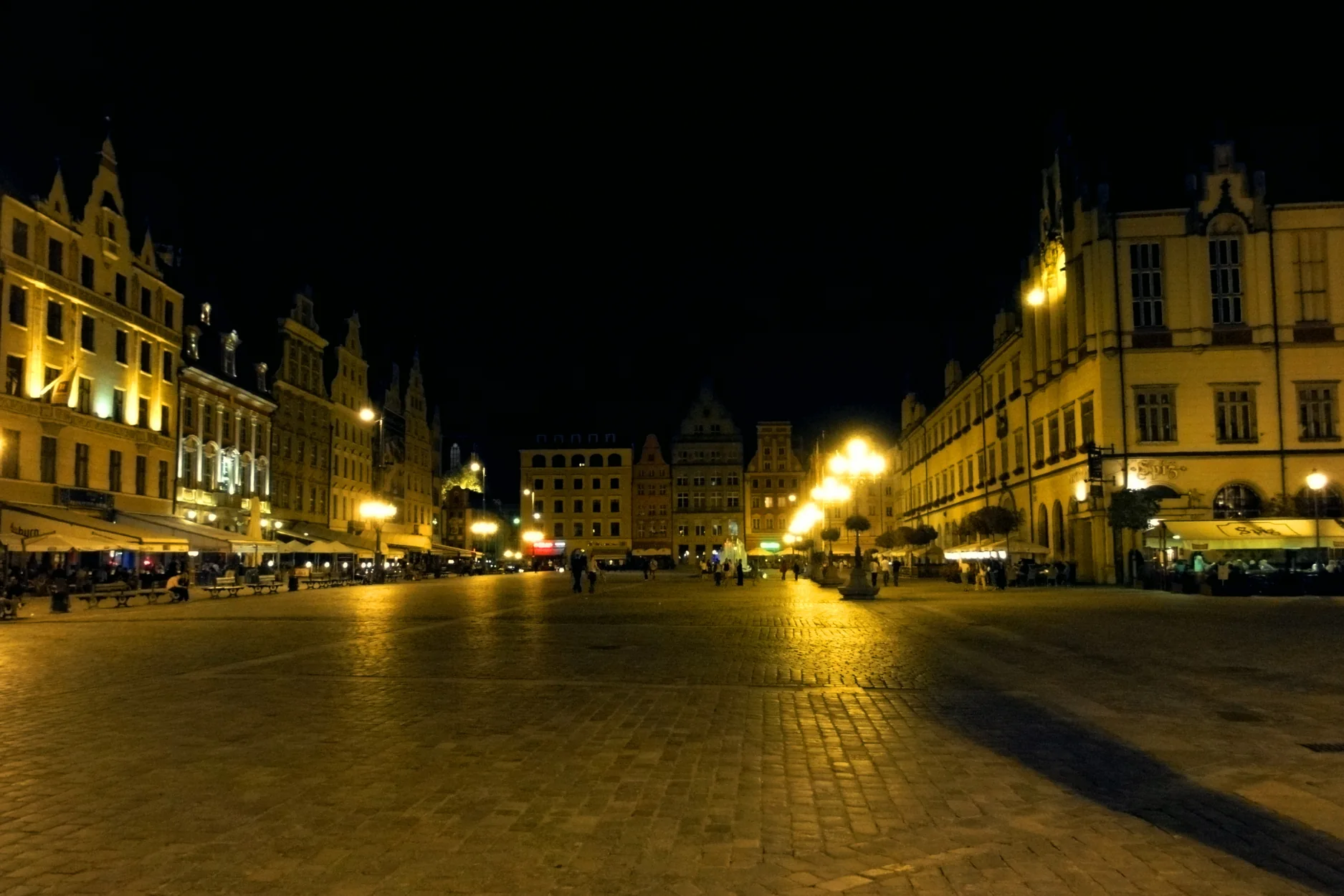
The Market Square is large, colourful and easy to understand. The Gothic Town Hall looks important without needing an explanation. Restaurant terraces occupy the edges, church towers close the view and small bronze dwarfs encourage visitors to behave as though urban history can be collected one ankle-high statue at a time.
It is an attractive centre.
It is also the least interesting possible summary of the city.
Wrocław works because the postcard version is surrounded by a more complicated place: a former German city rebuilt as a Polish one, a river capital divided by islands and bridges, a university city with enough daily life to resist becoming a historical display, and a regional base that can lead towards castles, mountains and towns across Lower Silesia.
It is not “Kraków, but cheaper”.
That is exactly why it may be the right choice.
Begin at Rynek and keep exploring
Wrocław’s Market Square has been the commercial and civic centre of the city since the Middle Ages.
It is where almost every visit starts, and there is no useful reason to avoid it merely because everyone else starts there too.
Walk around the Town Hall. Continue into Plac Solny. Look at the façades closely enough to notice that they do not belong to one neat architectural period. The centre was severely damaged during the final months of the Second World War and reconstructed afterwards.
That matters.
Wrocław does not offer an untouched medieval city. It offers a city that chose which pieces of its past to rebuild, which identities to emphasise and how much discontinuity visitors would be allowed to see.
The result is convincing enough that it is easy to stop asking questions.
Do not stop yet.
The history behind Wrocław's changing borders
Before 1945, the city was Breslau, a major German city with earlier Bohemian, Habsburg and Prussian chapters.
After the Second World War, borders shifted west. Most of the German population left or was expelled, while many new Polish residents arrived from territories that had become part of the Soviet Union, including Lviv and other eastern cities.
This is not background detail added to make the guide sound serious.
It explains why Wrocław’s identity can feel unusually constructed and unusually open at the same time.
The post-war population had to learn the city, rename it and decide how to relate to buildings created by people who were no longer there. The city’s current confidence is relatively recent.
For a more direct account of that transformation, the Zajezdnia History Centre uses a former bus depot to explain post-war Wrocław, the population changes and the city’s role in the Solidarity movement.
It provides more useful context than another hour spent locating dwarfs.
The Oder's islands and bridges

Wrocław is organised around the Oder rather than beside it.
Channels, islands, embankments and bridges repeatedly interrupt the street plan. The river is not a scenic edge added to the city. It is one of the reasons the city feels different depending on the direction of the walk.
From the Market Square, head through the university district towards the river. Continue across the islands towards Ostrów Tumski.
The name means Cathedral Island, although it is no longer technically an island. It remains Wrocław’s oldest historical and religious cluster, with the cathedral, churches, former ecclesiastical buildings and cobbled streets occupying a calmer part of the centre.
The famous lamplighter still lights the gas lamps manually in the evening.
That is picturesque.
It is also an activity performed in front of a growing crowd of people trying to photograph a man doing his job. Watch it when the timing works. Do not construct the entire evening around following him.
Ostrów Tumski is better used as part of a longer river walk than as a self-contained attraction.
Cross the footbridges. Sit beside the water. Continue towards the Market Hall or return through the university quarter.
The pleasure comes from how the pieces connect.
The Four Denominations District is useful before and after dark
South-west of the Market Square, the Four Denominations District contains a Catholic church, an Orthodox church, a Lutheran church and the White Stork Synagogue within a compact group of streets.
The district is sometimes promoted as a polished symbol of tolerance.
The actual appeal is more practical.
Włodkowica and Świętego Antoniego contain restaurants, bars, courtyards and places that continue to function after the main sightseeing day ends. The area connects naturally with Ruska Street and the former passageways around the western edge of the centre.
At Ruska 46, historic neon signs illuminate a courtyard shared by cultural organisations, workspaces and Recepcja, a bar that makes the site more than a photograph.
Visit the courtyard after dark.
Then decide whether to stay.
The dedicated Wrocław after-dark guide explains how this area connects to the Market Square, Pasaż Niepolda and the event-led clubs outside the obvious walking route.
The neon is not a contractual obligation to enjoy the bar.
Nadodrze: workshops, streets and murals

North of the river, Nadodrze appears frequently in contemporary Wrocław guides as the artistic district.
There are murals, workshops, renovated courtyards and small businesses. There are also ordinary apartment streets, uneven restoration and residents who did not move there to improve a visitor’s neighbourhood portfolio.
That is why it is worth walking.
Use the official mural and courtyard routes as orientation, but do not treat every painted wall as a major destination. Nadodrze works as a continuation of the city beyond the formal centre, especially when combined with the river, the university area or a meal away from the Market Square.
It is not a compulsory expedition in search of authenticity.
Some streets are attractive.
Some are not.
Both belong to Wrocław.
Centennial Hall and early modern architecture
The Centennial Hall sits east of the centre beside Szczytnicki Park, the zoo, the Four Domes Pavilion and the Japanese Garden.
Designed by Max Berg and built between 1911 and 1913, the hall was a major early achievement in reinforced-concrete construction and is now a UNESCO World Heritage Site.
It is large, severe and more important architecturally than almost anything around the Market Square.
It can also be closed or partly inaccessible when an event is taking place.
Check the programme rather than assuming the interior is permanently available for inspection.
The surrounding area still justifies the tram ride. The Four Domes Pavilion houses contemporary art. The park gives the city room to breathe. The multimedia fountain operates seasonally, although watching water respond to music is not essential to understanding Lower Silesia.
Several worthwhile places sit close together here.
That is the reason to go.
Hydropolis: water and an unexpected museum
A museum about water can sound like a building created for school trips that accidentally admits adults.
Hydropolis is more useful than that.
It occupies a converted nineteenth-century water reservoir and combines urban infrastructure, environmental systems, engineering and multimedia displays. It is especially effective when the weather has made another long outdoor walk unattractive.
The exhibition is modern and accessible without pretending that every screen represents a cultural revelation.
Allow roughly two hours.
Do not add it merely to increase the attraction count.
Wrocław's dwarfs and the story behind them
Wrocław’s bronze dwarfs began as a reference to the Orange Alternative, an anti-communist protest movement that used absurdity and dwarf imagery during the 1980s.
The first figures carried a political connection.
The later population became tourism, branding, private commissions and a city-wide collecting exercise.
There are now enough of them that deliberately searching for every one can reorganise an otherwise sensible trip around pavement furniture.
Notice them.
Let children collect them.
Photograph the ones that are genuinely funny.
Do not spend half a day proving that a map was accurate.
A cultural day that makes the river useful

Start around Ostrów Tumski early enough to walk the smaller streets before visitors concentrate around the cathedral. Continue via the river paths and bridges toward the National Museum and the Panorama of the Battle of Racławice. The latter is a huge painted panorama presented as an immersive circular encounter; it is not simply another gallery of historical canvases. The attraction is worthwhile for its presentation even if the military subject is not your usual interest.
Ticket planning can make the museum day unusually economical. The National Museum in Wrocław says a ticket for the Racławice Panorama includes one admission to permanent exhibitions at the National Museum, Ethnographic Museum and Four Domes Pavilion within three months. It is not a licence to enter every temporary exhibition, so read the exact conditions. The museum also lists free permanent-entry days: Saturday at the National and Ethnographic Museums, Tuesday at the Four Domes Pavilion. If you have just one cultural half-day, choose based on what you want to see rather than on a pass that you will not fully use.
At ul. Wystawowa 1, the Four Domes Pavilion near the Centennial Hall presents twentieth-century and contemporary art in an architectural setting that feels entirely different from the medieval centre. The museum's visitor details list regular permanent-collection admission of 20 PLN (roughly €5). The hours change between summer and winter, and the October–March schedule is already in effect from 1 October. It is a valuable reason to take a tram away from the centre, particularly when the Old Town feels visually repetitive.
The eastward afternoon: Centennial Hall, a park and ordinary city life

Hala Stulecia / Centennial Hall is an engineering landmark, not another reconstructed medieval symbol. The surrounding Szczytnicki Park and the Japanese Garden area change the pace of a city break: tree-lined paths, water, residential neighbourhood edges, students and families rather than a nonstop sequence of monuments. Visit the hall and park as one route, with time for an actual rest, especially in warm months.
You can combine this outing with the Four Domes Pavilion and then ride back into the centre. That is a complete half-day or longer depending on museum time, not a quick detour from the Market Square. If rain intervenes, Hydropolis, the water-focused knowledge centre at Na Grobli, is another substantial indoor stop. The operator currently advises allowing around two hours and gives opening hours and transport directions, including nearby tram stops. Buy a timed slot where required instead of assuming immediate walk-in entry.
Wrocław's river setting is particularly enjoyable in late spring and early autumn. In high summer, consider morning walks and museum time in the heat; in winter, the route is shorter and more atmospheric than green. The city's character changes more across the seasons than the bright square-centred imagery suggests.
After dark in a real Silesian city
The Four Denominations District is one natural place for dinner and a later drink: compact, sociable and close to the centre without simply duplicating the most tourist-facing stretches of Rynek. Nadodrze provides a different mix of workshops, cafés, residential streets and smaller cultural spaces; it is better visited as a neighbourhood with a changing programme than a guaranteed nightlife strip.
Look up an exhibition opening, film, gig or performance before choosing the evening destination. Wrocław's student population creates plenty of energy, but event calendars matter. For a meal, explore Silesian and Polish staples alongside contemporary restaurants; the city is larger and more cosmopolitan than a pierogi-and-beer stereotype.
Two nights can cover the centre, river and one district. Three nights let you go out to the Centennial Hall and contemporary art without converting the entire break into tram transfers. That is the more satisfying Wrocław: the river, the postwar history and the present-day cultural city sharing a weekend.
Where to stay
Around the Market Square
This is the simplest option for a first visit.
Most central sights, restaurants and bars are walkable. The trade-off is noise, tourist pricing and accommodation entrances that may sit above active restaurants or late bars.
Check recent comments about street noise rather than relying on “central location” as an automatic advantage.
Four Denominations District
Włodkowica, Świętego Antoniego and the streets towards Ruska provide a better balance when restaurants and evenings matter.
You remain close to the Market Square without sleeping directly on it.
Some streets are still lively late at night. Choose the exact building, not only the neighbourhood label.
Near the main railway station
The station area is practical for an early departure, a short stay or a wider Polish rail trip.
The restored station itself is impressive. The surrounding roads and commercial buildings are less atmospheric, but the centre remains walkable and tram connections are strong.
This is an operational choice, not a romantic one.
Nadodrze
Nadodrze can work for a longer or repeat visit when a residential setting matters more than immediate access to the main attractions.
Accommodation quality varies between renovated buildings and older structures. Check the entrance, lift and room photographs carefully.
“Historic tenement” can describe both character and stairs.
You probably do not need a car
Central Wrocław is walkable and the tram network reaches Centennial Hall, the zoo, Nadodrze and most districts a visitor is likely to use.
From the airport, daytime buses 106 and 129 and night bus 206 connect towards the city, with line 106 continuing to the main railway-station area.
A car becomes useful when Wrocław is the base for Lower Silesia rather than the entire trip.
That wider region can include Książ Castle, the wooden and half-timbered towns, the Churches of Peace, mountain areas around Kłodzko and the complicated industrial and border landscapes towards Czechia and Germany.
The Black Triangle road trip takes that last idea farther west through Czechia, Germany and Poland. It is a separate route, not a Wrocław day trip.
Inside central Wrocław, the car mainly requires somewhere to be left.
Collect it when leaving.
How long Wrocław needs
Two full days are enough for the central city.
That means enough—not complete.
One day can combine the Market Square, university district, river islands and Ostrów Tumski.
The second can take in Centennial Hall, one museum and the western or northern neighbourhoods.
Three or four nights allow Wrocław to become a base rather than a sequence. They also make room for the evenings, longer meals and the possibility that the river is more enjoyable than whatever was scheduled after it.
Stay longer when the pace works.
Leave earlier when the city has made its point.
There is no civic reward for exhausting the destination.
Using the city well
Wrocław works for travellers who like attractive cities without requiring every hour to feel historically important.
It suits people who enjoy walking, riverfronts, varied architecture, long meals and trips that can expand into a wider region.
It works well as a first Polish city, but even better as the city chosen after deciding that Kraków’s greater fame is not automatically useful.
Wrocław may disappoint visitors seeking a single monumental story, a perfectly preserved old centre or an itinerary dominated by internationally famous museums.
Wrocław's appeal spreads beyond its attractive main square. Branches of the Oder connect islands and bridges, nearby neighbourhoods offer different rhythms, and the city's layered history gives its colourful architecture more depth. Spend time beyond Rynek to see those contrasts.
Wrocław becomes more convincing once the colourful centre is allowed to stop representing everything.
Hero photograph: Marek Śliwecki – Wrocław Town Hall at night (CC BY-SA 4.0); displayed with a layout crop.
Additional photographic credits: Fred Romero – Tumski Bridge over the Oder River toward Ostrów Tumski in Wrocław (CC BY 2.0); Andrzej Otrębski – Large public mural on a building in the Nadodrze district of Wrocław (CC BY-SA 4.0); Olgierd Rudak – Four Domes Pavilion contemporary art museum in Wrocław, April 2026.jpg) (CC BY-SA 4.0); Olgierd Rudak – Hydropolis exhibition and water-knowledge centre in Wrocław%202.jpg) (CC0 1.0). Images displayed with possible layout crops.