Sarajevo's valley brings historic streets, contemporary neighbourhoods, mountains and memorable food into one remarkable city break.
Where it is — and how to get there
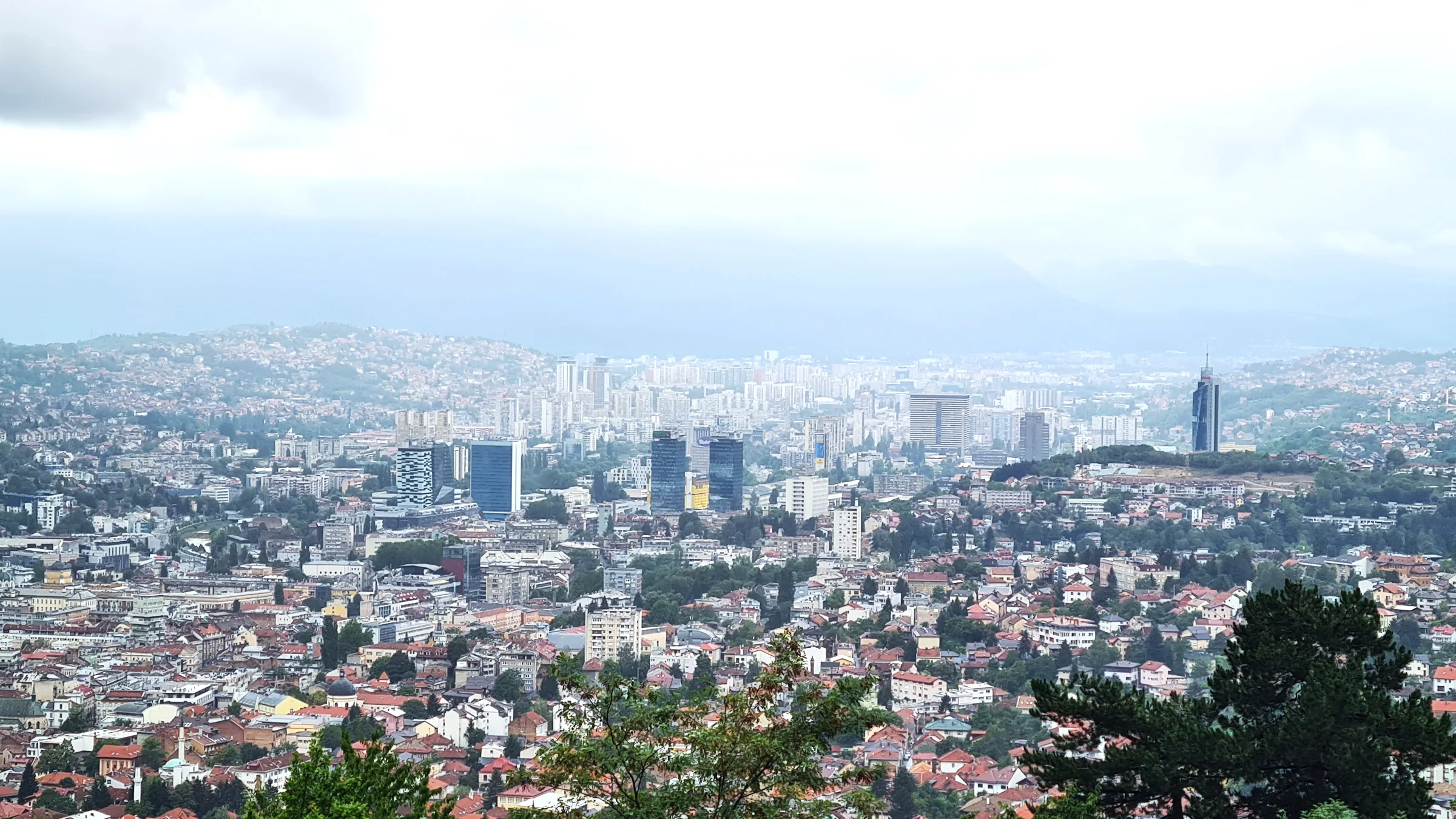
Sarajevo is the capital of Bosnia and Herzegovina, stretched east–west through a narrow valley along the Miljacka and enclosed by mountains. Baščaršija sits at the eastern end of the urban line; the airport and newer residential districts are farther west, which makes the city's shape unusually easy to read once you see it on a map.
Sarajevo International Airport lies south-west of the centre with bus/taxi transfers into the city. Intercity buses carry much of the regional traffic; rail is particularly useful on the scenic route towards Mostar and Herzegovina. Drivers arriving from Serbia, Croatia or Montenegro should budget mountain-road and border time rather than trusting kilometre counts alone.
Sarajevo is a rewarding city to explore on foot, especially when you follow the Miljacka from Baščaršija through the shopping and administrative centre towards the wider residential districts. Ottoman lanes, Austro-Hungarian façades, Yugoslav buildings and cafés occupy a narrow valley beneath wooded hills. The city is approachable for a short break, yet a longer stay makes room for its museums, food, cable car and everyday street life.
The 1914 assassination and the 1992–95 siege are fundamental to understanding Sarajevo. The museums and memorials deserve serious time and context. So do the city’s bakeries, neighbourhood football culture, tram lines, ordinary shopping streets and evenings out. A good itinerary lets these different experiences sit beside one another rather than making every café or building into an illustration of the same historical tragedy.
Follow the Miljacka to understand Sarajevo's shape
Sarajevo extends along a narrow east–west valley rather than around one symmetrical historical centre. Start at Baščaršija, follow Ferhadija through the pedestrian shopping district, then continue towards Marijin Dvor, Grbavica and the residential areas towards Ilidža. This geography also explains why a tram ride can reveal a great deal of the city's growth.
The hills climb steeply from the river, shaping both daily transport and the history of the siege. They also offer some of the city's most memorable views. For a first day, stay in the walkable eastern and central corridor; for a second, choose a neighbourhood or mountain excursion that makes use of the valley's wider geography.
Baščaršija's shops, squares and bazaar lanes
Baščaršija remains an active commercial area as well as Sarajevo's most familiar visitor quarter. Bakers, craft workshops, food counters, religious buildings, restaurants and souvenir shops share narrow streets, and the atmosphere changes as shutters open, tour groups arrive and evening tables fill.

Start around Sebilj and continue to Kazandžiluk, traditionally associated with coppersmiths. The city's visitor guide to streets and squares provides useful orientation. Gazi Husrev-beg Mosque is another important landmark, and a respectful visit may fit well into a walk focused on the district's commercial and religious history.
The bazaar is worth enjoying even when it is busy with visitors. Arriving early gives you a different impression from returning after dinner, and the combination helps explain how this old part of the city continues to function.
Eat ćevapi, burek and something beyond the expected menu
Sarajevo is a very good city for a straightforward meal. Ćevapi are grilled minced-meat fingers commonly served with flatbread and onion; burek and other filled pastries are easy options when you want to keep exploring. Traditional aščinica kitchens serve cooked dishes, while contemporary restaurants offer a wider range of Bosnian and international food.
A real menu is more helpful than an unsupported promise that meals here are always cheap. At Bulevar Ćevabdžinica, the published examples used in this guide are 13 BAM (€6.65) for ten ćevapi and 8 BAM (€4.09) for five. These are examples from one business rather than a citywide price guarantee. If you want cooked dishes, Aščinica is another place to research before choosing a meal.
It is enjoyable to compare different grill counters, but food need not become a competitive checklist. A good pastry, a bowl of stew or a leisurely dinner in an ordinary neighbourhood restaurant can be just as memorable as the most famous ćevapi address.
Bosnian coffee, from the traditional service to modern cafés
A traditional Bosnian coffee service is worth trying, particularly if you enjoy taking time at a table. Dibek in Baščaršija offers a deliberately atmospheric setting for coffee, tea and hookah, while other parts of the city serve espresso, cappuccino and everyday café drinks without an elaborate ritual.
For a dated comparison, the published Del Gusto menu lists espresso at 3 BAM (€1.53) and Bosnian coffee at 5.50 BAM (€2.81). The setting is different from a traditional kafana, so these prices illustrate choice rather than setting a universal price. Check the current menu if the amount matters to your budget.
One of Sarajevo's pleasures is how easily a pause at a café becomes a substantial part of the afternoon. Choose a table with a view of a street you enjoy, not only the one said to represent the entire city's identity.
The changing streets between Ottoman and Austro-Hungarian Sarajevo
Near Ferhadija, the Sarajevo Meeting of Cultures marker draws attention to the shift between the older bazaar streets and the more formal buildings of the Austro-Hungarian period. The contrast is visible in street width, façades and commercial spaces; it is a useful way to introduce the city's changing administration and architectural styles.

Continue past the Eternal Flame towards Marijin Dvor, where Yugoslav-era institutions and newer buildings add further layers. The city was shaped through different periods of rule, migration, planning and conflict. A longer walk communicates those changes more clearly than a slogan about East meeting West.
The Latin Bridge and the events of 1914
The Latin Bridge is a modest river crossing with enormous historical significance. The assassination of Archduke Franz Ferdinand and Sophie took place nearby on 28 June 1914, becoming one of the immediate triggers of the First World War. Seeing the location makes a familiar school-history event surprisingly tangible.
The nearby Museum of Sarajevo 1878–1918 helps place the event within the Austro-Hungarian period. The source prices used here are 5 BAM (€2.56) for admission and 20 BAM (€10.23) for a combined ticket covering the five Sarajevo Museum annexes; confirm current arrangements at the museum.
The bridge can be appreciated as part of a wider riverside walk. The experience becomes richer when you have time for the surrounding streets and a museum rather than treating one place as a complete explanation of 1914.
Museums for the history of Sarajevo and Bosnia
The War Childhood Museum offers a deeply personal view of childhood during conflict through objects and short testimonies. Its careful presentation can be emotionally demanding, and it is worth allowing time afterwards rather than moving immediately to the next memorial.
The History Museum of Bosnia and Herzegovina provides a wider institutional perspective; the published information cited by the original guide listed daily opening 09:00–19:00 and adult admission at 10 BAM (€5.11). Check current hours and rates, particularly around holidays. The National Museum explores much more than twentieth-century conflict, including archaeology, natural history and Bosnia's cultural heritage.
Each has a different purpose. Choose two museums you genuinely want to understand, give them proper time, and leave space for a change of atmosphere between difficult exhibitions.
Tunnel of Hope: planning a separate visit
The Tunnel of Hope is near the airport in Butmir, away from the compact city-centre museum route. During the siege, the tunnel provided a crucial connection between besieged Sarajevo and territory beyond the airport area, allowing the movement of people, supplies and equipment.
The published visitor prices in this guide are 20 BAM (€10.23) for regular admission, 8 BAM (€4.09) for students and 3 BAM (€1.53) for an audio guide. The museum has stated that it does not accept cards or foreign currency, so bring Bosnian convertible marks and verify the current payment policy in advance.
Treat the museum as a meaningful part of a day, including the journey to and from Butmir. It is too important to squeeze into the last half-hour of sightseeing because it appears close to the airport on a small map.
Sarajevo's hills, the siege and today's viewpoints
Sarajevo's surrounding hills are beautiful places from which to see the valley, but they also explain much of the geography of the siege. From Yellow Fortress and Vratnik, the relationship between the dense urban corridor and the elevated terrain becomes much easier to appreciate.

Enjoy the view and pay attention to the residential streets on the way up. These neighbourhoods contain houses, schools, small businesses and ordinary routines as well as important history. An afternoon walk with a café stop can give the viewpoint a different rhythm from a historical tour.
Take the Trebević cable car into the mountains
Mount Trebević rises directly above the city, with the Trebević Cable Car offering access from the urban area. The timetable cited by the original guide was 12:00–21:00 on Monday and 09:00–21:00 on other days, with published visitor prices 15 BAM (€7.67) one way and 20 BAM (€10.23) return. Verify the current schedule and fares because weather, maintenance and season can change service.

The ride turns a busy valley into a panorama, and the upper area offers walking paths, trees and mountain air. The former Olympic bobsleigh track is a popular historical stop, but wear appropriate shoes and remain on established accessible routes. Trebević deserves a few hours in suitable weather and is also a useful reminder that the landscape is one of Sarajevo's main attractions.
Marijin Dvor and the wider central city
Marijin Dvor combines administrative buildings, museums, shopping, hotels and busy traffic. It illustrates another phase of Sarajevo's development, less concentrated on old bazaars and more on the civic institutions and housing of a modern capital.
The National Museum and History Museum are close enough to connect with a walk through the district. The former Holiday Inn, closely associated with foreign journalists during the siege, is now an operating hotel. Continue west to see how residential and commercial areas stretch along the valley and why the tram becomes increasingly useful.
Grbavica: neighbourhood streets and football culture
Grbavica, south of the Miljacka, was directly affected by the war and division of Sarajevo. Today it is also a lived-in area of apartments, cafés, schools, shops and the stadium of FK Željezničar, which anchors a long-running local football culture.
A visit here suits someone interested in how the wider city functions beyond the old centre. Choose a café, look for a match or walk through the neighbourhood as part of a route west. Its history matters, but so does the way residents use it today.
Everyday encounters and Sarajevo's direct service style
In Sarajevo, hospitality can be relaxed and straightforward rather than elaborately performative. A waiter may be brief while a café is busy, a hotel employee may give concise directions and a shopkeeper may become talkative once a conversation starts. These ordinary encounters vary from person to person and have little to do with a travel guide's generalisation about national character.
A greeting, a clear request and patience work well. Enjoy conversations when they develop naturally, and allow workers and residents the same freedom to be busy, reserved or friendly that you would expect in any other city.
Sarajevo after dark: cafés, pubs and different nights
Baščaršija remains lively beyond daytime shopping hours, while Ferhadija, Skenderija and the streets towards Marijin Dvor have their own bars, restaurants and nightlife options. A traditional music evening, a modern pub, a commercial club or one slow drink are all reasonable ways to enjoy the capital.
For a solo woman or man, the useful questions are where the venue is, what its programme is and how easy it will be to return to the hotel. A centrally located bar can be pleasant without promising new friends at every table, while a special concert elsewhere may be worth arranging transport for. Check the actual event rather than relying on a generic label like 'Sarajevo party district'.
Tram, buses and the geography of getting around
The tram follows the east–west shape of Sarajevo's valley and is particularly useful when going from the old centre towards Marijin Dvor and the residential districts. Trolleybuses, buses and minibuses connect other parts of the city, including routes that require more planning.
Ticket formats and validation rules differ, so buy the correct ticket for your service, validate paper tickets when necessary and verify transfers instead of assuming one ticket works across every operator. Walking is attractive around Baščaršija and Ferhadija; public transport earns its place once you move farther west or uphill. For a late-night journey, a recognised taxi may be more practical than trying to make an uncertain connection.
Cash, cards and the convertible mark
Bosnia and Herzegovina uses the convertible mark (BAM), fixed to the euro at €1 = 1.95583 BAM. Dividing a BAM price roughly by two is a practical mental estimate when checking restaurant, museum and transport costs.
Cards are increasingly common in larger hotels, shops and restaurants, but cash remains useful at smaller cafés, food counters, transport ticket points and some museums. The Tunnel of Hope has specifically stated that it requires cash in BAM. Carry a modest supply of local currency rather than assuming a business will accept euro banknotes.
Winter air pollution and mountain weather
Sarajevo's valley has a serious seasonal challenge: in winter, temperature inversions can trap pollution beneath the surrounding hills. Beautiful snowy views can coincide with unhealthy air, reduced visibility and uncomfortable outdoor conditions for children, older people and travellers with respiratory sensitivities.

Check current air-quality readings when planning a winter trip and again during the visit. Adapt walks if pollution is high; the view from Trebević may be clearer than the valley below, but the mountain excursion does not eliminate exposure while you are staying in town. Late spring and early autumn generally provide more comfortable conditions for a walking-focused city break.
Street safety and mountain mine-risk areas
Central Sarajevo is usually approachable for visitors, especially on main routes and busy streets. Use ordinary city precautions with phones, wallets and bags in crowded markets, public transport and busy events. Choose your late return in advance if staying uphill or outside the central corridor.
The more unusual hazard appears on some rural or abandoned terrain outside established city routes. Landmines and unexploded ordnance remain in parts of Bosnia and Herzegovina, so stay on marked paths, established roads and officially accessible recreation areas. A derelict structure or an apparent shortcut in the hills is not a reason to leave a recognised route. These precautions allow you to enjoy the city and mountains while taking a specific, well-documented risk seriously.
Where to stay in Sarajevo
Baščaršija is a fine base for someone who wants historic streets, food counters and cafés immediately outside the door. Check the gradient and luggage access because even a beautifully located guesthouse can involve steep stairs or uneven approaches. Evening noise also depends on the exact address.
The Ferhadija pedestrian area is convenient for a first stay, with easy walking connections to Baščaršija, the river and museums. Marijin Dvor suits visitors planning museum visits, tram travel or a more contemporary urban setting; see its map location. For a residential atmosphere, look at Grbavica, comparing the approach to transport and your evening plans. Hotels and apartments are easier to evaluate by their specific street and return route than by neighbourhood slogans.
For a stay shaped by restaurants, bars and the walk home, the Sarajevo neighbourhood-and-nightlife hotel guide compares Ferhadija, Baščaršija, Centar and Marijin Dvor in more detail.
A city-and-mountain day that fits the geography
Begin with Baščaršija, the Latin Bridge and a long walk towards Marijin Dvor. Spend time in the museum that most interests you, then choose either an afternoon in the neighbourhoods or a mountain excursion rather than assuming you can do every major attraction at once.
The Sarajevo visitor-information website and the cable-car operator help with current practical planning. Weather can change the usefulness of Trebević, particularly in winter, so a flexible schedule is more valuable than a detailed itinerary that depends on clear skies.
Visiting difficult historical places with care
The Tunnel of Hope, War Childhood Museum and other exhibitions describe experiences that deserve attention and sufficient context. Choose a manageable number of historical sites, read carefully and allow time for reflection or a different activity afterwards.
Sarajevo residents have varied personal and family histories, and a traveller will not discover a single tidy conclusion by spending an afternoon at memorials. Respect homes and private spaces when taking photographs, and let a museum's documented testimony guide your understanding rather than approaching neighbourhoods in search of visible damage.
Food, evening streets and a good winter plan
Food and social life make a Sarajevo visit enjoyable in every season. A morning pastry in Baščaršija can lead into museum time and an afternoon walk; later, you might choose a traditional grill, contemporary restaurant or music event closer to your hotel.
Winter deserves a different rhythm. When air-quality readings are poor, shift more time indoors and choose venues and museums that suit your interests. In milder seasons, the long river-and-neighbourhood walks and the cable car can occupy much more of the trip.
How many nights work best?
Two full days allow an introduction to Baščaršija, the Latin Bridge and a museum, followed by a wider urban walk or a trip up Trebević. Three or four nights are preferable if you want multiple museums, a relaxed food itinerary, the Tunnel of Hope and time outside the most visited streets.
Sarajevo can also start a longer journey. To the southeast, Tjentište and Sutjeska offer a very different mountain and memorial landscape; a route towards Nikšić takes you into inland Montenegro. Allow realistic mountain driving and border time when extending the trip.
Build the visit around architecture, history or everyday life
Architecture fans will enjoy the transition from Baščaršija through Austro-Hungarian and Yugoslav Sarajevo. Travellers drawn to recent history can plan meaningful museum visits and a separate Tunnel of Hope excursion. Anyone who loves urban life, food and walking will find a lot to appreciate along the river and in the neighbourhoods beyond the old centre.
The city's atmosphere changes from a bazaar morning to a museum afternoon or an evening café, while a cable-car ride reveals the wider mountain setting. You do not have to choose one version of Sarajevo to understand it; those different experiences are what make a longer visit worthwhile.
Sarajevo's past and its lively present
Sarajevo's historical sites are important and deserve thoughtful visits. So do the cafés, markets, football culture, modern neighbourhoods and the lives that continue around them. Its beautiful valley makes these parts of the city feel connected even when the histories they represent are complicated.
A satisfying trip lets you enjoy the beauty of the setting, understand some of the difficult past and spend time in the contemporary capital. Sarajevo rewards that combination with more variety than a quick sightseeing list can offer.