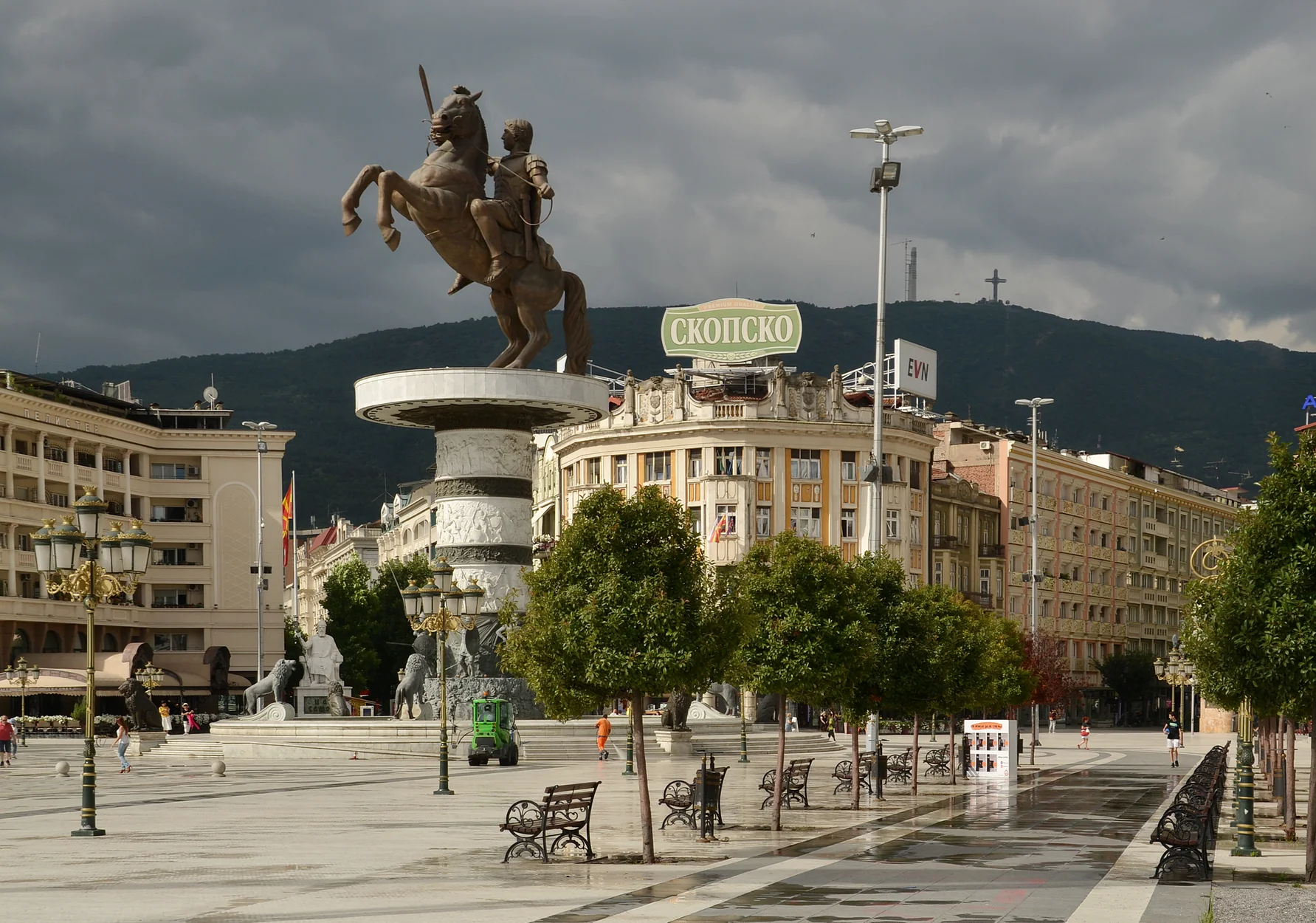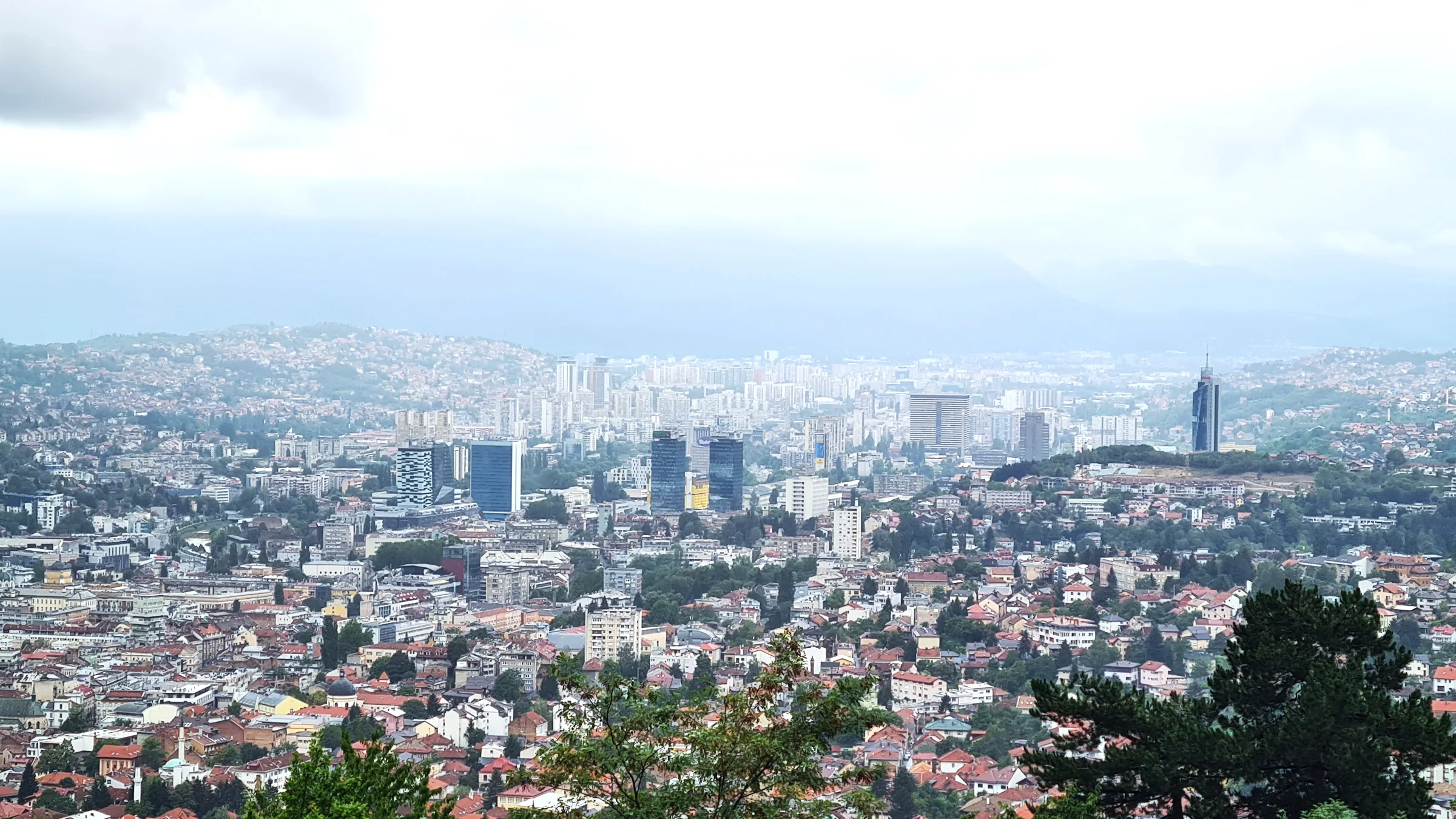
Sarajevo feels denser because several centuries of urban history share one narrow valley; Skopje changes character within a few minutes as the monumental centre gives way to the Old Bazaar and post-earthquake city.
Where this sits
Sarajevo is Bosnia and Herzegovina's mountain-valley capital; Skopje is North Macedonia's capital on the Vardar. Both are compact inland-Balkan cities shaped by rupture, rebuilding and political memory, but they ask very different things from a short visit.
Sarajevo and Skopje are both inland Balkan capitals with Ottoman, Yugoslav and post-Yugoslav layers, but the similarity is more useful on a map than on the ground. Sarajevo is a long city compressed into a mountain valley, with Baščaršija, Austro-Hungarian streets, Yugoslav districts and the memory of the 1990s war sitting physically close together. Skopje is smaller at visitor scale and more abrupt: Macedonia Square, the Stone Bridge, the Old Bazaar and the post-earthquake city can all enter the same first-day walk.
For a short trip, the decision is less about which city has “more sights” than about the kind of density you want. Sarajevo is stronger when food, café culture and historical continuity are part of the daily rhythm. Skopje is stronger when you want a compact two-night capital that also works as the launch point for Matka, Kruševo or Ohrid.
The answer in one minute
Choose Sarajevo if you want:
- two or three nights with a strong sense of place from the first walk;
- Baščaršija, Austro-Hungarian streets and Yugoslav urban layers in one compact central route;
- food and coffee that become part of the trip rather than scheduled attractions;
- mountain-valley geography that helps explain the city's modern history;
- an easy continuation toward Mostar, the Drina, Sutjeska or Montenegro.
Choose Skopje if you want:
- a compact two-night stop;
- the visual argument of Skopje 2014 alongside the Old Bazaar and modernist city;
- a capital where the main visitor areas are easy to connect on foot;
- Matka as a simple extension and a natural route onward through North Macedonia;
- a city break that leaves more time for the rest of the country.
Sarajevo usually wins on food, atmosphere and historical depth. Skopje usually wins on compactness and how easily it can sit inside a wider North Macedonian trip.
Sarajevo packs several urban eras into one walk
Start in Baščaršija and the Ottoman street pattern is still obvious in the small lanes, courtyards, shops, mosques and food businesses. Walk west and the architecture changes into the Austro-Hungarian city, then farther again into the administrative and residential fabric of Yugoslav and post-war Sarajevo.

The valley keeps these layers close enough that geography becomes part of the history lesson. Hills rise immediately around the centre, the Miljacka gives the city a clear axis, and the twentieth-century story is visible without turning every day into a memorial itinerary.
That is why Sarajevo can feel full after only two days. There is a lot to see, but there is also pleasure in the normal rhythm: coffee, burek, ćevapi, bakeries, evening terraces and the simple act of moving between neighbourhoods. Our Sarajevo guide goes deeper into that balance.

Skopje moves quickly from spectacle to ordinary city
The first encounter is hard to separate from the monumental centre. Statues, facades, bridges and Macedonia Square make the Skopje 2014 project impossible to miss, while the 1963 earthquake and later modernist rebuilding explain why the surrounding city looks so different from the centre's historical styling.

Cross the Stone Bridge and the Old Bazaar changes the scale almost immediately. Mosques, shops, food, workshops and Albanian-speaking city life sit close to a central zone that was designed to project a very different national image. Move beyond both and the post-earthquake city becomes more legible.
This variety fits comfortably inside a short stay. Skopje does not need four days to make sense, but the full Skopje guide is useful if you want the city to be more than Macedonia Square plus one bazaar walk.
Arrival and daily logistics
Sarajevo International Airport is close to the city, and the current Centrotrans airport–Bentbaša/Baščaršija bus costs 5 BAM (about €2.55) one way. The timetable varies by weekday and weekend, so check the actual departure rather than assuming a fixed frequency.
Skopje International Airport sits farther outside the centre. The official airport shuttle currently costs 199 MKD (about €3.20) one way and stops at points including the Central Bus Station and Holiday Inn area, with departures aligned to flight schedules.
Inside the cities, Sarajevo's central visitor areas are highly walkable but stretched along the valley; trams and local transport become more useful as you move west. Skopje needs less transit for a short first visit because Macedonia Square, the river and Old Bazaar sit close together.

Food and evenings
Sarajevo has the more immediately recognisable food identity. Burek, ćevapi, grilled dishes, bakeries, sweets and Bosnian coffee are easy to encounter without building a specialist food itinerary. The centre stays social into the evening through cafés, restaurants and bars, so a good night does not depend on finding one particular entertainment district.
Skopje has a broader food culture than a two-day visitor sometimes discovers, with Macedonian and Albanian influences, grills, bakeries and kafana-style dining. The evening is compact enough to improvise, although a traveller specifically chasing club nights or events should check what is actually on rather than assume a large nightly circuit.
Neither city needs to win a “party capital” contest to be enjoyable after dark. Their strength is that dinner, drinks and public streets still feel connected to the city you explored during the day.
For travellers choosing Sarajevo partly for its evenings, the Sarajevo where-to-stay comparison makes the next decision more concrete: the best room is not always the one closest to the old bazaar.
Which one fits a wider Balkan route?
Sarajevo connects naturally toward Mostar, the Drina valley, Sutjeska, Serbia, Croatia and Montenegro. Those routes are often slower than the distance on the map suggests, but the road itself can be part of the trip. Our inland Balkans route is built around exactly that kind of travel.
Skopje works especially well inside North Macedonia. Matka is close enough for a short extension, while Kruševo and Ohrid can follow without turning the itinerary into a sequence of border crossings.
The two capitals themselves are not an especially elegant short-hop pair. Current overland options between Sarajevo and Skopje are long and often indirect, so a three- or four-day trip should choose one rather than burn a large part of a day trying to connect them. They make more sense together only inside a longer Balkan route.

Making the actual trip work
Sarajevo fits a two- or three-night visit when you want Ottoman-era streets, a mountain-framed city, distinctive food and historical layers that deserve careful time. The valley makes a great deal accessible on foot, but the hills and museums should not be reduced to a rushed sightseeing sequence.
Skopje is different: the heavily redesigned central area, Old Bazaar, river crossings and late-Yugoslav architecture can occupy an engaging two-night visit. Look beyond the statues to understand the area's religious, ethnic and urban contrasts, and add Kruševo or Ohrid when continuing through North Macedonia.
The right decision depends on the wider route as much as on taste. Sarajevo works particularly well in a Bosnia trip; Skopje is a practical gateway to a longer North Macedonian itinerary. Give either a real evening and you will see much more than its headline landmark.