Choose the programme and the neighbourhood, and give Sarajevo time to make a good night of both.
Where you are
Sarajevo is the capital of Bosnia and Herzegovina in a long mountain valley. Baščaršija, Ferhadija and the modern central districts offer different evening rhythms, while later venues and accommodation can be far apart.
An evening in Sarajevo can start with the last light over the valley, move into an old-town courtyard for music and finish in a club well beyond the bazaar. It can just as happily be a long dinner followed by coffee, baklava and a walk along Ferhadija. The two evenings belong to the same city, and both deserve space in a nightlife guide.
The practical choice is geographical. Baščaršija is the historic Ottoman core for cafés, food and quiet conversation; Ferhadija links it to a busier central stretch of bars; music venues and later clubs are scattered rather than concentrated on one strip. A specific concert or DJ can make the difference between an ordinary weekday and a memorable night.
Watch the valley change colour
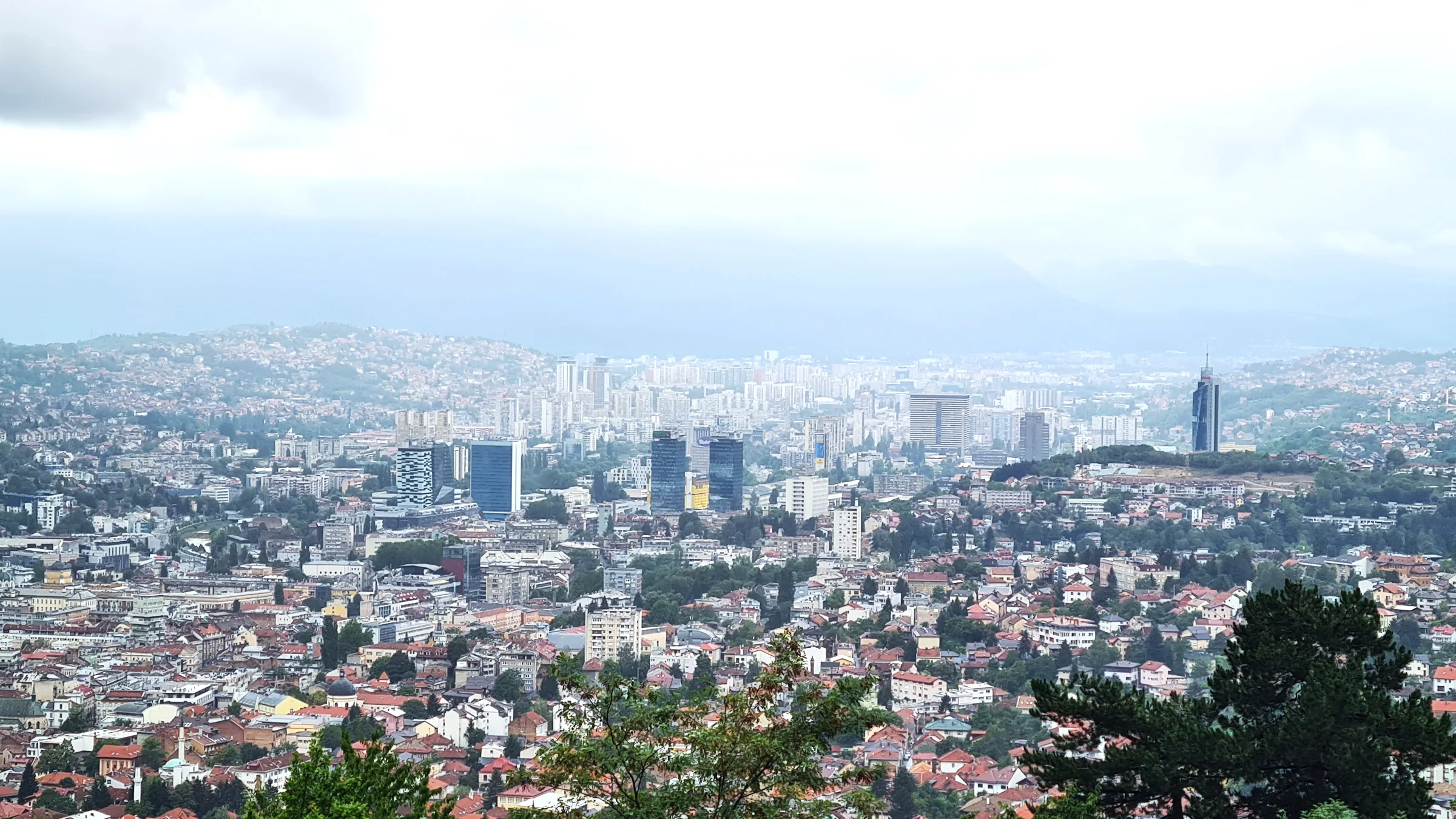
Before choosing a venue, give Sarajevo half an hour outdoors. The view from Žuta Tabija (Yellow Fortress) places the whole bowl of the city beneath the mountains. The climb is steep, and weather, fading light and footing matter, but it makes the east–west geography instantly understandable. You can also keep the evening simple around the riverside and the old town rather than climb.

In the centre, the transition from daylight to evening is unusually satisfying. The streets of Baščaršija retain working businesses, religious spaces and restaurants alongside visitors. A cup of Bosnian coffee or a modest dinner lets you absorb the place before deciding whether to look for music. Treat the mosque areas and their immediate surroundings as ordinary lived religious spaces, particularly during Ramadan, rather than a themed nightlife quarter.
Baščaršija and a slow first hour
The Sebilj fountain makes an obvious meeting point. Walk the lanes towards the copper shops and cafés, then choose where to eat. Ćevapi and grilled dishes are as recognisable here as the town-hall façade, and a familiar restaurant can be enjoyable without needing a discovery narrative. If you want an alcohol-led evening, the next stage is more useful westwards along Ferhadija or at a confirmed venue.

Traditional Bosnian coffee is a real evening social option, not a consolation prize for people who dislike clubs. Several historic cafés close earlier than bars, so arrange dinner and coffee before assuming you can return to a particular terrace after midnight. Friday and Saturday are more active, but Sarajevo's venues have independent schedules.
Sevdah belongs to the city, not just a tourist programme
Sevdalinka, often shortened to sevdah, is a Bosnian song tradition associated with longing, memory and expressive performance. Listening can be extraordinary when you find an actual programme. The Art Kuća Sevdaha in Halači 5 documents singers and composers and helps explain the tradition; it is primarily a cultural starting point, not a guarantee of a nightly live concert. Visit Sarajevo lists the house in the heart of Baščaršija.
Look for a clearly announced live set, concert, or traditional-music evening. Ask whether the performance is a seated show, restaurant music or an informal gathering. Each can be rewarding, but the experience, reservation and end time differ. A beautifully presented performance can be just as worth attending as a small local night; authenticity is not a competition.
Ferhadija, music bars and late clubs
From Baščaršija, Ferhadija is the natural westward walk. A night here can mean sitting outside a pub, joining friends for a round or moving towards a ticketed performance. The street is useful as a pedestrian connection, rather than a promise that every venue along it stays open all night.

The Sarajevo Tourist Board maintains a clubs and music-venues directory including Cinemas Sloga, Jazz Club Monument, City Pub and Kino Bosna. The list is a starting point for checking events, not a ranking of reliably busy rooms. In particular, Kino Bosna's programme and the evening at Sloga can be very different. Check a venue's current social channels, admission and address before leaving the hotel.


If electronic music or a concert is the point of the night, buy into the specific line-up, not a claim that Sarajevo is an all-night club capital every day of the week. Major events and festivals can transform the available options, while a quiet midweek evening may reward a neighbourhood bar instead.
What drinks and transport cost
Bosnia and Herzegovina uses the convertible mark (BAM/KM), fixed against the euro at roughly 1.96 KM (about €1). A July 2026 Sarajevo local-night guide offered broad bar estimates of 3–5 KM (about €1.50–€2.55) for beer and 8–14 KM (about €4.10–€7.15) for a cocktail. These are illustrative estimates from that guide, not checked prices for the particular bar you enter; menus, venue type and special events matter. Read the dated local night overview before using those figures to budget.
Public transport is inexpensive. The Sarajevo Tourist Board's transport overview cites a single ticket at 1.60 KM (about €0.82) from kiosks or 1.80 KM (about €0.92) from the driver. Check the current operator information, payment arrangements and last service rather than assuming a ticket bought at 19:00 guarantees a ride home at 02:00.
Getting home is a separate decision
The valley stretches westward much farther than the walkable old centre. Choosing accommodation in Baščaršija or the central Ferhadija corridor keeps a first evening straightforward. Staying towards Ilidža or farther west may be comfortable and good value, but a late return deserves its own plan. Do not rely on an unverified claim about all-night trams or a rideshare brand being available.
At night, use well-lit central routes and arrange a reputable, identifiable taxi where the route is longer or quieter. Confirm the fare method before the ride and keep the address written down. Winter evenings introduce cold, slippery surfaces and poorer visibility on steep streets. It is sensible to enjoy the famous view before nightfall and keep most of the late socialising on flatter central routes.
If evenings are part of the reason for visiting, choose the sleeping address before choosing the last bar. Our where-to-stay guide for Sarajevo's nightlife compares the neighbourhoods, noise and late return routes.
A weeknight can be worth staying out for
Sarajevo's café and food culture makes a quiet evening feel complete. Baščaršija is enjoyable for the simple sequence of a walk, coffee and dinner, particularly when the weather is cold and the older streets are more atmospheric than busy. A concert or sevdah performance can make the night more memorable, but neither should be presented as a guaranteed walk-in attraction.
For a programme-led evening, choose the event first and the district second. Check whether a music venue has a seated concert, a dance floor or a private booking, and whether the advertised start time is also the time the doors open. The names in a city directory are useful addresses, not evidence that something is happening every night.
A practical first evening might remain within walking distance of Ferhadija and the old bazaar, while a second can follow a specific performance and a prearranged journey home. That approach works for couples, groups and solo travellers without assuming they all want the same kind of late night.
Sarajevo after dark as a solo woman
A woman travelling alone can choose any of the main evening options, from cafés and concerts to later bars. The useful differences are whether the venue has a clear programme, whether you will be walking back through a busy district and whether you retain control of transport. Pick a busy, comfortable room, leave whenever you wish and favour a traceable taxi if your accommodation is beyond the centre. There is no reason to dramatise ordinary social interaction, nor to pretend an unfamiliar late-night route needs no planning.
For a first trip, a hotel or apartment within an easy central walk is worth paying a little more for if it allows a relaxed end to the evening. Sarajevo's neighbourhoods have different gradients and transport access; the full Sarajevo city guide helps place the nightlife inside the rest of the city.
Make a real two-evening plan
On the first evening, enjoy the view, eat in Baščaršija, learn something about sevdah and finish with a bar around the centre.

On the second, choose an actual performance or club night from the calendar and plan how to return. The two nights can be full without trying to check off an implausible list of six venues.
The night continues beyond the bazaar

Sarajevo's liveliest quality after dark is the way different uses of the city coexist. Historical streets remain social, music moves between formal concerts and intimate rooms, and the modern city keeps working alongside the postcard centre. The memorable evening is the one that fits the programme and the company, with enough time to enjoy the place rather than rushing between names.
Photo documentation: These documentary images show Vijećnica at night (Julian Nyča, 2017, CC BY-SA 3.0), the Yellow Fortress view (CC BY-SA 4.0), Sebilj in 2008 (Julian Nyča, CC BY-SA 4.0), Ferhadija in January 2026, Sloga's 2026 interior (CC BY-SA 4.0) and the Miljacka in 2011 (Tiia Monto, CC BY-SA 3.0). Photos are documentary, not live conditions; consult each linked file page for the exact author, licence and reuse obligations.
Additional subject-specific photography: Kino Bosna venue, 2015 (Bjoertvedt, CC BY-SA 4.0); Baščaršija by night, 2009 (Natalie Wilson, CC BY 2.0).