

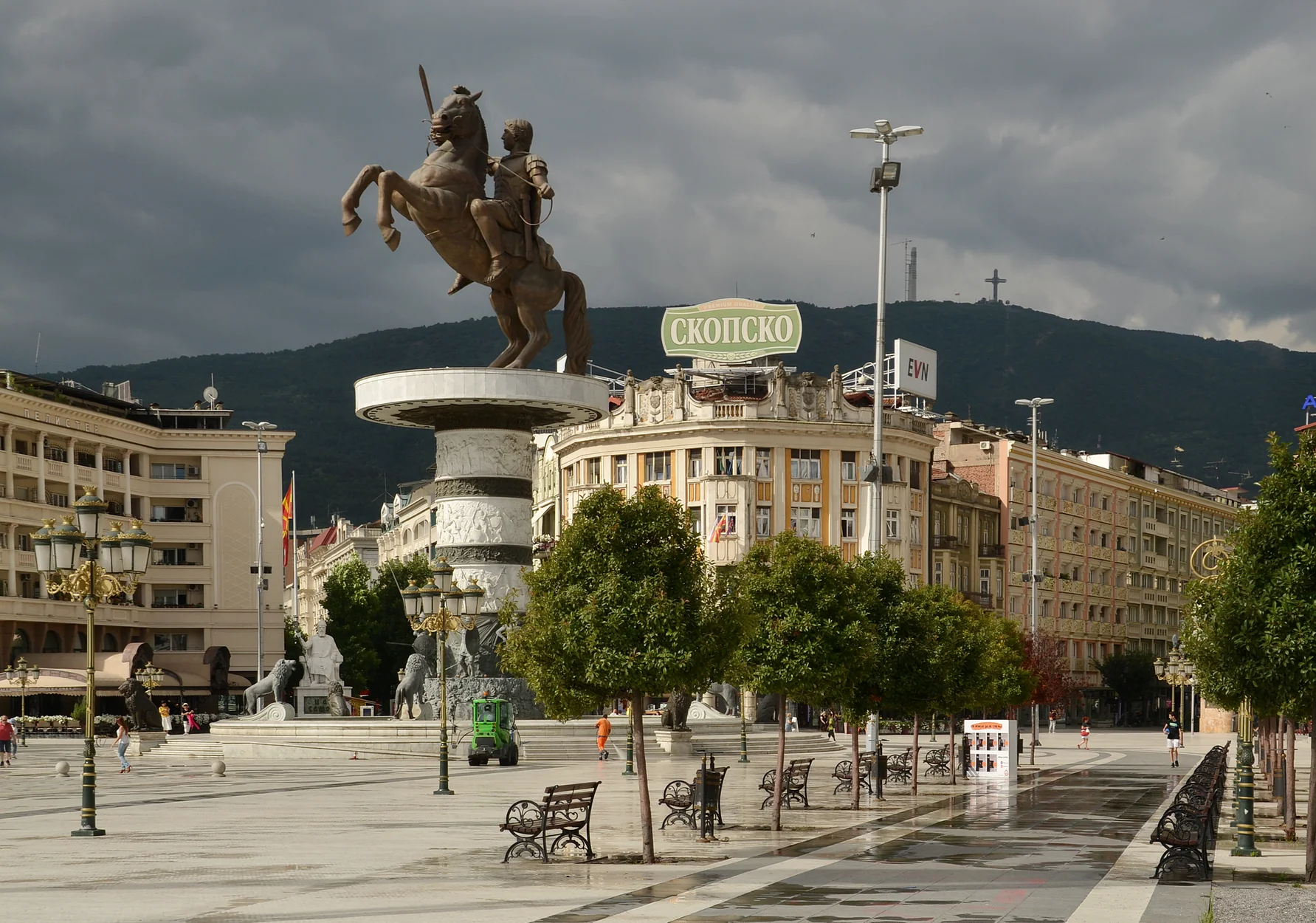
Skopje is easier to grasp quickly; Sofia rewards the extra day with more neighbourhoods, stronger transport and a much larger city beyond the central landmarks.
Where this sits
Skopje is North Macedonia's compact capital on the Vardar; Sofia is Bulgaria's larger western capital below Vitosha Mountain. They sit on the same broad inland-Balkan axis but produce very different city breaks.
Skopje and Sofia sit only a few hundred kilometres apart and can be connected by direct bus, but they work at different scales. Skopje puts much of the first visit into a compact centre: Macedonia Square, the Vardar, Stone Bridge and Old Bazaar are close enough to understand in a day. Sofia is a larger capital with a metro, several distinct central districts, Roman archaeology, Orthodox and Ottoman landmarks, socialist architecture and Vitosha Mountain on the horizon.
That makes the choice unusually practical. If you have two nights and want the city to fit around a wider North Macedonian route, Skopje is efficient and distinctive. If you have three or four nights and want the capital itself to carry more of the trip, Sofia has the broader range.
The answer in one minute
Choose Skopje if you want:
- a strong two-night stop;
- a centre that is easy to cover on foot;
- the contrast between Skopje 2014, the Old Bazaar and the post-earthquake modernist city;
- Matka as an easy nearby extension;
- a natural starting point for Ohrid, Kruševo and the rest of North Macedonia.
Choose Sofia if you want:
- three or four nights without running out of city;
- a metro that makes the airport and outer districts easy to use;
- Roman, medieval, Ottoman, royal and socialist layers in the same capital;
- a larger restaurant, bar and nightlife range;
- Vitosha Mountain and a much wider Bulgarian road network.
For a short visual hit, Skopje is stronger. For a fuller city break, Sofia usually has more depth.
Skopje is compact, theatrical and easy to read on foot
Macedonia Square and the surrounding monumental project give Skopje a first impression few European capitals can reproduce. The statues, reconstructed facades and bridges are part architecture, part identity project and part tourist spectacle. They are worth seeing precisely because they tell you something about how the modern state wanted the centre to look.

The useful second half of the walk begins across the Stone Bridge. The Old Bazaar changes the scale and social mix, while the wider city brings in the modernist rebuilding that followed the 1963 earthquake. Those layers are close enough together that a two-night stay can feel complete rather than rushed.
Use the full Skopje guide if you want to connect the monuments to the bazaar, post-earthquake architecture and the rest of the city.

Sofia is larger and more rewarding once the first centre walk is over
Sofia does not present one clean historical story. Roman remains appear below modern streets; Orthodox churches, a mosque, royal-era buildings and socialist state architecture share the central city; residential districts and the mountain extend the trip well beyond the main sightseeing axis.

That can make the first afternoon less dramatic than Skopje. It also gives Sofia more room to grow over several days. The metro helps, because the city is large enough that staying mobile matters. Vitosha is not merely a background photo either: it can become part of the trip if the weather and your schedule allow.
The full Sofia guide is strongest when used as a city guide rather than an old-town checklist.
Airport access and transport are a real point of difference
Skopje International Airport sits outside the city. The official shuttle is currently 199 MKD (about €3.20) one way and serves stops including the Central Bus Station; its timetable is built around flight arrivals and departures. A taxi is faster but much more expensive.
Sofia Airport is integrated into the metro at Terminal 2. In 2026, after Bulgaria's switch to the euro, a single Sofia public-transport ticket costs €0.80. The M4 metro runs from the airport toward Sofia University and Serdika, making arrival unusually cheap and simple for a capital airport.
Inside Skopje, the compact visitor core reduces how much transit you need. Inside Sofia, the metro is what makes the larger urban area practical.

The direct bus makes a two-city route realistic
Unlike Sarajevo and Skopje, Skopje and Sofia are a sensible pair in one itinerary. Current direct buses take roughly 4¼ to 5 hours, with several services on many days. Border formalities can stretch the schedule, so do not plan a tight airport connection on the back of the advertised arrival time.
That opens a useful option: two nights in Skopje, bus to Sofia, then three nights in Sofia. It gives you the contrast without adding a flight and turns the comparison into a straightforward overland route.
Nightlife and evenings
Sofia has more range. Central bars, live music, electronic events, Studentski Grad and neighbourhood venues create several different night systems, and the larger population means there is simply more programming to choose from. Sofia After Dark goes into the practical differences.
Skopje is easier to improvise. Dinner, bars and a walk through the centre can fill a short night without much planning, but event-specific clubbing is more dependent on what is happening during your dates.
For travellers who want nightlife to be one of several reasons for the trip, Sofia is the safer bet. For travellers who want a compact evening after a full sightseeing day, Skopje is perfectly capable of carrying two nights.
Which capital works better with the rest of the country?
Skopje is the cleaner gateway to a compact national route. Matka can be added quickly; Kruševo and Ohrid extend the trip without huge distances; North Macedonia is small enough that the capital rarely needs to dominate the itinerary.
Sofia opens a much larger Bulgarian network. Plovdiv, the Rhodopes, Veliko Tarnovo, Buzludzha and Belogradchik all point in different directions, so the capital can be the start or end of a substantial road or rail trip rather than the centre of it.
If you want a small country to become manageable quickly, Skopje has the advantage. If you want the capital itself to sustain several days before a bigger route, Sofia does.

Making the actual trip work
Skopje is an intriguing two-night capital with a highly theatrical central area and a much older bazaar culture across the Vardar. Its compact geography suits someone who wants to explore on foot, understand what has been built and rebuilt, and move easily into the rest of North Macedonia.
Sofia offers more variety over three or four nights: Roman layers, central markets, neighbourhood cafés, cultural spaces and Vitosha as a real mountain excursion. Its public transport is much more important to the itinerary, and the after-dark scene includes several very different districts and types of event.
The direct bus can make both capitals practical on a longer Balkan route when schedules and border conditions work. Choose Skopje for a shorter stop full of contrasts; Sofia for a fuller capital stay with more separate experiences to combine.
